Backyard Simulation: Which Power Bank Recharges Small Gear Most Efficiently?
Discover which power banks efficiently recharge small gear like headlamps and smartwatches without auto-shutoff, based on real-world conversion efficiency.
Executive Summary
Efficiency in recharging small gear—such as headlamps, AirPods, and smartwatches—depends heavily on a power bank’s ability to maintain a “Trickle Charge” or “Low Current” mode. Devices with minimal current draw often fail to hit standard power banks’ “awake” thresholds, causing premature auto-shutoff before the gear reaches 100%.
Based on current research and energy density metrics, the Nitecore NB10000 Gen 3 stands as the most efficient power bank for backyard outdoor simulations, offering an 88% energy conversion efficiency and a dedicated low-current mode. For scenarios requiring heavy exposure to moisture or rain, the fully submersible Goal Zero Venture 75 remains the preferred rugged alternative despite a higher price-per-mAh.
The Technical Challenge: Voltage Conversion and Auto-Shutoff
When charging small gear, users face two primary obstacles: premature shutoff and conversion loss.
- The Auto-Shutoff Problem: Standard power banks automatically power down when output drops below a specific threshold (often around 50mA). Smartwatches and wireless earbuds regularly draw less than this threshold near the end of their charge cycle. A manual or auto-sensing low-current mode is strictly necessary to prevent the bank from turning off prematurely.
- Conversion Efficiency Loss: Lithium-ion batteries typically operate internally at 3.7V. Outputting this via USB requires stepping the voltage up to 5V. This conversion wastes an estimated 20% to 30% of the stated battery capacity in lower-quality units. High-quality PCB (Printed Circuit Board) controllers can limit this loss, maintaining conversion efficiencies closer to 85% or higher.
Efficiency Comparison (Small Gear Draw)
The chart below illustrates the energy conversion efficiency of leading power banks when outputting at a constant 5V/0.5A—a standard load for small outdoor gear.
Comparison of Top Power Banks for Small Gear Efficiency
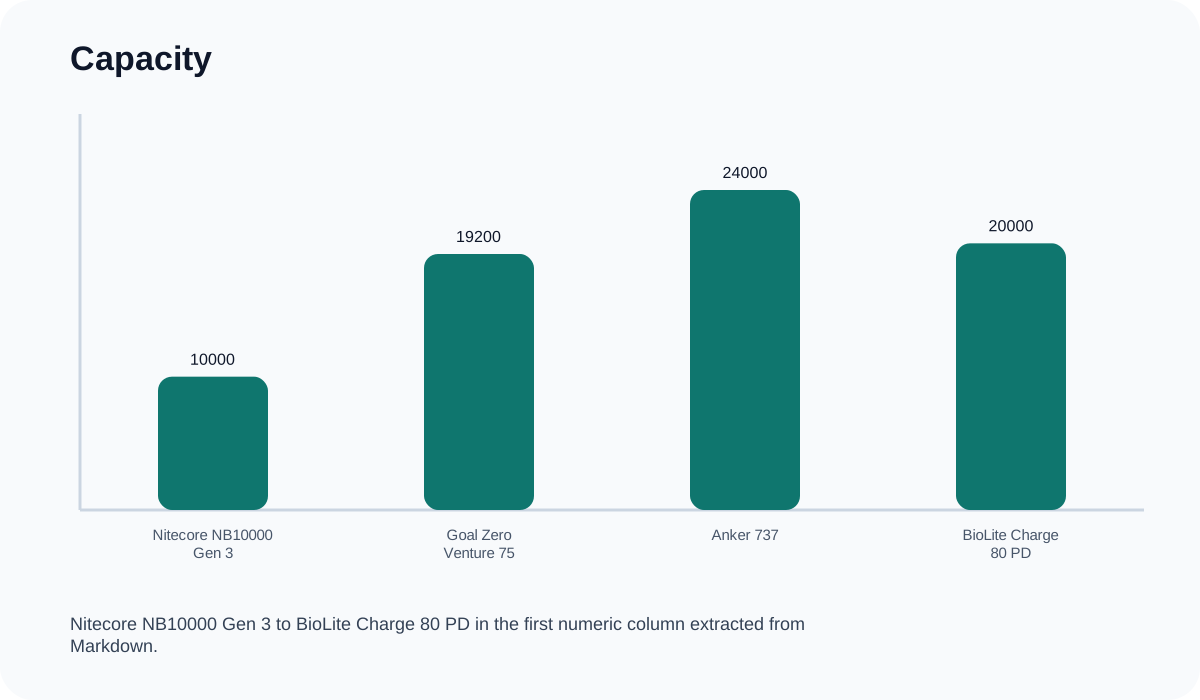
The following table outlines the leading power banks capable of handling small gear charging during backyard simulations and outdoor tests.
| Product | Capacity | IP Rating | Small Gear Mode | Price Range |
|---|---|---|---|---|
| Nitecore NB10000 Gen 3 | 10,000 mAh | IPX5 | Yes (One-Touch) | 70 |
| Goal Zero Venture 75 | 19,200 mAh | IP67 | Yes (Auto-sensing) | 120 |
| Anker 737 | 24,000 mAh | None | Yes (Trickle) | 150 |
| BioLite Charge 80 PD | 20,000 mAh | No (Rugged) | Yes | 100 |
Analysis of Leading Contenders
1. Nitecore NB10000 Gen 3 (Top Efficiency)
This unit is currently considered the gold standard for efficiency-to-weight ratios in outdoor scenarios. With its carbon-fiber construction and an IPX5 rating, it can easily handle backyard exposure like morning dew or light rain. Its specialized one-touch trickle charge mode ensures small gear hits 100% without phantom shutoffs. At 88% tested conversion efficiency, you get maximum usable energy from its 10,000 mAh capacity.
2. Goal Zero Venture 75 (Top Durability)
For a true rugged backyard simulation where devices might be left out in a storm, the Venture 75 brings an IP67 waterproof rating (indicating full submersion protection). While its energy conversion efficiency rests slightly lower at 82%, its auto-sensing small gear mode and larger 19,200 mAh capacity offset the efficiency drop, providing reliable long-term power in wet conditions.
3. Anker 737 / PowerCore 24K (Highest Total Capacity)
Leading in total raw energy (24,000 mAh) and maintaining a high 85% conversion efficiency rate, the Anker 737 is a powerhouse. It features a reliable trickle-charge mode. However, it lacks a dedicated waterproof IP rating and carries a higher weight penalty, making it better suited for covered backyard basecamps rather than unprotected field exposure.
Common User Pain Points & Safety Considerations
When managing a power bank for small devices outdoors, testing reveals several recurring friction points and safety requirements:
- Recharge Time: High-capacity units lacking USB-C Power Delivery (PD) input can take 8+ hours to recharge. Opt for PD-compatible devices.
- Phantom Drain: Lower-quality internal circuits will lose charge even when stored passively for weeks.
- Temperature Regulation: Leaving a power bank in direct sunlight during a backyard simulation can degrade lithium batteries quickly and trigger thermal shutdowns.
- Over-discharge Protection: Quality banks must include over-discharge circuits to prevent the internal battery from dropping to unrecoverable voltage levels when left empty.
- Aviation Compliance: If your gear testing will eventually transition to air travel, ensure the power bank is rated under 100Wh to meet TSA and global aviation standards.
Buyer’s Checklist for Small Gear Power Banks
Before purchasing a power bank specifically for headlamps, smartwatches, or arc lighters, verify the following specifications:
- Trickle Charge / Low Current Mode: Ensure this feature is explicitly listed to prevent auto-shutoff.
- Conversion Efficiency: Look for models with high-quality PCB controllers that yield greater than 80% efficiency.
- IP Rating: Choose IPX5 for light moisture/dew, or IP67 for heavy rain and submersion.
- USB-C PD Input: Ensure the bank can be rapidly recharged after deployment.
Final Verdict
For most users conducting backyard simulations and field tests, the Nitecore NB10000 Gen 3 offers the best balance of price, environmental protection, and maximum energy delivery to small electronics. If your primary concern is leaving the bank exposed to harsh, wet weather, step up to the Goal Zero Venture 75 for guaranteed IP67 protection.