Best Battery Capacity Labels You Can Actually Trust
We analyze real-world testing data to expose fake mAh claims and highlight the battery brands that actually deliver on their advertised capacity.
Executive Summary
The “capacity gap”—the discrepancy between a battery’s advertised milliamp-hours (mAh) and its actual usable energy—is the primary challenge when evaluating portable power and rechargeable cells. Our analysis of third-party testing data reveals that you can consistently trust premium brands like Panasonic (Eneloop) and Anker, which deliver between 90% and 99% of their stated capacity.
Conversely, generic “no-name” cells frequently inflate ratings by 200% or more. For high-drain devices like arc lighters, camping gear, and power banks, anything labeled over 3,600mAh for a single 18650 cell is categorically fraudulent. Buyers should prioritize safety certifications (UL 2054, IEC 62133) and evaluate capacity in Watt-hours (Wh) to account for voltage conversion losses.
The “Capacity Gap” Explained
Usable capacity in high-quality power stations and banks typically ranges from 80% to 94% of the advertised value. This 6% to 20% drop is not necessarily a deceptive practice; it is the result of internal conversion losses (stepping voltage up or down) and Battery Management System (BMS) safety buffers designed to prolong battery life.
Fake capacity claims, however, are rampant in the 18650 and AA rechargeable markets. Standard 18650 lithium-ion cells claiming 6,000mAh to 12,000mAh are physically impossible to manufacture with current technology, which caps at approximately 3,600mAh.
Brand Reliability: Label Accuracy vs. Durability
The following chart visualizes third-party benchmark scoring for label accuracy (how close actual capacity is to the box label) and overall durability.
Stated vs. Tested Capacity: Real-World Data
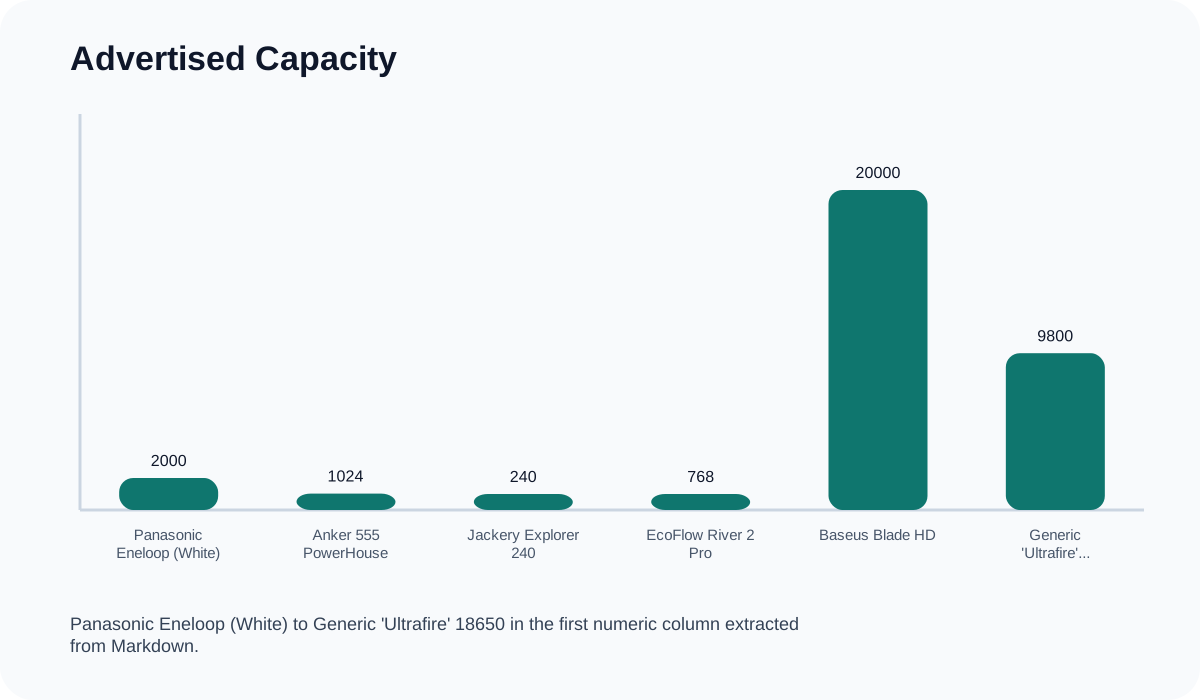
To separate marketing from physics, third-party tests evaluate actual power delivery under load. As seen below, established manufacturers provide highly accurate ratings, while budget generic batteries fall dangerously short.
| Brand/Model | Advertised Capacity | Tested Usable Capacity | Efficiency (%) | Typical Price (USD) |
|---|---|---|---|---|
| Panasonic Eneloop (White) | 2,000mAh | 1,980mAh | 99% | 20 (4pk) |
| Anker 555 PowerHouse | 1,024Wh | 962.5Wh | 94% | 600 |
| Jackery Explorer 240 | 240Wh | 211.2Wh | 88% | 250 |
| EcoFlow River 2 Pro | 768Wh | 634.3Wh | 82.6% | 500 |
| Baseus Blade HD | 20,000mAh | 14,800mAh | 74% | 80 |
| Generic ‘Ultrafire’ 18650 | 9,800mAh | 850mAh | 8.6% | 5 |
Analysis: Decoding Trusted Battery Specs
Why Watt-Hours (Wh) Matter More Than mAh
Evaluating a battery exclusively by its milliamp-hours (mAh) can be highly misleading. Watt-hours (Wh) provide a much more accurate metric for runtime because they account for the voltage at which the energy is delivered. Modern silicon-carbon batteries are improving overall energy density, but they require specific 3.0V cutoff optimizations to reach full potential. Always look for the Wh rating when comparing large power banks or power stations.
The Danger of Generic 18650s
High-drain devices—such as tactical flashlights, emergency radios, and certain arc lighters—often rely on 18650 cells. The data clearly shows that generic marketplace cells (like “Ultrafire”) claiming 9,800mAh are entirely fraudulent. In testing, these cells often deliver less than 900mAh (an 8.6% efficiency rate). Worse, these counterfeiters bypass critical safety testing to save on manufacturing costs.
Safety Certifications Are Your Proxy for Trust
If a company lies about its capacity, it is highly likely to cut corners on safety components. Trustworthy labels will feature certifications like UL 2054 or IEC 62133-2. These standards mandate rigorous abuse testing, including short-circuit, overcharge, and thermal runaway evaluations.
Buyer’s Checklist: Spotting Reliable Capacity
Before purchasing a replacement battery, power bank, or power station, verify these four criteria:
- [ ] Calculate the Maximum Physical Limit: If an 18650 battery claims more than 3,600mAh, it is fake. Do not buy it.
- [ ] Look for Watt-Hours (Wh): Prioritize product labels that clearly state Wh alongside mAh.
- [ ] Verify Safety Certifications: Check for genuine UL 2054, UL 2056, or IEC 62133-2 markings.
- [ ] Expect an 80-90% Usable Yield: Know that even a top-tier 10,000mAh power bank will typically only yield 8,000mAh to 9,000mAh to your devices due to conversion loss.
Final Verdict
For sheer label accuracy, Panasonic (Eneloop) remains the gold standard in the AA/AAA rechargeable market, delivering an impressive 99% of its advertised capacity. In the larger power bank and portable power station categories, Anker leads the pack with up to 94% efficiency. Avoid generic brands with wildly inflated specs; they not only fail to deliver power but present serious thermal safety risks.