Best EDC Battery Banks for Urban Carry and Weekend Camping
Discover the top EDC battery banks of 2026 for urban and outdoor use. We compare weight, IP ratings, and PD charging for Nitecore, Anker, and Goal Zero.
Executive Summary
For seamless transition between urban daily carry and weekend camping in 2026, the best EDC battery banks strike a precise balance between sub-300g weight and robust Power Delivery (PD) capabilities. The Nitecore NB10000 (Gen 4) remains the definitive leader for ultra-light carry at just 150g, while the Goal Zero Venture 35 offers the highest standard of durability with its IP67 rating for wet camping conditions.
Modern users should expect standard capacities between 10,000mAh and 20,000mAh, with USB-C PD 3.0/3.1 as a non-negotiable feature. Effective field integration requires a minimum of 20W for smartphone charging, scaling up to 65W+ for laptop-capable units.
Leading EDC Power Banks (2026 Comparison)
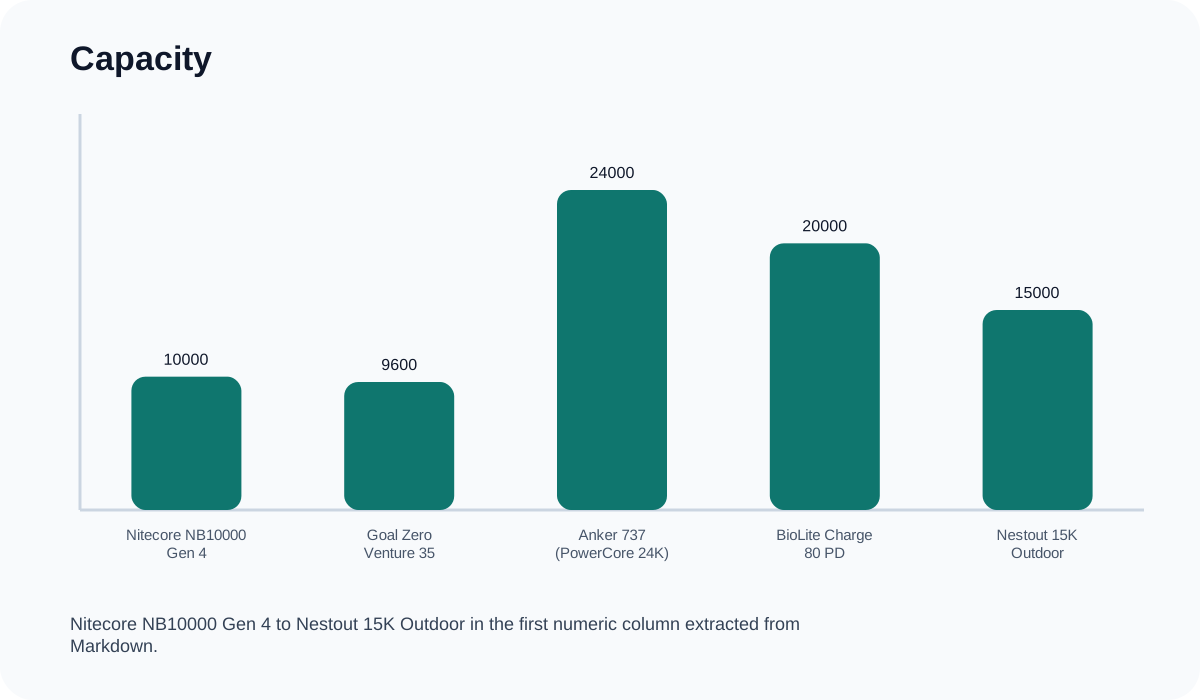
Selecting the right power bank requires matching your primary use case to the device’s physical and technical limits. Below is a comparison of the top-performing models in current market testing.
| Model | Capacity | Weight | IP Rating | Best For | Price Range |
|---|---|---|---|---|---|
| Nitecore NB10000 Gen 4 | 10,000mAh | 150g | IPX5 | Ultra-light EDC | 85 |
| Goal Zero Venture 35 | 9,600mAh | 287g | IP67 | Wet Camping | 70 |
| Anker 737 (PowerCore 24K) | 24,000mAh | 630g | None | Laptop/Urban | 150 |
| BioLite Charge 80 PD | 20,000mAh | 465g | None | Weekend Group Use | 100 |
| Nestout 15K Outdoor | 15,000mAh | 360g | IP67 | Rugged Adventure | 65 |
Energy Density and Engineering Efficiency
When evaluating EDC gear, energy density dictates how much power you can carry per gram. Higher Watt-hour (Wh) per 100g metrics represent superior engineering and weight efficiency, making them ideal for everyday carry.
Key Analysis: Bridging Urban and Outdoor Use
1. Weight Efficiency vs. Durability
The primary tension in EDC power banks is the trade-off between weight and ruggedness. The Nitecore NB10000 (Gen 4) solves the weight issue by utilizing a carbon fiber frame, achieving an industry-leading 150g for 10,000mAh capacity. However, weekend camping demands distinct durability metrics. While an IP64 rating is the baseline for outdoor survival, models like the Goal Zero Venture 35 set the standard with IP67 ratings, guaranteeing total dust protection and survivability during brief water immersion.
2. Charging Capabilities and Real-World Capacity
High wattage is mandatory for 2026 urban carry. USB-C Power Delivery (PD 3.0/3.1) guarantees fast charging, requiring at least 20W to efficiently top up modern smartphones and 65W or more for powering laptops (handled easily by heavier models like the Anker 737).
However, buyers must be aware of the ‘nominal’ vs. ‘effective’ capacity gap. A major consumer pain point is expecting 10,000mAh of actual charge from a 10,000mAh battery. In reality, due to voltage conversion and heat loss, effective output is typically 60% to 70% of the stated rating.
3. Safety Standards and Travel Limitations
Taking power banks on flights or into high-heat camping environments requires strict adherence to safety protocols. FAA regulations strictly limit individual lithium-ion banks to 100Wh (approximately 27,000mAh), meaning all units in our top comparison are flight-safe. Additionally, premium outdoor banks now incorporate dedicated NTC (Negative Temperature Coefficient) thermal sensors and multi-chip protections to actively prevent thermal runaway in hot camping conditions.
Real User Pain Points to Avoid
Field reports reveal three consistent failure points for EDC battery banks:
- Vampire Drain: The tendency for a bank to self-discharge while sitting unused in a bag.
- Misleading Capacity: Miscalculating power needs by assuming a 10,000mAh bank can fully charge a 5,000mAh phone twice (expect 1.2 to 1.4 charges due to the 60-70% effective capacity rule).
- Port Failures: Non-ruggedized units frequently suffer USB-C port failure when exposed to pocket lint or trail dust. Choose models with rubberized port covers if taking them outdoors.
Buyer’s Checklist
- Check Effective Capacity: Multiply the listed mAh by 0.65 to estimate actual usable power.
- Verify Port Protection: Ensure the unit has rubberized seals if taking it camping.
- Confirm PD 3.0+: Look for at least 20W output for phones, 65W+ for laptops.
- Check Flight Limits: Ensure the capacity is safely under the FAA 100Wh / 27,000mAh limit.
- Look for IP64+ Rating: Required for reliable weekend outdoor use.
Final Verdict
For the purest urban EDC and ultralight hiking, the Nitecore NB10000 Gen 4 is unmatched due to its incredible 24.6 Wh/100g energy density. For users who prioritize camping and require guaranteed waterproofing, the Goal Zero Venture 35 provides the necessary IP67 peace of mind. Finally, urban professionals needing laptop power should turn to the Anker 737, provided they can accommodate its 630g weight.