Best Power Banks for Recharging Arc Lighters on Multi-Day Trips
Discover the top power banks for arc lighters. We compare trickle-charge capabilities, weight-to-power efficiency, and IP ratings for multi-day outdoor trips.
Executive Summary
For multi-day outdoor trips, the ideal power bank for recharging an arc lighter must feature a “Trickle Charge” or “Low Current” mode. Because arc lighters utilize very small lithium-ion polymer batteries (typically between 200mAh and 500mAh), standard high-output power banks will often fail to recognize the device and automatically shut off during the charging cycle. Based on efficiency, durability, and low-current compatibility, the Nitecore NB10000 Gen 2 is the optimal choice for ultralight backpackers, while the Dark Energy Poseidon Pro is the definitive pick for extreme environmental durability.
The Auto-Shutoff Problem
Most modern power banks are designed to rapidly charge smartphones and laptops. When you plug in a low-draw device like an arc lighter, the power bank’s circuitry assumes charging is complete and goes into “sleep” mode. To successfully recharge an arc lighter in the backcountry, you must use a power bank equipped with a dedicated Trickle Charge mode (common in Nitecore and Anker models). This ensures a steady, low-current flow that fully charges the lighter’s sensitive cell without timing out.
Top Power Banks for Arc Lighters: Specifications
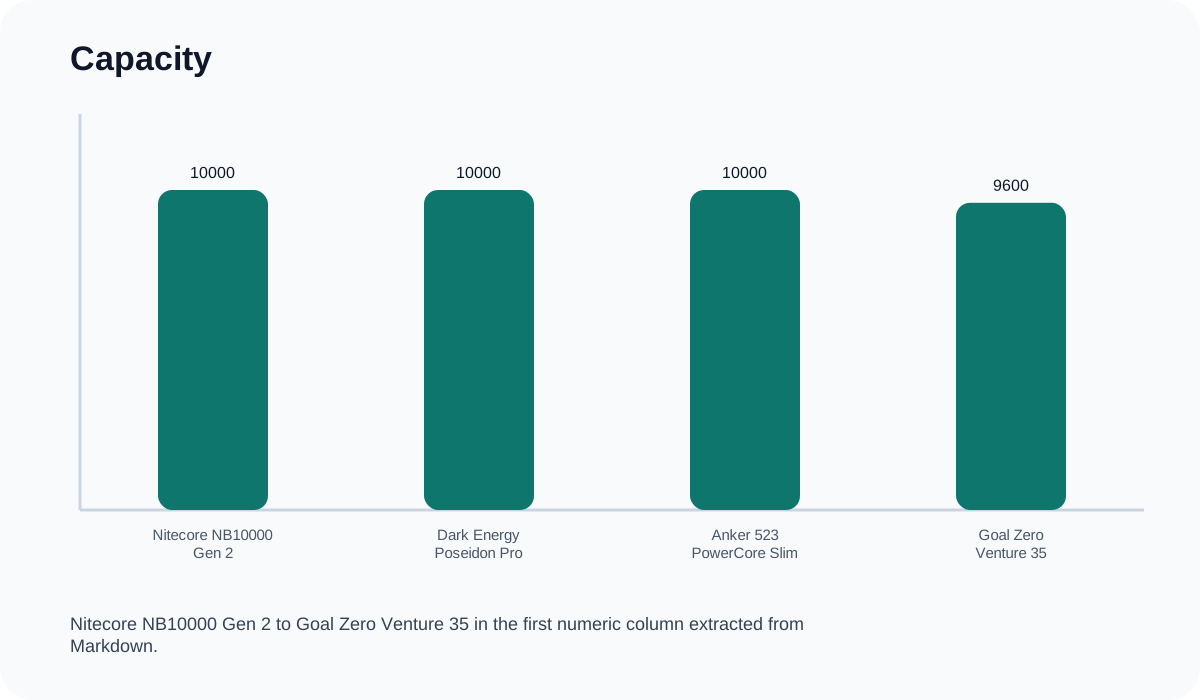
When evaluating a power bank for trail use, weight, battery capacity, water resistance, and price are the key metrics. Below is a comparison of the leading models suited for low-draw devices.
| Product | Capacity | Weight | IP Rating | Price |
|---|---|---|---|---|
| Nitecore NB10000 Gen 2 | 10,000 mAh | 5.3 oz | IPX5 | $59.95 |
| Dark Energy Poseidon Pro | 10,000 mAh | 9.6 oz | IP68 | $119.99 |
| Anker 523 PowerCore Slim | 10,000 mAh | 7.4 oz | N/A | $49.99 |
| Goal Zero Venture 35 | 9,600 mAh | 10.1 oz | IP67 | $69.95 |
Efficiency vs. Durability
While raw capacity matters, backpackers measure utility by how much power they get per ounce carried. Ultralight carbon fiber builds offer superior efficiency, but “ruggedized” banks sacrifice weight for enhanced waterproofing and armor.
Analysis: The Nitecore NB10000 outputs an estimated 1,886 mAh per ounce of carry weight, vastly outperforming the Dark Energy Poseidon Pro (1,041 mAh/oz). However, this data highlights a direct trade-off: the heavier Poseidon Pro secures an IP68 rating, making it completely submersible, whereas the highly efficient Nitecore only offers IPX5 water resistance.
Real-World Pain Points and Safety Considerations
Waterproof Claims and Corrosion
While many “rugged” power banks advertise an IP67 rating (designed to survive 1 meter of submersion for 30 minutes), real-world reliability on long trips is often compromised by physical wear. Rubber port gaskets frequently fail over time. Furthermore, exposure to salt air or fine trail dust can corrode unprotected USB-C ports, rendering the bank useless. Regular inspection of your device’s gasket seals is highly recommended before setting out.
Thermal Management
The lithium-ion polymer cells used inside arc lighters are sensitive to heat. Fast-charging power blocks can sometimes generate excess heat during the discharge-to-charge cycle. Models featuring advanced thermal management, such as Anker’s ActiveShield technology or power banks utilizing GaN components, help prevent overheating, ensuring your lighter’s battery remains safe and functional.
Final Verdict
- Best for Ultralight Travel: Nitecore NB10000 Gen 2. Its carbon-fiber chassis delivers an unmatched 1,886 mAh/oz ratio, and its easily accessible low-current mode is perfect for keeping your arc lighter charged without auto-shutoff issues.
- Best for Extreme Environments: Dark Energy Poseidon Pro. If your multi-day trip involves heavy rain, river crossings, or extreme grit, the IP68 rating justifies the 9.6-ounce weight penalty and the higher $119.99 price point.
Pre-Trip Checklist for Arc Lighters
- Enable Low Current Mode: Before plugging in, verify how to engage your power bank’s trickle charge (often a double-press or long-hold of the power button).
- Check Cable Compatibility: Ensure you have the correct cable. Some older arc lighter models only charge via USB-A to USB-C cables, rather than direct USB-C to USB-C.
- Inspect Port Gaskets: Verify that the rubber seals on your IP67/IP68 power bank are intact and free of debris to prevent trail dust and moisture penetration.