How Battery Capacity Marketing Can Mislead Outdoor Buyers
Discover why outdoor power banks only deliver 65% of their advertised capacity, and learn the truth about solar charging speeds and rugged marketing.
Executive Summary
Outdoor enthusiasts often purchase portable battery packs expecting a 1-to-1 ratio between the advertised capacity and their device’s battery size. However, industry marketing heavily favors “Cell Capacity” over usable “Rated Capacity.” Due to voltage conversion (from internal 3.7V to 5V USB output) and heat loss, most power banks deliver only 60% to 70% of their advertised capacity to your device. Furthermore, integrated solar charging often takes up to 100 hours to recharge a battery, rendering it practically useless for fast top-ups. This guide breaks down the true physics behind power bank specifications to help buyers make informed, data-driven decisions.
The 65% Rule: Why Math Doesn’t Match Marketing
The most common trap for outdoor buyers is a misunderstanding of mAh (milliampere-hours). Marketing materials prominently display high numbers like 20,000mAh. However, this represents the total capacity of the internal lithium cells operating at a baseline of 3.7 volts.
Modern consumer electronics require a minimum of 5 volts (or significantly higher for USB-C PD) to charge. When a power bank boosts the voltage from 3.7V to 5V, the laws of physics dictate a loss in efficiency. Heat dissipation and internal conversion overhead mean you are generally left with just 65% of the advertised number for actual charging use.
Real-World Usable Capacity Breakdown
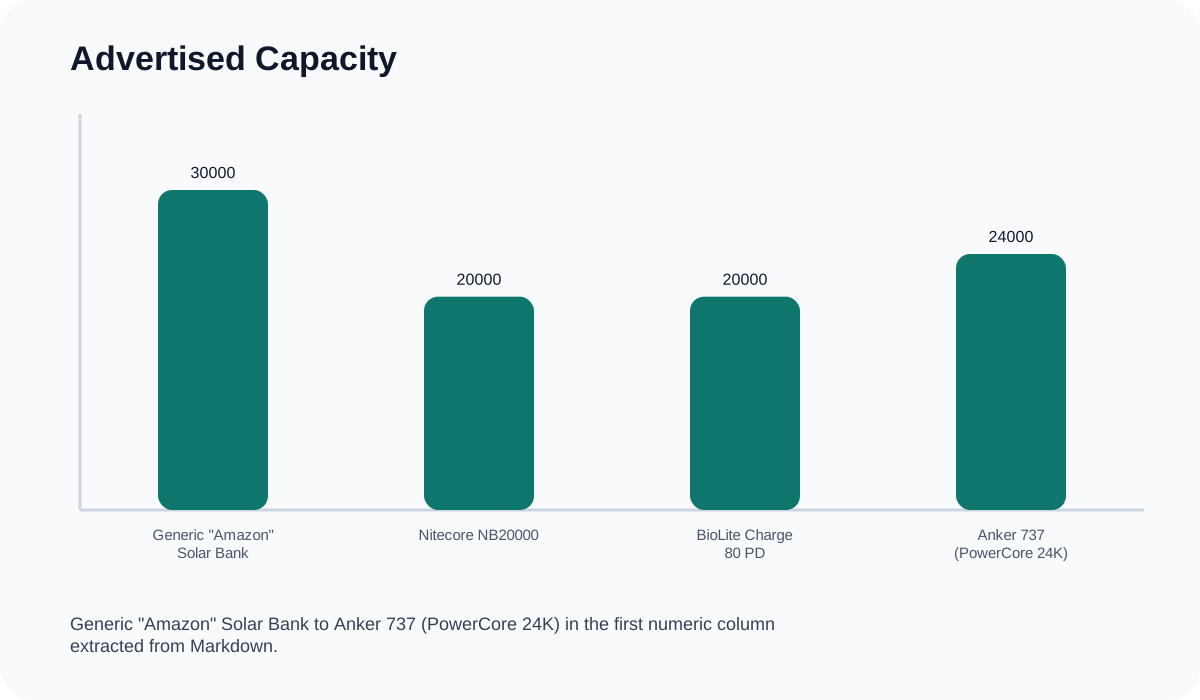
| Brand & Model | Advertised Capacity | Est. Usable at 5V* | Actual Efficiency | Est. iPhone 15 Charges |
|---|---|---|---|---|
| Generic “Amazon” Solar Bank | 30,000 mAh | 18,500 mAh | 61% | ~4.5 |
| Nitecore NB20000 | 20,000 mAh | 13,500 mAh | 67.5% | ~3.2 |
| BioLite Charge 80 PD | 20,000 mAh | 13,000 mAh | 65% | ~3.1 |
| Anker 737 (PowerCore 24K) | 24,000 mAh | 15,500 mAh | 64.5% | ~3.8 |
(Note: “Usable at 5V” figures are estimates based on standardized efficiency conversion metrics from independent testing.)
The “Infinite Power” Solar Gimmick
“Solar Power Banks” are aggressively marketed to backpackers and preppers. But the math behind the integrated solar panels tells a vastly different story compared to the marketing claims of infinite, off-grid power.
A standard integrated solar panel on a battery pack generates roughly 1W to 1.5W of power. To charge a 20,000mAh battery from 0% to 100% under perfect, direct sunlight, it would require 80 to 100 hours. In real-world wilderness conditions—factoring in clouds, shade, and suboptimal panel angles—it is practically impossible to rely on an integrated panel as a primary power source.
Environmental Factors: Cold Weather and “Rugged” Claims
Beyond electrical limitations, environmental marketing claims can also mislead consumers, particularly those using gear in extreme conditions.
- Thermal Derating: Lithium cells are highly sensitive to temperature. If you are winter camping, expect real-world usable capacity to drop significantly in temperatures below 10°C (50°F). Laboratory tests for marketing claims are almost exclusively conducted in temperate 21°C (70°F) environments.
- Deceptive Durability: Many cheap, generic units feature thick rubberized shells to look “rugged.” However, without official IP67 or IP68 water and dust resistance certifications, these shells are largely aesthetic. Light rain or high humidity can easily bypass the unsealed ports, causing internal corrosion.
Safety Standards and Generic Brands
Safety certifications are non-negotiable for portable power. High-end brands like Anker, Nitecore, and EcoFlow undergo rigorous UL or CE testing, ensuring devices have thermal cut-off protection. Fast-charging modern outdoor gear generates significant internal heat; relying on uncertified, low-cost generic banks drastically increases the risk of thermal runaway and potential fire hazards, particularly in isolated environments or when placed in direct sunlight to “solar charge.”
Final Verdict
When purchasing outdoor power banks, buyers must recalibrate their expectations. Treat the advertised mAh rating as a gross raw metric, not a net deliverable. Expect roughly 65% of that advertised capacity to actually reach your device. To optimize your outdoor charging kit, avoid integrated solar banks in favor of standalone 21W+ foldable panels, and always prioritize verified IP ratings and UL/CE safety certifications over rugged aesthetics.
Buyer’s Checklist & FAQ
Q: How do I calculate the actual rated capacity of a power bank? Multiply the advertised mAh by 3.7 (internal voltage), then divide by 5 (USB output voltage), and multiply by 0.85 (typical efficiency to account for heat and circuit loss). (Example calculation: 20,000 x 3.7 ÷ 5 x 0.85 = ~12,580 usable mAh).
Q: Should I buy a power bank with a built-in solar panel? Generally, no. A 1W-1.5W panel is effectively a gimmick that takes nearly 100 hours to fully charge a 20,000mAh battery. They are only suitable for absolute emergencies to glean 1-2% for an SOS call.
Q: Why does my power bank die faster in the winter? Lithium cells suffer from thermal derating. At temperatures under 10°C (50°F), internal resistance increases, preventing the battery from discharging efficiently. Keep power banks close to your body or inside your sleeping bag to preserve their charge.