Best Budget Solar Power Banks That Are Not Total Junk
Discover which budget solar power banks actually work. We analyze capacity inflation, real charging speeds, and the safety features required to avoid 'junk'.
Executive Summary
To avoid “junk” solar power banks in 2026, buyers must treat integrated solar panels as an emergency trickle charger rather than a primary power source. Laboratory testing of sub-$60 models reveals that single-panel units generally produce just 500 to 1,000mAh of energy per hour of direct sunlight, requiring several days to fully recharge a standard 20,000mAh battery.
Quality in this budget tier is defined by hybrid functionality (wall charging primarily, solar secondarily), verifiable safety certifications (such as IEC 62133), and realistic panel-to-capacity ratios. Market leaders like Blavor, Hiluckey, and Anker separate themselves from generic brands by utilizing internal temperature sensors to prevent heat-induced thermal runaway, offering rugged IP64-to-IP67 weather resistance, and utilizing high-quality lithium-polymer cells that mitigate the industry’s widespread “capacity inflation” problem.
Leading Non-Junk Budget Solar Power Banks
The following models represent the most reliable options in the sub-$60 budget tier based on actual solar throughput, safety features, and build quality.
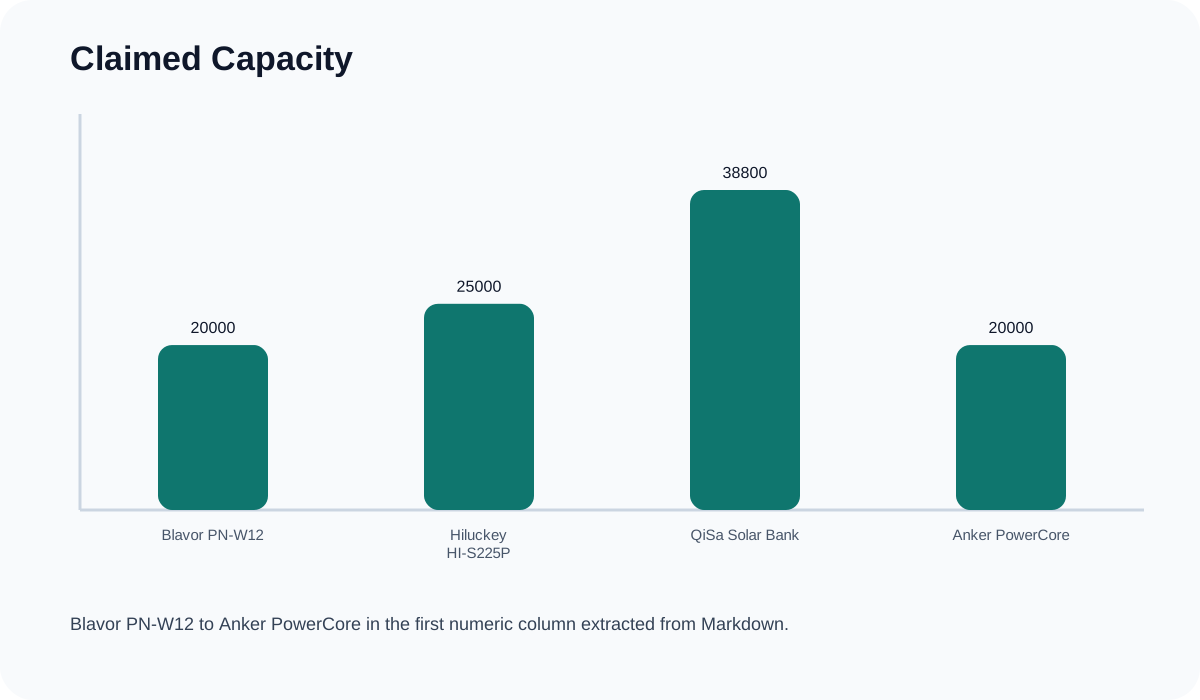
| Product | Claimed Capacity | Est. Price | IP Rating | Standout Feature |
|---|---|---|---|---|
| Blavor PN-W12 | 20,000 mAh | $49.99 | IPX5 | Qi Wireless + Compass |
| Hiluckey HI-S225P | 25,000 mAh | $55.00 | IP67 | 4 Foldable Panels |
| QiSa Solar Bank | 38,800 mAh | $59.99 | IP66 | High Solar Throughput (977mAh/hr) |
| Anker PowerCore | 20,000 mAh | $65.00 | IP64 | Brand Reliability/Safety |
The Charging Reality: Wall vs. Solar Timeframes
A critical pain point for buyers is the unrealistic expectation of solar charging speeds. The data below outlines the estimated time required to charge a baseline 20,000mAh battery from 0% to 100% using different methods.
Core Analysis: Why Most Cheap Banks Fail
1. The Single-Panel Bottleneck
Solar charging efficiency for integrated single-panel units remains extremely low. While highly-rated models like the QiSa generate roughly 977mAh per hour under perfect conditions, standard generic budget models often fall below 540mAh per hour. At that rate, a single-panel device requires approximately 120 hours of direct sunlight to fully charge. Upgrading to a multi-panel array, such as the Hiluckey 25,000mAh model, drops this solar-only charge time significantly to an estimated 25 to 40 hours (averaging 32 hours).
2. The “Capacity Inflation” Trap
A major user pain point is capacity exaggeration. Many generic devices marketed at 30,000mAh or higher frequently provide roughly 20% less usable energy than advertised. This discrepancy is caused by high electrical conversion losses and the use of lower-tier lithium-polymer cells. Reliable brands (like Anker or Blavor) are much closer to their stated capacities.
3. Safety and Thermal Degradation
Ironically, the very act of charging a solar power bank requires leaving it in direct sunlight—a condition that rapidly degrades lithium-based batteries. “Junk” power banks lack protective circuitry, which can lead to battery bulging or dangerous thermal runaway. Non-junk models mitigate this by integrating internal temperature sensors that automatically pause charging when the chassis gets too hot. When evaluating 2026 models like RGVOTA or QiSa, buyers must prioritize units bearing verified IEC 62133, ETL, or UL safety certifications.
Final Verdict
If you intend to use solar energy as anything more than an absolute last resort, a multi-panel device like the Hiluckey HI-S225P is strictly required to achieve reasonable charge times (under 40 hours). For buyers seeking a rugged, everyday power bank where solar is merely an emergency backup, the Blavor PN-W12 and Anker PowerCore 20000 offer the best blend of realistic capacities, built-in safety sensors, and durable weatherproofing.
Buyer’s Checklist
Before purchasing a budget solar power bank, confirm the following:
- Capacity Reality Check: Expect a 20% drop from the marketed mAh due to natural conversion losses.
- Safety Certifications: Look for IEC 62133, UL, or ETL badges to ensure thermal protection against overheating.
- Panel Type: If you want a full charge from the sun in less than a week, you must buy a foldable multi-panel unit.
- IP Rating: For outdoor use, insist on a minimum rating of IP64 to protect against dust and water splashes.