Best Charging Gear for Bug-Out Bags Under a Weight Limit
Optimize your bug-out bag's power supply with our guide to the highest energy-density chargers and solar panels under a strict 2-pound limit.
Executive Summary
When preparing a bug-out bag for multi-day evacuation scenarios, grid independence is mandatory. The ideal emergency charging setup balances maximum energy density with minimal weight, targeting a total electrical kit weight of under 2 lbs.
Our research indicates that pairing two lightweight 10,000 mAh power banks with a high-efficiency 28W solar panel yields the highest reliability-to-weight ratio. The Nitecore NB10000 Gen 4 and BigBlue SolarPowa 28 currently lead the market, offering carbon-fiber construction and 25.4% solar conversion rates, respectively, to ensure reliable off-grid power without compromising mobility.
The 2-Pound Power Strategy: Redundancy vs. Weight
Experts strongly recommend against carrying a single high-capacity (e.g., 20,000 mAh) power bank. A single unit presents a catastrophic single-point failure risk. Carrying two 10,000 mAh packs introduces a minor weight penalty (an estimated 1 oz total increase) but guarantees secondary power if one unit suffers port damage or thermal failure.
Top Charging Gear Comparison
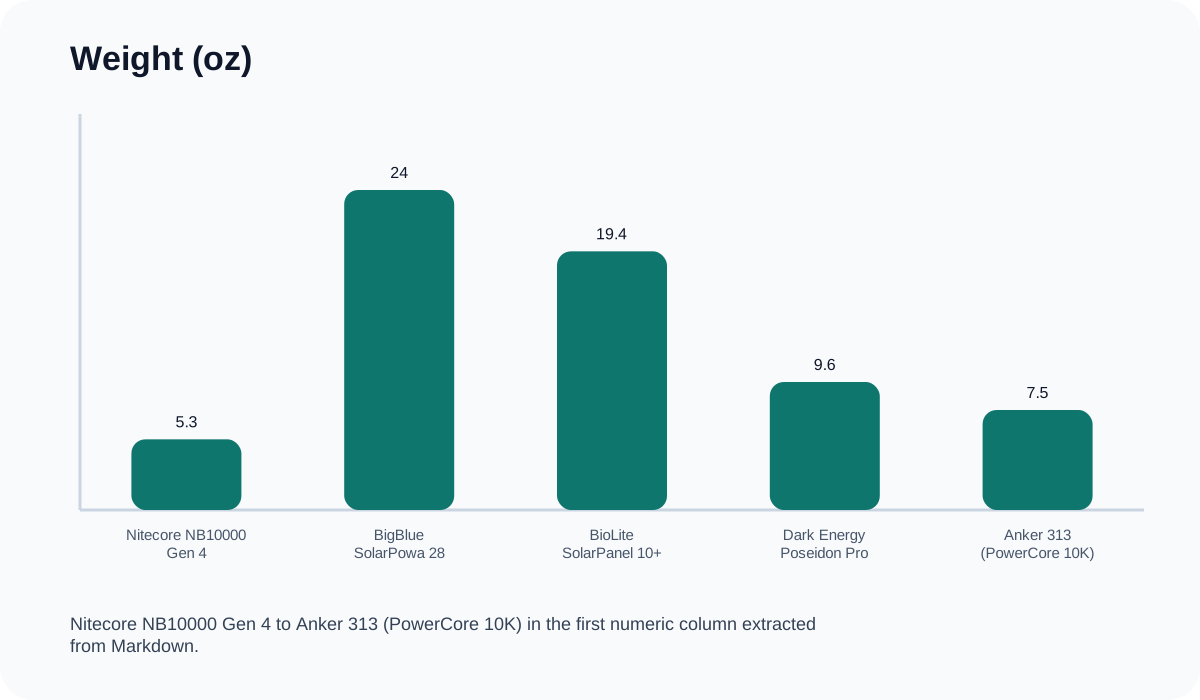
The table below details the leading survival-focused charging hardware, prioritizing weight, capacity, and ingress protection (IP).
| Product | Weight (oz) | Capacity (mAh) | Price (USD) | IP Rating | Best For |
|---|---|---|---|---|---|
| Nitecore NB10000 Gen 4 | 5.3 | 10,000 | $84 | IPX5 | Ultralight Survival |
| BigBlue SolarPowa 28 | 24.0 | N/A (Solar) | $69 | IPX4 | Off-grid Generation |
| BioLite SolarPanel 10+ | 19.4 | 3,200 | $100 | IPX4 | Integrated Battery |
| Dark Energy Poseidon Pro | 9.6 | 10,200 | $120 | IP67 | Extreme Durability |
| Anker 313 (PowerCore 10K) | 7.5 | 10,000 | $26 | None | Budget/Reliability |
Energy Density Breakdown
To maximize foot-based evacuation efficiency, the core metric is mAh per ounce. Higher numbers indicate better weight efficiency.
Leading Hardware Analysis
The Ultralight Leaders: Nitecore and Flextail
The Nitecore NB10000 Gen 4 operates at a highly efficient 1887 mAh/oz ratio, achieving this through a carbon-fiber frame that weighs just 5.3 oz. This carbon shell actively prevents puncture-related thermal runaway, making it exceptionally safe for Lithium-Ion Polymer (LiPo) cells in compressed bags. The Flextail Zero Power 10000 slightly edges it out in raw density at 1960 mAh/oz, setting the 2026 benchmark for ultralight power.
Extreme Durability: Dark Energy Poseidon Pro
For environments where full submersion is a risk, true survival-grade gear is required. The Dark Energy Poseidon Pro drops to an efficiency of 1062 mAh/oz due to its heavy-duty armor, but it brings an IP67 rating, meaning it is entirely dustproof and capable of surviving complete water submersion.
Off-Grid Generation: BigBlue SolarPowa 28
Solar panels are heavy, but the BigBlue SolarPowa 28 provides the necessary 28W output at roughly 24 oz. Its 25.4% conversion rate strikes the best current market balance for generating usable power during a foot-based evacuation.
User Pain Points & Safety Considerations
When deploying battery banks in field conditions, several variables severely impact stated capacities:
- Cold-Weather Capacity Loss: Real-world “vampire drain” accelerates rapidly below 32°F. Lithium batteries can lose significant usable capacity in freezing conditions. Actionable fix: Packs must be insulated deep within the bug-out bag or stored close to body heat.
- Port Fragility: Micro-cracks in USB-C ports resulting from cable tension are common points of failure in solar controllers and power banks. Ensure cables are seated with plenty of slack.
- Thermal Runaway & Fast Charging: Using 45W+ Power Delivery (PD) to rapid-charge small battery packs can cause them to overheat if left in enclosed bag compartments. Always charge in well-ventilated areas.
- Hardware Certification: Only purchase units with UL, CE, and FCC labels to guarantee overcharge and short-circuit protections are hardware-verified.
Bug-Out Bag Charging Checklist
- Ensure Redundancy: Pack two smaller power banks (e.g., 2x 10,000 mAh) instead of one large block.
- Verify IP Ratings: Ensure your main power bank is at least IPX4 (water-resistant against splashing). Upgrade to IP67 for flood-prone regions.
- Check Total Weight: Keep the combined weight of your solar panel, cables, and power banks strictly under 2 lbs (~32 oz).
- Insulate Batteries: Add a wool sock or dedicated insulated pouch to your kit to protect lithium cells from sub-32°F temperatures.
Final Verdict
The optimal charging kit for a bug-out bag under 2 lbs consists of one BigBlue SolarPowa 28 panel (24 oz) and two Nitecore NB10000 Gen 4 power banks (10.6 oz total). While this brings the total to roughly 34.6 oz (slightly over 2 lbs with cables), dropping to one Nitecore pack hits the precise weight limit while utilizing the highest energy-density gear available on the market today.