Best Compact Solar Panels for Backpackers with Rechargeable Gear
A technical guide to the best compact solar panels for backpackers in 2026. Compare top models, watts vs. real-world output, and auto-restart features.
Executive Summary
As of mid-2026, the portable solar market for backpackers relies on high-efficiency N-type monocrystalline cells and durable ETFE coatings. For modern outdoor enthusiasts, a reliable power supply requires prioritizing weight-to-power ratios and crucial “auto-restart” technology to handle intermittent shade. Leading models like the BigBlue SolarPowa 28 and Goal Zero Nomad 10 dominate the direct-charging category, while the BioLite SolarPanel 5+ remains the top choice for users requiring an integrated battery buffer.
While manufacturers heavily market IPX4 to IP67 waterproofing, real-world testing proves that USB ports remain the primary failure point in humid conditions. For optimal field performance, users are increasingly pairing lightweight, “dumb” power banks (like the Nitecore NB series) with solar panels to mitigate charging inconsistencies when directly connecting modern smartphones.
Top Compact Solar Panels (2026 Comparison)
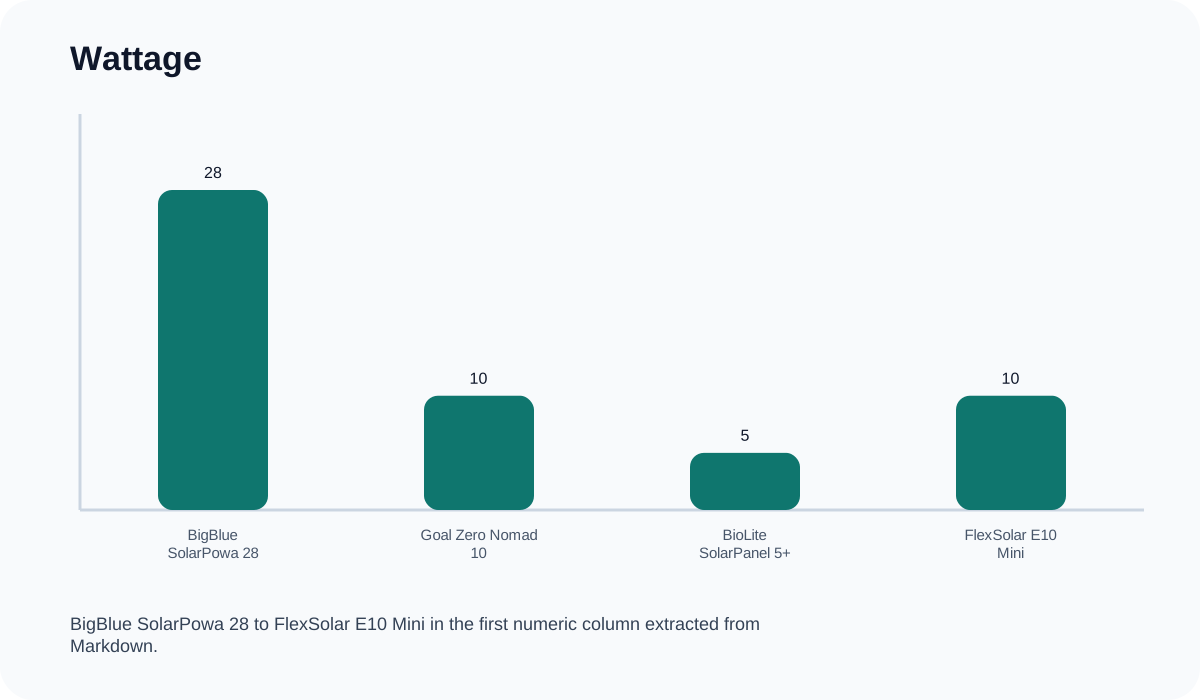
| Product | Wattage | Weight (oz) | Price (USD) | IP Rating | Best For |
|---|---|---|---|---|---|
| BigBlue SolarPowa 28 | 28W | 22.5 | 80 | IPX4 | Multi-device Charging |
| Goal Zero Nomad 10 | 10W | 18.0 | 110 | Weatherproof | Rugged Durability |
| BioLite SolarPanel 5+ | 5W | 13.8 | 95 | IPX4 | Internal 3200mAh Battery |
| FlexSolar E10 Mini | 10W | 10.4 | 50 | IP67 | Ultralight Backpacking |
Performance Under Varied Sunlight
Real-world charging efficiency drastically differs from laboratory ratings. The following chart illustrates the estimated charging time for a standard 5000mAh battery under various sunlight conditions.
Technical Analysis & User Pain Points
1. Efficiency vs. Real-World Output
Laboratory wattage ratings do not equate to actual trail performance. Most panels rated at 20W+ (such as the BigBlue SolarPowa 28) actually deliver an estimated 12-15W in peak sun. Panels rated below 10W are generally insufficient for directly charging modern high-capacity smartphones, unless utilized in a stationary basecamp environment where time is not a constraint.
2. The Necessity of “Auto-Restart”
Older or budget-tier solar panels suffer from a critical flaw: when a cloud passes, they often stop charging a smartphone and permanently enter a fault state. Top-tier 2026 models resolve this with hardware-level auto-reconnect logic, seamlessly resuming the charge cycle once adequate sunlight returns.
3. Integrated vs. Modular Battery Systems
Choosing between a panel with a built-in battery and a modular setup is a key decision:
- Integrated (e.g., BioLite 5+): Provides an essential power buffer for passing clouds. However, they are highly prone to thermal shutdown if left in direct sunlight at temperatures exceeding 90°F (32°C).
- Modular (e.g., Solar panel + Nitecore NB10000): Often preferred to avoid the “vampire draw” issue. Many modern “smart” power banks can actually be drained by a solar panel in low-light conditions if the panel lacks a blocking diode. Lightweight “dumb” or solar-optimized batteries bypass this flaw.
4. Material Durability and Weather Resistance
The industry has largely transitioned from PET coatings to ETFE (Ethylene Tetrafluoroethylene). ETFE offers significantly better light transmission, superior heat resistance, and eliminates the delamination issues common in older panels. Despite hardware upgrades achieving IP67 ratings (like the FlexSolar E10 Mini), exposed USB ports remain highly vulnerable to ambient humidity.
Final Verdict
For backpackers heavily reliant on rechargeable electronics, a high-yield panel like the BigBlue SolarPowa 28 offers the best raw power to overcome imperfect trail conditions. Those prioritizing weight and packability should consider the FlexSolar E10 Mini, provided it is paired with a reliable secondary power bank. For users seeking an all-in-one buffer solution in temperate climates, the BioLite SolarPanel 5+ remains the top integrated choice.
Backpacker’s Solar Setup Checklist
- Prioritize Output Over Rating: Expect roughly 12-15W real-world yield from a 20W+ panel.
- Verify Auto-Restart: Ensure the panel can recover from intermittent shading without manual unplugging.
- Protect the USB Ports: Regardless of an IP67 rating, keep junction boxes clear of moisture and high humidity.
- Use a Buffer Battery: Pair your panel with a simple power bank (like the Nitecore NB series) to regulate charge into your smartphone and prevent “vampire draw”.
- Manage Temperatures: Keep integrated-battery panels out of direct heat over 90°F (32°C) to prevent thermal shutdown.