Best Foldable Solar Panels for Overlanding Charging Tables
Discover the best foldable solar panels for overlanding charging tables. Compare top brands by cost per watt, efficiency, and real-world off-grid performance.
Executive Summary
For overlanders seeking to power centralized charging tables, high-output foldable solar panels paired with a portable power station currently offer the best balance of output, portability, and value. The Renogy 200W Portable Foldable delivers the most efficient price-to-watt ratio at $2.00/W, while the EcoFlow 160W provides superior durability with an IP68 waterproof rating. For a fully integrated furniture solution, the GoSun Solar Table-60 serves as a dual-purpose 60W charging surface. Across the board, 2026 technological shifts toward N-Type and Bifacial cells are raising standard conversion efficiencies above 23%, though real-world power yields generally sit at 70-85% of rated capacity depending on shade and weather conditions.
Comparative Specifications
When evaluating panels for an overlanding charging hub, cost per watt, physical weight, and environmental protection (IP rating) are the primary differentiators.
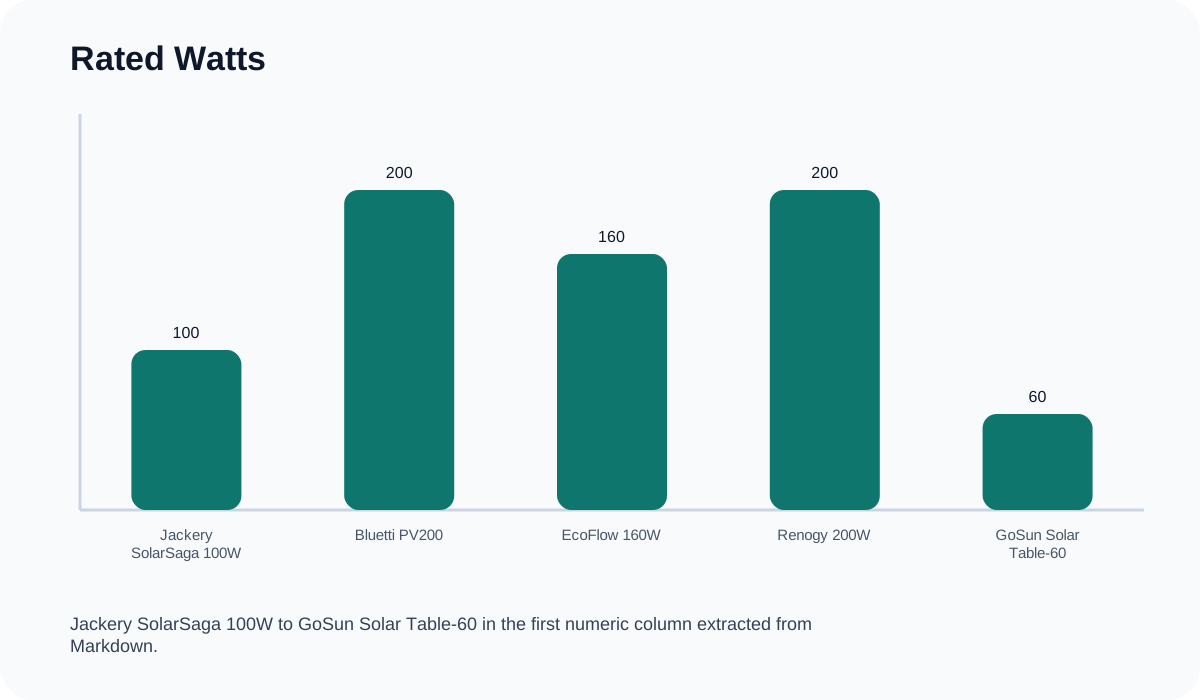
| Product | Rated Watts | Price | IP Rating | Weight |
|---|---|---|---|---|
| Jackery SolarSaga 100W | 100W | $299 | IP65 | 9.1 lbs |
| Bluetti PV200 | 200W | $499 | IP65 | 16.0 lbs |
| EcoFlow 160W | 160W | $349 | IP68 | 15.0 lbs |
| Renogy 200W | 200W | $399 | IP65 | 14.0 lbs |
| GoSun Solar Table-60 | 60W | $299 | IP45 | 18.0 lbs |
Cost vs. Efficiency Analysis
The chart below breaks down the relationship between upfront cost per watt and the solar conversion efficiency of leading portable panels.
Performance and Real-World Efficiency
Laboratory ratings rarely reflect wooded campsite conditions. Real-world testing reveals that most foldable solar panels achieve between 70% and 85% of their rated wattage in clear, direct sunlight.
- Charging Baselines: Under optimal conditions, a 100W panel generates enough sustained power to recharge a standard 300Wh portable power station in approximately 4 to 6 hours.
- Weather Durability: High-end models like the EcoFlow 160W are pushing industry standards by incorporating IP68 waterproof ratings, allowing them to withstand heavy rain and brief submersion. In contrast, standard mid-range models typically cap out at IP65, meaning they are only splash-proof and must be stowed during downpours. The GoSun Solar Table-60 has an IP45 rating, making it more vulnerable to harsh weather conditions.
User Pain Points & Safety Considerations
Integrating foldable solar into an off-grid charging table setup introduces specific operational challenges that users must navigate:
- Shade Sensitivity: Traditional P-Type solar cells are highly susceptible to partial shading. A single leaf obstructing a cell can cause total panel output to plummet by up to 50%. Newer N-Type and Bifacial panels mitigate this, but shade management remains critical.
- The “Babysitting” Requirement: To maintain maximum charging efficiency, users must physically reposition ground-deployed panels every two hours to track the sun’s trajectory.
- Electrical Safety Protocol: Improper connection sequences can cause electrical arcing and irreversible surge damage to the solar controller. Always connect the battery/power station to the charge controller before unfolding and exposing the panels to the sun.
- Theft Vulnerability: Lightweight, high-value foldable panels placed far from the main campsite for optimal sun exposure are prime targets for opportunistic theft.
Final Verdict
For a dedicated overlanding charging table hub, the Renogy 200W Portable Foldable offers the most practical capability for extended trips. Its combination of 200W high yield and a class-leading $2.00/W cost profile makes it the optimal choice for powering centralized devices. However, if your overlanding routes frequently encounter extreme weather, paying the premium for the EcoFlow 160W and its IP68 certification is a necessary investment for long-term reliability.
Overlanding Solar Setup Checklist
- Match Wattage to Battery: Ensure your panel’s real-world output (70-85% of rated) aligns with your power station’s required daily replenishment rate.
- Verify IP Ratings: Assess typical travel weather. Choose IP68 for wet climates and IP65 for arid environments.
- Confirm Connection Sequence: Memorize the safe connection order (Battery -> Controller -> Panel) to prevent arcing.
- Plan for Theft Mitigation: Utilize lockable tether cables if deploying panels at a distance from the vehicle.