Best Power Banks That Can Handle Cold Weather Better
Cold weather can reduce power bank capacity by up to 50%. Discover the best winter-ready power banks, thermal efficiency ratings, and cold-weather safety rules.
Executive Summary
Sub-zero temperatures dramatically reduce the performance of standard lithium-ion power banks. In deep cold, internal resistance increases and chemical reactions slow down, leading to a temporary capacity loss of 20% to 50%. For outdoor and winter professionals, standard consumer power banks often fail when needed most.
Our research identifies the Nestout 15000 as the most thermally efficient winter power bank, retaining roughly 99% of its efficiency near freezing. The Dark Energy Poseidon Pro leads in extreme environmental durability, rated down to -20°C. Crucially, while discharging these batteries in the cold is safe, charging a power bank below 0°C (32°F) without internal heaters can cause permanent “lithium plating,” permanently destroying battery capacity and presenting a severe fire risk.
Battery Capacity Retention in Freezing Temperatures
The following chart illustrates the estimated temporary capacity loss typical lithium-ion power banks experience as temperatures drop, based on empirical winter testing standards.
Cold-Weather Power Bank Comparison
Below is a comparison of the top-rated portable power banks for cold-weather usage, evaluating price, ingress protection (IP) ratings, and thermal operating limits.
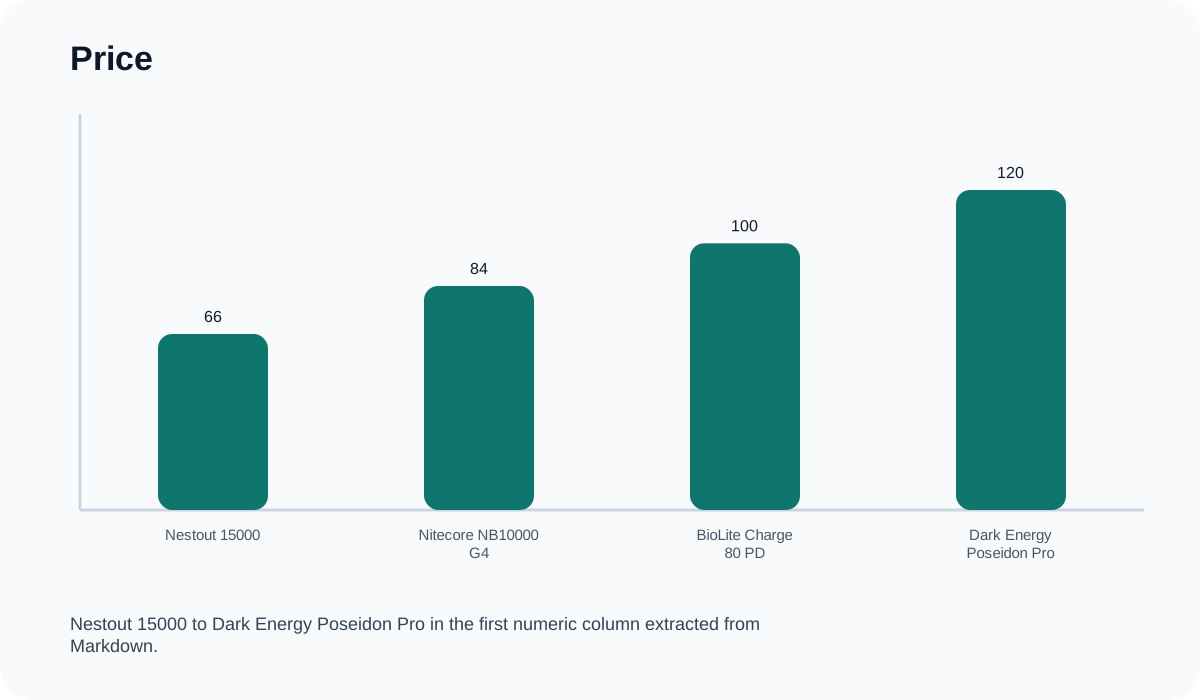
| Product | Price | IP Rating | Operating Temp | Best Feature |
|---|---|---|---|---|
| Nestout 15000 | $66 | IP67 | -10°C to 45°C | Best thermal efficiency retention |
| Nitecore NB10000 G4 | $84 | IPX5 | -10°C to 40°C | Carbon fiber shell (ultralight) |
| BioLite Charge 80 PD | $100 | N/A | -20°C to 40°C | High capacity (20Ah) durability |
| Dark Energy Poseidon Pro | $120 | IP68 | -20°C to 60°C | Military-grade shock resistance |
Analysis of Leading Models
1. Nestout 15000
At $66, the Nestout 15000 is the highest-performing unit for strict thermal retention. Testing shows it maintains approximately 99% efficiency in near-freezing conditions. Its IP67 rating ensures it is highly resistant to snowmelt and condensation, making it a reliable choice for alpine hikers.
2. Nitecore NB10000 Gen 4
Priced at $84, the Nitecore NB series employs a specialized carbon fiber shell designed to regulate temperature while remaining incredibly light. However, cold-chamber testing indicates that due to its thin, uninsulated frame, it can lose roughly 13% efficiency in the cold compared to bulkier, better-insulated models.
3. Dark Energy Poseidon Pro
For extreme environments, the $120 Dark Energy Poseidon Pro boasts an IP68 waterproof rating and an operating threshold down to -20°C (-4°F). This unit prioritizes military-grade shock and environmental resistance, making it an excellent choice for deep winter expeditions.
4. BioLite Charge 80 PD
At $100, the BioLite Charge 80 PD operates safely down to -20°C (-4°F) and provides a heavy-duty 20Ah capacity. While it lacks an official IP waterproof rating, its robust design makes it a dependable workhorse for extended winter basecamps.
Critical Safety Considerations & User Pain Points
Operating lithium-ion chemistry in freezing environments introduces specific hazards and functional barriers that buyers must understand.
- The Lithium Plating Hazard (Do Not Charge Below 0°C): Discharging a power bank is generally safe down to -20°C, but charging the power bank itself below 0°C (32°F) is highly dangerous. Doing so causes irreversible “lithium plating” on the battery’s anode, which permanently reduces capacity and drastically increases the risk of internal short-circuits and fire.
- “Ghost Drainage”: In deep cold, users often experience rapid voltage drops. A device may appear completely empty, but this is a temporary chemical limitation. Once warmed up (e.g., inside a sleeping bag), the capacity usually returns.
- Brittle Hardware: Standard PVC charging cables can become rigid and brittle in deep cold, often snapping when flexed.
- Charging Refusals: Many modern power banks feature a Battery Management System (BMS) that actively prevents output or input if the core temperature is too low. Users must warm the device in a pocket before it will function.
Winter Power Bank Checklist
To ensure reliable off-grid power during the winter months, follow these strict operational guidelines:
- Keep It Warm: Store your power bank in an interior jacket pocket close to your body heat during the day, and inside your sleeping bag at night.
- Never Charge While Freezing: Never connect a solar panel or wall charger to your power bank if its internal temperature is below 0°C (32°F).
- Upgrade Your Cables: Pack braided nylon or specialized silicone cables, which resist freezing and snapping better than standard plastic cables.
- Expect Capacity Loss: Always budget for a 20% to 50% loss in total output capacity if you are venturing into sustained sub-zero environments.
Final Verdict
For most winter enthusiasts looking for maximum cold-weather efficiency without overspending, the Nestout 15000 is the standout choice. If weight is the absolute primary concern for ultralight alpine setups, the Nitecore NB10000 Gen 4 remains a competitive, albeit slightly less thermally efficient, option. Regardless of the model chosen, strictly adhering to temperature safety guidelines is mandatory to prevent permanent battery failure.