Best Power Banks with Built-In Flashlights for Emergency Kits
Discover 2026's top power banks with flashlights for emergency kits. Compare capacity, IP67 waterproofing, solar efficiency, and real-world battery runtime.
Executive Summary
For 2026 emergency preparedness, the ideal power bank must deliver high-capacity energy storage alongside ruggedized durability and reliable multi-mode lighting. A viable emergency power bank requires a minimum of 10,000mAh capacity and an IP67+ rating to withstand adverse environmental conditions.
While models from Goal Zero, Nitecore, and Anker dominate the high-durability market by integrating USB-C Power Delivery (PD) for rapid recharging, buyers must be aware of performance realities. Real-world usable battery capacity is typically 15% to 25% lower than advertised, and integrated solar panels function only as emergency trickle chargers. Selecting the right unit requires balancing total capacity, flashlight lumen output, and long-term storage safety mechanisms.
Leading Emergency Power Banks Compared
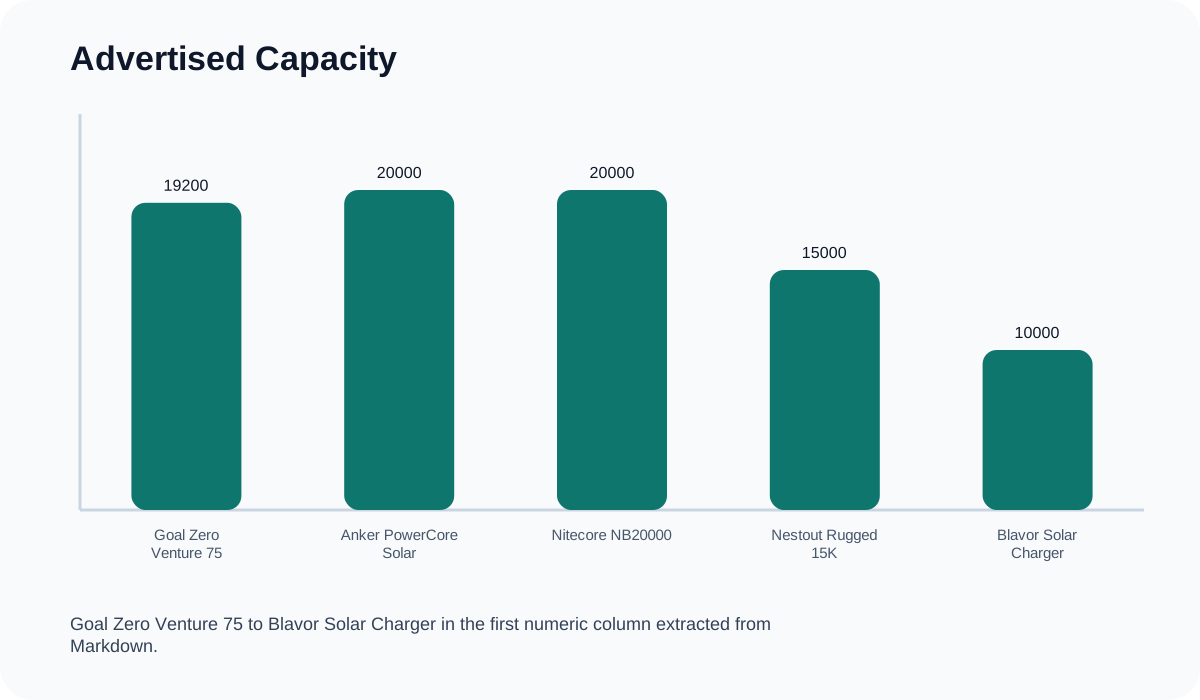
The following table outlines the leading power banks tested and vetted for emergency readiness, focusing on capacity, light functionality, ingress protection (IP), charging methods, and price.
| Product | Advertised Capacity | Flashlight Features | IP Rating | Charging Method | Price Range |
|---|---|---|---|---|---|
| Goal Zero Venture 75 | 19,200 mAh | 50 Lumens / 3 Modes | IP67 | USB-C PD (60W) | 120 |
| Anker PowerCore Solar | 20,000 mAh | LED Array / SOS | IP65 | Solar / USB-C | 75 |
| Nitecore NB20000 | 20,000 mAh | Low-power status LED | IPX5 | USB-C PD (45W) | 130 |
| Nestout Rugged 15K | 15,000 mAh | Optional Attachments | IP67 | USB-C PD | 85 |
| Blavor Solar Charger | 10,000 mAh | Dual LED / Compass | IPX5 | Solar / Wireless | 45 |
Analysis: The Reality of Capacity and Recharging
Actual vs. Advertised Capacity
When calculating how many times a power bank can charge your critical communication devices, you cannot rely purely on the marketing label. Data shows that real-world usable capacity is consistently 15% to 25% lower than the advertised mAh ratings. This occurs due to unavoidable heat loss and the necessary voltage conversion from internal 3.7V lithium cells to the 5V or 9V required by USB outputs. For example, a 10,000mAh unit will effectively deliver an estimated 7,500mAh to 8,500mAh to your devices.
The Truth About Integrated Solar Charging
A major pain point for users is the misunderstanding of integrated solar panels. While heavily marketed as primary power sources, they lack the surface area required for high efficiency.
Testing indicates that integrated panels typically recover only 100 to 300mAh per day in direct sunlight. At this rate, fully recharging a 20,000mAh unit via solar alone would take over two weeks. Consequently, solar should be viewed strictly as a survival feature for trickle-charging a dead phone just enough to make an emergency call.
Durability and Lighting Features
Waterproofing Benchmarks
In storm, flood, or hurricane scenarios, water resistance is non-negotiable. The industry standard for a rugged emergency unit is an IP67 rating, which means the device is entirely dust-tight and can survive submersion in up to 1 meter of water for 30 minutes. Models like the Goal Zero Venture 75 and Nestout Rugged 15K meet this critical benchmark.
Note on User Pain Points: Even with IP67 ratings, charging ports can become severely corroded if the protective rubber seals are not perfectly seated before moisture exposure. Always inspect seals before packing the unit.
Flashlight Functionality
Modern emergency banks have transitioned from single low-output LEDs to functional “work light” arrays capable of producing up to 500 lumens. Dedicated SOS and strobe modes are standard for signaling rescuers.
However, highly sensitive external power buttons frequently cause flashlights to turn on accidentally while packed inside “Go Bags,” completely draining the emergency reserve before an actual crisis occurs. Units with recessed buttons or required double-tap activations are highly recommended.
Safety Considerations and Storage Guidelines
Lithium-ion power banks pose safety risks if mismanaged. Official safety guidelines based on IEC 62133 standards dictate several mandatory practices for emergency kits:
- Thermal Runaway Risk: Never charge power banks in enclosed, unventilated spaces or leave them baking on a car dashboard in direct sunlight. Solar units are particularly susceptible to overheating while charging.
- Battery Management Systems (BMS): Ensure your chosen unit features internal BMS to provide over-current and short-circuit protection.
- Long-Term Storage Protocol: Storing lithium batteries at 100% or 0% charge for prolonged periods causes cell swelling and permanent degradation. The optimal storage level is between 50% and 70%.
Emergency Kit Maintenance Checklist
Because lithium-ion batteries suffer from “self-discharge” (losing 2% to 5% of their charge per month while sitting idle), “pack it and forget it” is a dangerous strategy. Follow this maintenance routine:
- Quarterly Check-Up: Unpack the power bank every 3 to 6 months.
- Cycle the Battery: Discharge the unit slightly, then recharge it back to the 50%-70% optimal storage range.
- Inspect Seals: Verify that all rubber port covers are intact, free of debris, and tightly closed.
- Test the Light: Ensure the flashlight and SOS functions are operating correctly.
Final Verdict
For a dedicated emergency “Go Bag,” prioritizing build quality over massive capacity is often the smartest route, as 20,000mAh+ rugged units become exceptionally heavy. The Goal Zero Venture 75 stands out as the premium choice due to its verified IP67 rating, excellent USB-C PD fast charging, and reliable 50-lumen multi-mode flashlight. For users on a strict budget, the Anker PowerCore Solar provides high capacity and an SOS LED array, though users must manage expectations regarding its solar capabilities.