Best Power Solutions for Campsites Without Vehicle Access
Discover the most weight-efficient, waterproof power solutions for hike-in campsites. Compare ultralight power banks, LiFePO4 stations, and solar gear.
Executive Summary
For campsites lacking vehicle access, the optimal power solution is a modular system utilizing ultralight 10,000mAh power banks paired with high-efficiency 40W–60W foldable solar panels. Our analysis indicates that for hike-in distances over three miles, traditional portable power stations are too heavy. Ultralight power banks like the Nitecore NB10000 deliver up to 3x more weight-efficiency (Wh/lb) than mini power stations. Furthermore, while larger LiFePO4 (Lithium Iron Phosphate) stations offer exceptional safety and longevity, they generally lack official IP waterproofing. For unpredictable backcountry environments, true IP67 weather-sealed power banks are the preferred choice.
The Weight Efficiency Threshold
When carrying gear to a remote campsite, the primary constraint is the total weight-per-mile. At distances exceeding 3 miles, energy density becomes the most critical metric.
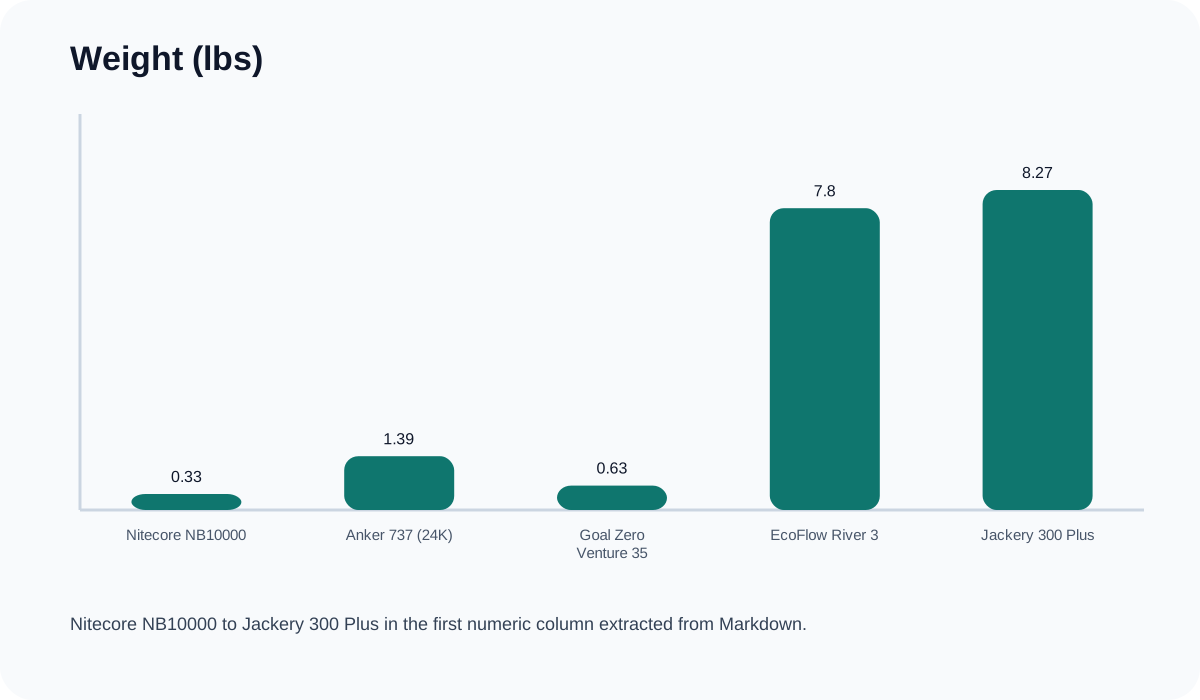
Lower-weight power banks provide nearly 4x the energy per pound compared to portable power stations. The Nitecore NB10000 Gen 4 (0.33 lbs) boasts an energy density of 116.7 Wh/lb. In contrast, “mini” power stations like the Jackery Explorer 300 Plus or EcoFlow River 3 offer less than 35 Wh/lb. Therefore, unless you are powering CPAP machines or large appliances, modular carbon-fiber power banks are the mathematically superior choice for long-distance hike-in sites.
Waterproofing and Durability Disparities
Backcountry environments expose gear to sudden rain, high humidity, and stream crossings. Only small-scale power banks consistently offer submersion-rated waterproofing.
Rugged units like the Goal Zero Venture 35 feature true IP67 ratings, meaning they can withstand temporary submersion in water. Large portable power stations (e.g., the Anker 737, EcoFlow River 3, and Jackery 300 Plus) are generally rated IP20 or IP21. They provide zero protection against water ingress and require external weather-sealed dry bags to survive severe storms.
Portable Power Comparison for Hike-In Camping
| Product | Type | Weight (lbs) | Capacity (Wh) | Waterproof Rating | Price Range |
|---|---|---|---|---|---|
| Nitecore NB10000 | Ultralight Bank | 0.33 | 38.5 | IPX5 | 85 |
| Anker 737 (24K) | High-Power Bank | 1.39 | 86.4 | None | 150 |
| Goal Zero Venture 35 | Rugged Bank | 0.63 | 35.0 | IP67 | 70 |
| EcoFlow River 3 | Mini Station | 7.80 | 245.0 | None | 250 |
| Jackery 300 Plus | Mini Station | 8.27 | 288.0 | None | 300 |
Battery Chemistry: LiFePO4 vs. NMC
If your power needs dictate a mini power station over a pocketable bank, LiFePO4 (Lithium Iron Phosphate) is the required safety benchmark.
LiFePO4 chemistry is highly resistant to thermal runaway, virtually eliminating the risk of battery fires if the unit is punctured or overheats in a hot tent. While LiFePO4 batteries carry a 20-30% weight penalty compared to older Lithium-ion (NMC) chemistries, the increased safety and 3,000+ cycle lifespan make them non-negotiable for remote off-grid camping.
The Solar Reality for Forest Canopies
Bringing solar to a campsite without vehicle access requires a strict evaluation of charging output versus panel weight. User data reveals that solar panels under 20W fail to provide sufficient charge under forest canopies.
While ultralight backpackers sometimes carry 10W panels (like the BioLite SolarPanel 10+), these require direct, unimpeded sunlight. For multi-day stationary off-grid use in typical shaded or semi-shaded campsites, 40W–60W foldable, ETFE-laminated panels (such as the Goal Zero Nomad 50) represent the minimum viable threshold to reliably recharge devices.
Final Verdict
For remote campsites without vehicle access, skip the 8-pound power stations unless absolutely necessary for high-draw medical devices. Instead, carry multiple Nitecore NB10000 Gen 4 units for pure weight efficiency, or a Goal Zero Venture 35 if heavy rain and water crossings are anticipated. Pair these with a 40W+ foldable solar panel to guarantee sustained power over multiple days.
Hike-In Power Setup Checklist
- Calculate weight constraints: Ensure your power system exceeds a 100 Wh/lb energy density if hiking over 3 miles.
- Verify IP Ratings: Do not assume large power stations are waterproof. Confirm IP67 or IPX5 ratings for exposed gear.
- Choose LiFePO4 for large units: If carrying a mini-station (like an EcoFlow River 3), confirm it uses LiFePO4 cells for fire safety.
- Size solar properly: Pack a minimum of a 40W panel if you anticipate relying on solar under tree coverage.
- Pack dry bags: Always store IP20-rated electronics in roll-top dry bags during transit.