Best Rechargeable Camping Lanterns for Family Sites
Compare the best rechargeable camping lanterns for families. Analyzing 500-800 lumen models, battery runtimes, IPX ratings, and critical safety features.
Executive Summary
The shift toward rechargeable LED lanterns for family campsites is driven by clear safety advantages: cool-touch surfaces, flicker-free lighting, and shatterproof materials. Based on 2026 market data, optimal family lanterns produce between 500 and 800 lumens and rely on multi-charging capabilities like USB-C, solar, and hand-crank options. Models such as the BioLite AlpenGlow 500 and Ledlenser ML6 lead in maximum runtime (up to 200 hours on low settings), while the Coleman Classic Recharge 800 offers the highest peak brightness. For off-grid reliability, features like frosted globes (to reduce glare) and “Dual Fuel” battery redundancies are critical differentiators.
Comparative Specifications
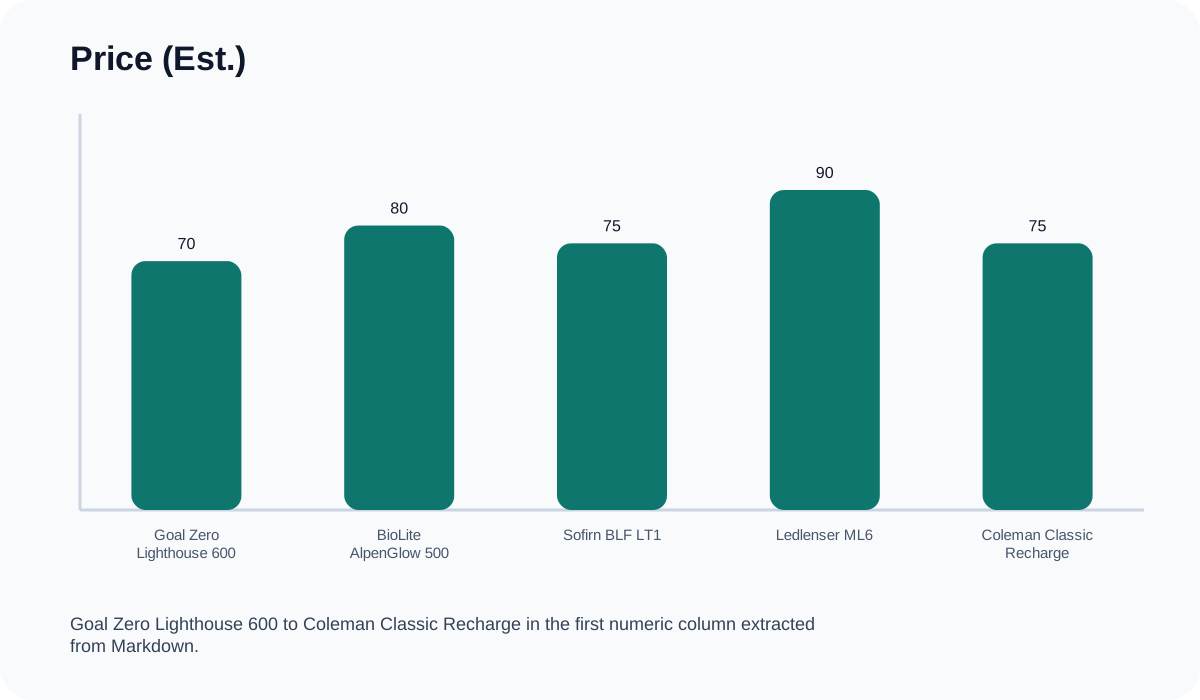
The following table evaluates five leading rechargeable lanterns based on price, light output, runtime, and water resistance capabilities.
| Model | Price (Est.) | Lumens | Max Runtime | IP Rating |
|---|---|---|---|---|
| Goal Zero Lighthouse 600 | $70 | 600 | 180h | IPX4 |
| BioLite AlpenGlow 500 | $80 | 500 | 200h | IPX4 |
| Sofirn BLF LT1 | $75 | 600 | 150h | IPX7 |
| Ledlenser ML6 | $90 | 750 | 200h | IP66 |
| Coleman Classic Recharge | $75 | 800 | 6h (High) | IPX4 |
Value Analysis: Brightness to Dollar Ratio
When optimizing for family camping budgets, peak brightness per dollar is a standard metric. However, raw output must be weighed against durability and light quality.
Note: Coleman provides the highest raw brightness value (10.67 Lm/) offsets lower lumen-per-dollar efficiency with higher color quality and extended runtimes.
Key Performance Analysis
Battery Runtime & Charging Infrastructure
Modern top-tier models prioritize efficiency over sheer brightness. Both the BioLite AlpenGlow 500 and Ledlenser ML6 achieve up to 200 hours of continuous lighting on their lowest settings.
USB-C has established itself as the baseline charging standard for 2026. However, emergency preparedness for family campsites makes “Dual Fuel” capability highly advantageous. Models like the Black Diamond Apollo feature a hybrid power system, accepting both internal rechargeable batteries and standard AA batteries as a backup, ensuring continuous illumination even during prolonged power outages.
Overcoming Common User Pain Points
Consumer reporting indicates three primary points of friction with rechargeable LED lanterns:
- Harsh Glare: Blinding light dispersion is the most frequent complaint. Users achieve the best results with models utilizing frosted globes or high-CRI (Color Rendering Index) warm LEDs to diffuse light and reduce eye strain.
- Vampire Drain: Parasitic battery drain during off-season storage frequently leaves families with dead lanterns upon arriving at the campsite.
- Hardware Fragility: Exposed or poorly sealed charging ports are common points of failure, necessitating careful review of a lantern’s weather sealing.
Safety & Durability for Families
For environments with children, thermal management and material safety are paramount. LED technology naturally provides cool-touch surfaces, eliminating the burn risks traditionally associated with gas-powered lanterns.
Durability standards vary significantly across the segment:
- Waterproofing: Ratings range from IPX4 (splash-resistant, found in the Goal Zero and Coleman models) up to IP66 (protection against high-pressure water jets, as seen in the Ledlenser ML6).
- Impact Resistance: Shatterproof globes are essential to prevent cuts from broken glass.
- Material Safety: Sourcing lanterns built with BPA-free plastics significantly reduces chemical exposure risks.
Family Camping Lantern Checklist
Before purchasing a lantern for your family site, verify the following specifications:
- Output: Is the maximum output between 500 and 800 lumens?
- Diffusion: Does it feature a frosted globe or warm-light (high-CRI) mode to prevent glare?
- Charging Protocol: Does it use a standardized USB-C port or offer alternative charging (solar/crank)?
- Runtime: Can it provide at least 150 hours of illumination on its lowest setting?
- Safety: Is the housing constructed from BPA-free, shatterproof plastic?
- Weather Resistance: Does it hold a minimum IPX4 rating?
Final Verdict
For maximum off-grid reliability and robust weatherproofing, the Ledlenser ML6 (IP66 rating, 200h runtime) justifies its 75, though its high-mode runtime is limited to an estimated 6 hours.