Best Rechargeable Lighters for Ultralight Hikers
Compare the top rechargeable plasma arc lighters for ultralight hikers in 2026, analyzing weight, battery runtime, and cold weather performance.
Executive Summary
Rechargeable plasma arc lighters are a highly reliable, sustainable fire-starting solution for ultralight hikers, particularly those navigating high altitudes and high-speed winds. Using high-voltage electricity to create an ionized arc, these fuel-free devices eliminate the oxygen density issues that commonly cause butane lighters to fail on alpine summits.
While specialized ultralight models weigh between 1.5 and 2.1 ounces—roughly four times heavier than a standard disposable lighter (e.g., Bic Mini)—they provide long-term efficiency for thru-hikers who already carry portable power banks. However, users must actively manage battery degradation in freezing temperatures and adapt to a narrower ignition surface area. Leading contenders in 2026 include the heavily ruggedized Survival Frog Tough Tesla 2.0 and the budget-friendly, USB-C equipped LCfun Waterproof Dual Arc.
Specifications and Performance Comparison
The following table breaks down the leading rechargeable lighters by weight, waterproofing, port type, and ignition capacity.
| Model | MSRP | Weight | Waterproof Rating | Port Type | Lights Per Charge |
|---|---|---|---|---|---|
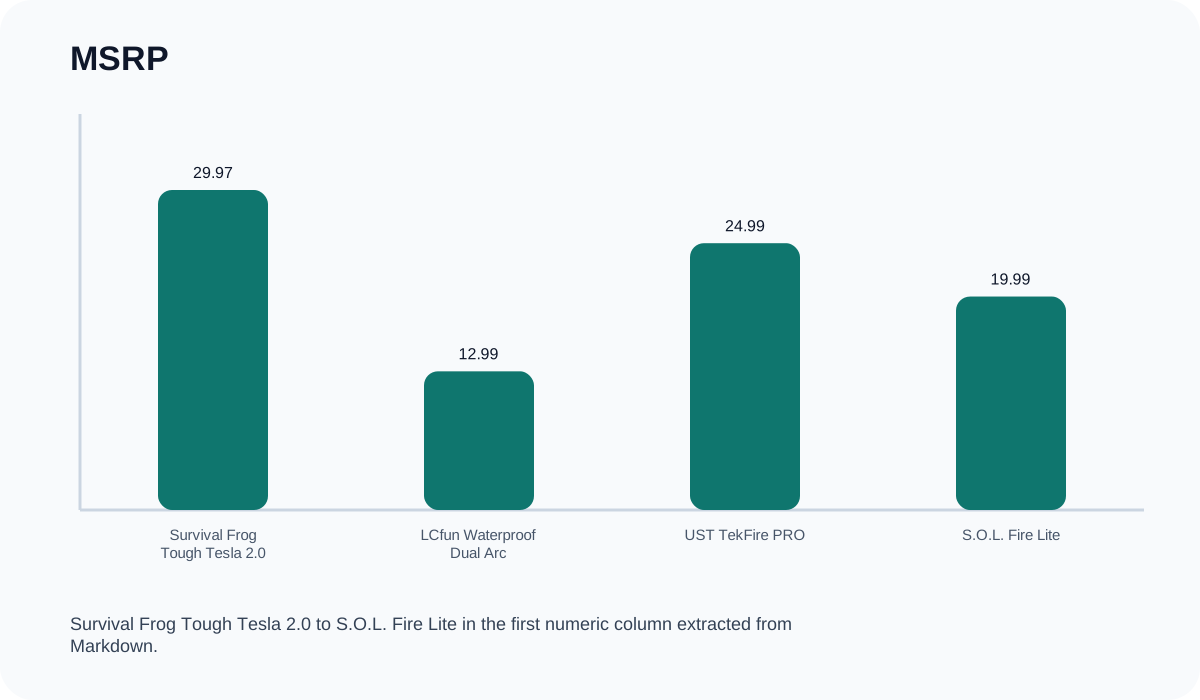
| Survival Frog Tough Tesla 2.0 | $29.97 | 1.8 oz | IP67 | Micro-USB | 300+ |
| LCfun Waterproof Dual Arc | $12.99 | 1.7 oz | IP56 | USB-C | 250 |
| UST TekFire PRO | $24.99 | 2.0 oz | IPX4 | Micro-USB | 250 |
| S.O.L. Fire Lite | $19.99 | 1.9 oz | Weather-Resistant | Micro-USB | 200 |
Weight vs. Capacity Analysis
Critical Analysis: Field Performance
Wind and Altitude Immunity
Traditional butane open-flame lighters struggle above specific elevations due to thin oxygen, and are easily blown out. Plasma lighters are entirely unaffected by oxygen density and high-speed winds. By generating a high-voltage electrical arc, they provide guaranteed ignition on exposed alpine summits where conventional fuel fails.
Cold Weather Limitations
The primary drawback of plasma lighters in the backcountry is cold sensitivity. The integrated lithium-ion batteries lose approximately 50% of their effective runtime in freezing conditions. Field Workaround: Hikers must keep the lighter in an internal pocket close to body heat during winter excursions to prevent rapid battery drain.
Usability Constraints
A recurring user pain point is the narrow “arc gap” between the lighter’s electrodes. Unlike a wide, open flame that can easily catch a flat surface, the tight spacing makes it difficult to ignite thick tinder bundles or larger sticks. Users must rely on fine, highly combustible tinder (like frayed cotton or thinly shaved fatwood) to ensure a quick catch.
Safety Considerations
Because plasma lighters output high voltage, manufacturers have built in several mandatory safety features:
- Automatic Shut-off: Most units automatically power down after 7 to 10 seconds of continuous use to prevent internal circuit damage and overheating.
- Locking Mechanisms: Top-tier models utilize a physical safety latch on the lid to prevent the button from being accidentally depressed inside a tightly packed backpack.
- Shock Hazard: Touching the active electrodes will deliver a painful, though non-lethal, electrical shock.
Final Verdict
For the strict ultralight hiker seeking maximum efficiency and modern charging standards, the LCfun Waterproof Dual Arc is the top recommendation. At just 1.7 ounces and $12.99, it is the lightest option tested and the only model featuring a modern USB-C port, streamlining cable management.
For hikers venturing into extremely wet or rugged environments where durability is paramount, the Survival Frog Tough Tesla 2.0 justifies its higher price ($29.97) and slight weight penalty (1.8 oz) with a superior IP67 waterproof rating and the highest capacity of 300+ lights per charge.
Backcountry Implementation Checklist
- Pack a Power Bank: Ensure your charging kit includes the correct cable (Micro-USB is still prevalent on many models; USB-C is becoming standard).
- Prepare Fine Tinder: Carry or prepare highly fibrous tinder that can fit within the narrow arc gap.
- Manage Thermal Output: In sub-freezing temperatures, move the lighter to a baselayer pocket 30 minutes prior to needing a fire.
- Engage Safeties: Always lock the lid clasp before returning the device to your pack to avoid accidental discharge and battery drain.