Best Rechargeable Safety Lights for Night Walking and Camps
Discover the top rechargeable safety lights of 2026 for night walking and camping. We compare lumens, IP ratings, battery runtime, and dual-fuel capabilities.
Executive Summary
The ideal rechargeable safety light for 2026 relies on USB-C connectivity, balanced weight distribution, and intuitive safety modes. For rugged basecamp needs, the Black Diamond Spot 400-R leads the pack with a fully submersible IP67 rating and a highly efficient 200-hour low-power runtime. For high-output trail navigation, the Petzl Swift LT delivers up to 1,100 lumens of peak brightness. Modern buyers should prioritize safety lights equipped with physical “lockout” features to prevent accidental battery drain, as well as “Dual Fuel” capabilities for those requiring emergency battery backups in remote off-grid environments.
Key Performance Comparisons
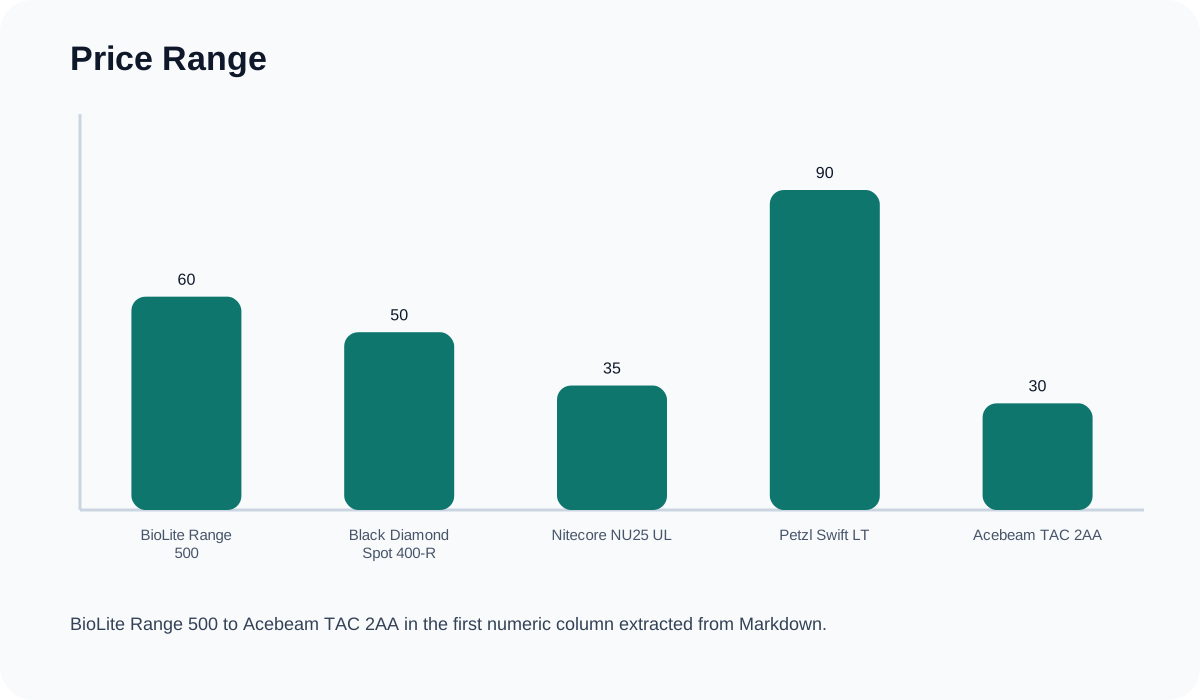
Safety Features and Specifications Table
| Product | Price Range | Waterproof Rating | Max Lumens | Charging Method | Key Safety Feature |
|---|---|---|---|---|---|
| BioLite Range 500 | 80 | IPX4 | 500 | USB-C | 360° Visibility Band |
| Black Diamond Spot 400-R | 65 | IP67 | 400 | USB-C | Lockout Mode |
| Nitecore NU25 UL | 45 | IP66 | 400 | USB-C | Red Light / SOS Mode |
| Petzl Swift LT | 110 | IPX4 | 1100 | USB-C | Reactive Lighting |
| Acebeam TAC 2AA | 50 | IP68 | 1600 | Dual Fuel (USB-C/AA) | Strobe / Signal Diffuser |
Battery Runtime Analysis
A critical pain point for campers is balancing high-output lumen modes with sustained battery life. The chart below quantifies the high-power versus low-power hour ratings for leading 2026 models.
Assessing the Data
While the Petzl Swift LT reaches an impressive 1,100 maximum lumens, it sacrifices high-power longevity, dropping to just 2 hours of peak runtime. Conversely, the Black Diamond Spot 400-R caps its maximum brightness at 400 lumens but extends its low-power utility to an estimated 200 hours. This makes the Spot 400-R substantially more efficient for extended, multiday basecamps where recharging options are limited.
Crucial Buying Considerations
1. Waterproofing: IPX4 vs. IP67
Entry-level models like the BioLite Range 500 and Petzl Swift LT feature IPX4 ratings, which protect against light splashes and drizzle. However, for unpredictable outdoor environments or rigorous trail running, IP67 or IPX8 (fully submersible) ratings are highly recommended. Models like the Black Diamond Spot 400-R and Acebeam TAC 2AA (IP68) ensure operational reliability even if dropped in streams or subjected to heavy downpours.
2. Dual Fuel and Charging Standards
USB-C has universally replaced Micro-USB in the 2026 market, speeding up charge times and reducing cable clutter. However, true redundancy relies on “Dual Fuel” architecture. Models like the Acebeam TAC 2AA allow users to swap standard AA batteries in when the internal or primary rechargeable pack depletes, providing a crucial fail-safe in emergencies.
3. Ergonomics and Interface Complexity
A prevalent user complaint involves overly complex, single-button multi-mode interfaces. Professional-grade lights increasingly mitigate this by using dedicated, separate buttons for spotlight, floodlight, and red-light functions. Furthermore, proper weight distribution—such as integrating rear-mounted battery packs—substantially reduces the “bounce” effect during night walks compared to front-heavy alternatives.
4. Night Vision and Lockout Modes
Red-light modes are essential for preserving night vision around a campfire and deterring wildlife. Additionally, physical lockout modes prevent the device from turning on inside a backpack, which remains a leading cause of dead batteries upon reaching a campsite.
Final Verdict
For general night walking and basecamp activities, the Black Diamond Spot 400-R offers the best overall balance of price (65), environmental durability (IP67), and battery efficiency (up to 200 hours). If absolute maximum visibility is required, the Acebeam TAC 2AA delivers up to 1,600 lumens alongside an industry-leading IP68 rating and versatile Dual Fuel charging.
Buyer’s Checklist
- Check the IP Rating: Ensure at least an IPX4 rating for dry climates, and demand IP67 or IP68 for wet environments and water crossings.
- Verify the Interface: Look for independent buttons controlling flood and red-light modes to avoid cycling through blinding white light in the dark.
- Test the Lockout: A physical lockout switch is mandatory to prevent accidental transit drain in your pack.
- Assess the Weight Distribution: Opt for rear-mounted battery packs if you plan to walk, hike, or run for prolonged periods to minimize bounce.