Best Rugged Power Banks for Wet and Dusty Trails
Discover the top rugged power banks for 2026. Compare IP67/IP68 ratings, weight-to-power efficiency, and real battery runtimes for extreme environments.
Executive Summary
As of mid-2026, the rugged power bank market for backcountry use is divided into two distinct categories: ultralight carbon-fiber models for fastpacking and heavy-duty, submersible shells for extreme wet and dusty conditions.
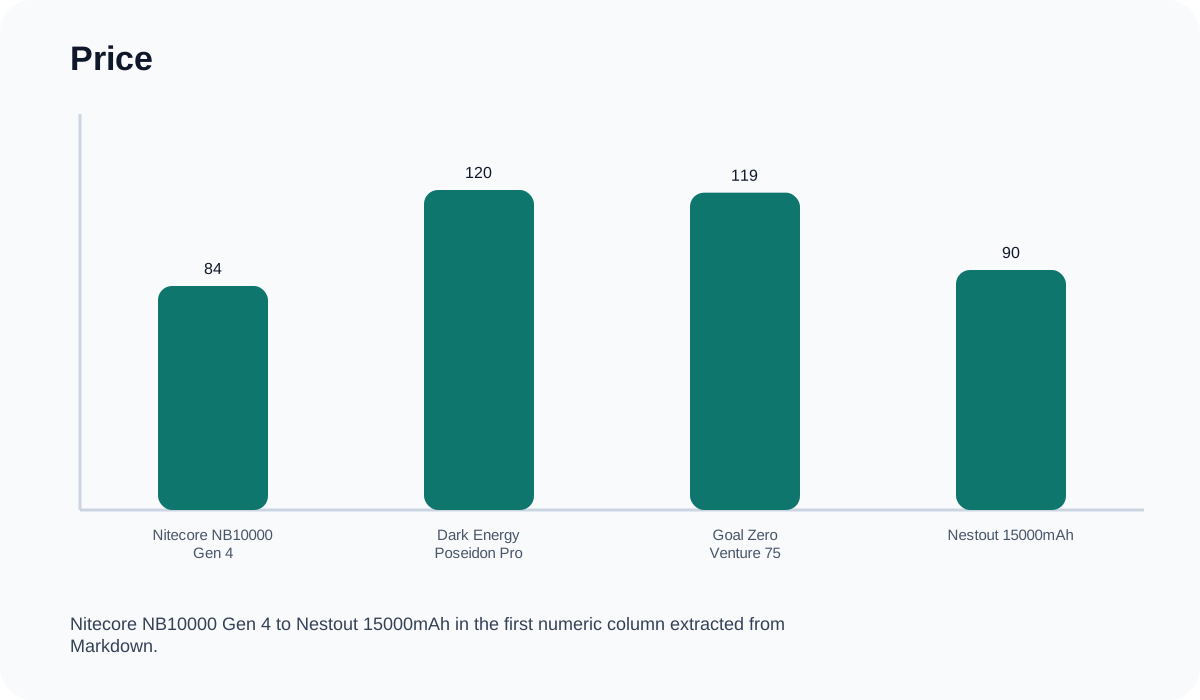
For maximum environmental protection, the Dark Energy Poseidon Pro (119) lead the pack with robust IP67/IP68 ratings capable of surviving deep river crossings and heavy dust. For hikers prioritizing weight, the Nitecore NB10000 Gen 4 ($84) dominates the weight-to-power efficiency segment. Real-world testing reveals that USB-C Power Delivery (PD) is critical for fast trail town resupplies, while integrated solar panels remain largely ineffective for primary charging.
Rugged Power Bank Comparison (2026 Models)
| Product | Price | Capacity | IP Rating | Weight |
|---|---|---|---|---|
| Nitecore NB10000 Gen 4 | $84 | 10,000 mAh | IPX5 | 150g |
| Dark Energy Poseidon Pro | $120 | 10,200 mAh | IP68 | 272g |
| Goal Zero Venture 75 | $119 | 19,200 mAh | IP67 | 577g |
| Nestout 15000mAh | $90 | 15,000 mAh | IP67 | 360g |
Trail Efficiency: Capacity vs. Weight
When packing for distance, every gram counts. The chart below illustrates the trail efficiency of leading power banks, measured in milliampere-hours (mAh) per gram. Higher values indicate better portability.
Critical Analysis for Trail Operations
Waterproof & Dustproof Standards
An IP67 rating (submersible to 1 meter for 30 minutes) is the strict baseline for any gear claiming to be “rugged.” However, for deep-trail environments featuring frequent river crossings or torrential monsoon conditions, IP68 is preferred. The Dark Energy Poseidon Pro achieves this standard, offering superior peace of mind. Note that the Nitecore NB10000 Gen 4, while exceptionally light, only carries an IPX5 rating (water-resistant against jets, not submersible), requiring a dedicated dry bag for wet conditions.
Battery Runtime & Actual Efficiency
A standard 10,000mAh bank is sufficient for a 2-3 day trip, effectively recharging smartphones, headlamps, and arc lighters. For expeditions lasting 5+ days, a 20,000mAh unit is required.
Buyers must account for circuit efficiency loss. Actual efficiency—the usable energy delivered to your devices versus the stored capacity—typically ranges from 70% to 82%, depending on the internal circuitry quality. Therefore, a 10,000mAh battery realistically delivers roughly 7,000 to 8,200mAh to your devices.
Charging Methods: USB-C PD vs. Solar
To minimize time spent at electrical outlets in trail towns, high-wattage USB-C Power Delivery (PD) at 18W to 45W is essential. This allows a fully depleted bank to recharge in hours rather than days.
Integrated solar panels on budget power banks are heavily critiqued by users. Charging a high-capacity power bank via a built-in panel often requires 40+ hours of direct sunlight. Solar should only be viewed as a trickle-charge “insurance policy” unless you are deploying external, foldable panels rated at 20W or higher.
Safety and User Pain Points
- Temperature Failures: Standard Lithium-ion (Li-ion) power banks reliably fail below 32°F (0°C) or above 95°F (35°C). For extreme temperatures, Lithium Iron Phosphate (LiFePO4) chemistries are emerging for better thermal stability, though they add significant weight.
- Port Cover Degradation: The leading cause of water ingress and device failure on the trail is the degradation or snapping of rubber port covers. Maintaining these seals is critical for true IP67/IP68 performance.
Final Verdict
If deep water and heavy dust are guaranteed, the Dark Energy Poseidon Pro is the most reliable, fully submersible option on the market. If you are fastpacking and actively counting grams, the Nitecore NB10000 Gen 4 provides unmatched efficiency, provided you store it in a protective dry bag during heavy storms.
Trail Buyer’s Checklist
- Verify the IP Rating: Ensure a minimum of IP67 if you anticipate rain or river crossings.
- Check the Input Wattage: Confirm the device accepts at least 18W USB-C PD for rapid recharging.
- Inspect Port Covers: Ensure rubberized covers are thick and securely attached to the chassis.
- Calculate Real Capacity: Multiply the stated mAh by 0.75 (estimated efficiency) to know your true charging allowance.
- Skip Built-In Solar: Save weight and money by avoiding units with integrated solar panels unless you also carry dedicated external arrays.