Best Small Electronics for a Lightweight Survival Belt Kit
Optimize your survival belt kit with 2026's ultra-lightweight electronics, featuring top satellite communicators, carbon fiber power banks, and battery safety.
Executive Summary
Modern survival belt kits in 2026 have abandoned heavy hand-crank devices and alkaline batteries in favor of ultra-lightweight carbon fiber shells, satellite-to-phone messaging, and universal USB-C standard charging. For belt-mounted kits where every gram matters, the ideal electronics loadout focuses on high-capacity power banks under 150g and satellite communicators offering over 14 days of tracking runtime.
The current gold standard for portable power is the Nitecore NB10000 Gen 3, while the Garmin inReach Mini 3 Plus dominates satellite communication. However, buyers face notable pain points, primarily regarding subscription-locked features and the inability to repair sealed lithium-ion units in the field.
Leading Survival Electronics for 2026
1. Satellite Communication: Dedicated vs. Integrated
The satellite communication market has split into two primary tiers: dedicated SOS devices and phone-integrated satellite messaging (e.g., T-Mobile T-Satellite). For survival belt kits, dedicated devices remain superior.
- Garmin inReach Mini 3 Plus: Weighing just 3.5 oz (approx. 99.2g), this device offers 14+ days of runtime at a 10-minute tracking interval. It features a dedicated SOS button and performs reliably in extreme cold. At a price range of 400 (averaging $399), it is the most critical component of a modern kit.
- ACR ResQLink 400: For strict emergency signaling without two-way messaging, this 5.2 oz device provides 24+ hours of active runtime with an IP67 waterproof rating.
2. Portable Power: The Carbon Fiber Shift
Traditional plastic power banks are too heavy for belt kits. The trend in 2026 heavily favors power-to-weight efficiency.
- Nitecore NB10000 Gen 3: Delivering 10,000 mAh at only 150g (5.3 oz), its carbon fiber frame offers an unmatched power-to-weight ratio. It features an IPX5 rating and costs between 75.
3. Lighting and Signaling
Micro-flashlights have achieved massive lumen outputs in sub-ounce packages.
- Nitecore TINI 2: Weighing an incredible 0.66 oz (18.8g), it provides 1 to 60 hours of runtime and carries an IP54 rating.
- RovyVon Aurora A8: Noted for its emergency UV and signaling capabilities at just 17.5g.
Capability and Specification Comparison
| Category | Product | Weight (oz) | Waterproof Rating | Runtime | Price Range |
|---|---|---|---|---|---|
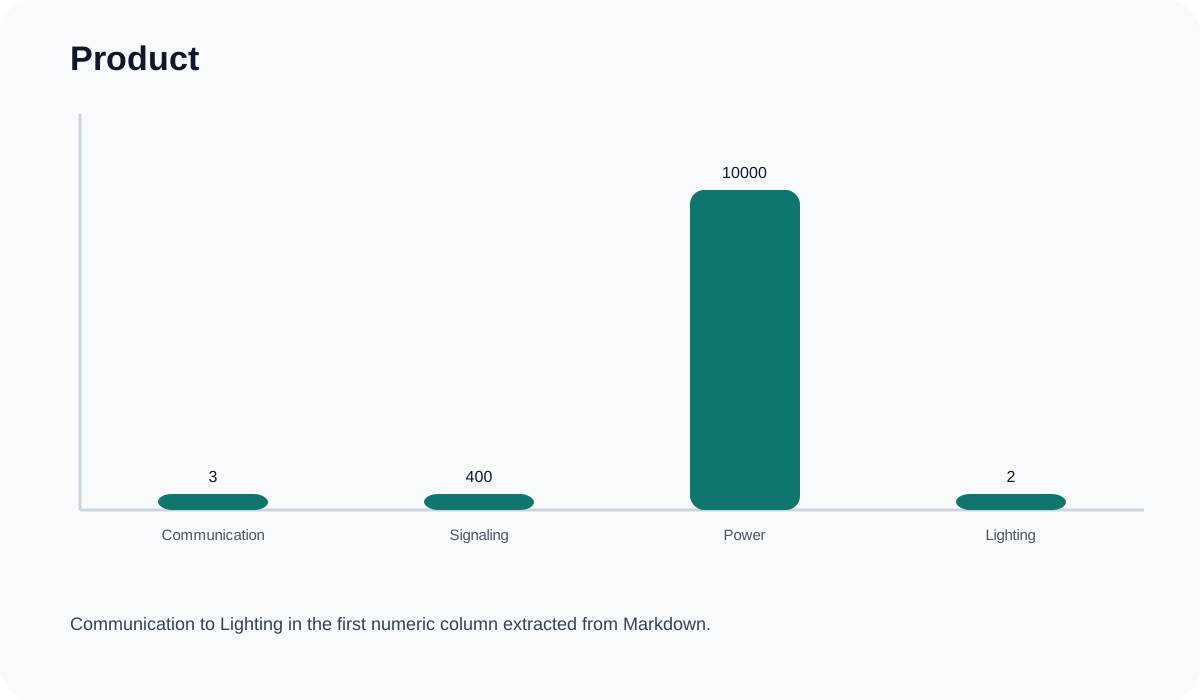
| Communication | Garmin inReach Mini 3 Plus | 3.5 oz | IPX7 | 14+ Days (10m tracking) | 400 |
| Signaling | ACR ResQLink 400 | 5.2 oz | IP67 | 24+ Hours (Active) | 360 |
| Power | Nitecore NB10000 Gen 3 | 5.3 oz | IPX5 | 10,000 mAh | 75 |
| Lighting | Nitecore TINI 2 | 0.66 oz | IP54 | 1 - 60 Hours | 45 |
Performance vs. Weight Analysis
When building a belt kit, items must justify their weight through high survival utility.
(Note: Folding solar panels, such as the Blavor Solar Power Bank, generally provide too little benefit for their weight in minimalist belt kits compared to high-density power banks.)
Real User Pain Points & Safety Considerations
USB-C Standardization vs. Proprietary Cables
USB-C has successfully become the universal charging standard. However, proprietary magnetic charging systems (such as those used by Olight, including models like the Warrior 3S) remain a frequent user pain point for those seeking a minimalist, “one-cable” system in the wilderness.
Waterproofing Vulnerabilities
While flashlights are shifting toward IP68 (capable of continuous submersion), power banks like the NB10000 Gen 3 typically max out at IPX5 or IPX6. This is sufficient for heavy rain, but highly vulnerable if the wearer is fully submerged during a water crossing.
Thermal Runaway Risks
Carrying high-density lithium batteries on a belt places them dangerously close to the body. The primary safety concern is “thermal runaway.” Strict mitigation protocols include using hard-case storage for spare cells and conducting routine inspections for any physical battery swelling.
Final Verdict
For a 2026 ultra-lightweight survival belt kit, the data clearly supports a three-piece electronic loadout: the Garmin inReach Mini 3 Plus for lifesaving communication, the Nitecore NB10000 Gen 3 for critical power reserves, and the Nitecore TINI 2 for primary illumination. This combination provides maximum utility for well under a pound of total weight. Avoid folding solar setups, which offer low utility-to-weight ratios in belt applications.
Pre-Deployment Electronics Checklist
- Standardize Cables: Verify all devices utilize USB-C to eliminate redundant cables.
- Inspect Batteries: Physically check all power banks and flashlights for swelling to prevent thermal runaway.
- Confirm Subscriptions: Ensure satellite messenger subscriptions are active, as features are tightly locked behind paywalls.
- Check Waterproofing: Address IPX5 vulnerabilities by placing power banks inside a secondary waterproof bag if deep water crossings are anticipated.
Trustworthy Sources
- Ultralight, Ultra-Performance Backcountry Electronics (backpackinglight.com/ultralight-backcountry-electronics-revised-2024/) - Provides rigorous weight-to-performance testing for micro-electronics in outdoor survival contexts.
- Best Satellite Communicators of 2026 (outdoorgearlab.com/topics/camping-and-hiking/best-satellite-messenger) - Details the latest 2026 models and subscription cost analysis which is a major user pain point.
- Lithium Battery Safety Checklist (survivalsolutions.com.au/lithium-battery-safety/) - Outlines critical safety guidelines regarding carrying high-energy density cells on a belt.