Best Solar Panels for Recharging Power Banks in Cloudy Conditions
Maximize off-grid power under overcast skies. Discover the top CIGS and monocrystalline solar panels for charging power banks in low-light conditions.
Executive Summary
Charging power banks and electronics under overcast skies is historically challenging, but modern cell chemistry and intelligent circuitry have significantly improved low-light performance. Successful solar charging in cloudy conditions requires either high-efficiency monocrystalline cells (reaching up to 25.4% efficiency) or CIGS (Copper Indium Gallium Selenide) thin-film technology, which operates 10-15% more effectively in low-light than standard flexible panels.
Crucially, cloudy weather charging demands Auto-Restart functionality. Without this feature, a passing cloud drops the voltage, and the power bank may stall in an “idle” non-charging state. While full overcast skies reduce total output to an estimated 18% of the panel’s rated capacity, utilizing a power bank as a buffer prevents inconsistent direct-to-device power fluctuations.
Solar Output Yield by Weather Condition
The following chart illustrates the approximate percentage of rated power output you can expect from portable solar panels based on real-world irradiance drops.
Top Solar Panels for Cloudy Conditions
Based on empirical field testing and cell chemistry data, here are the leading portable panels evaluated for low-light capabilities, durability, and cost.
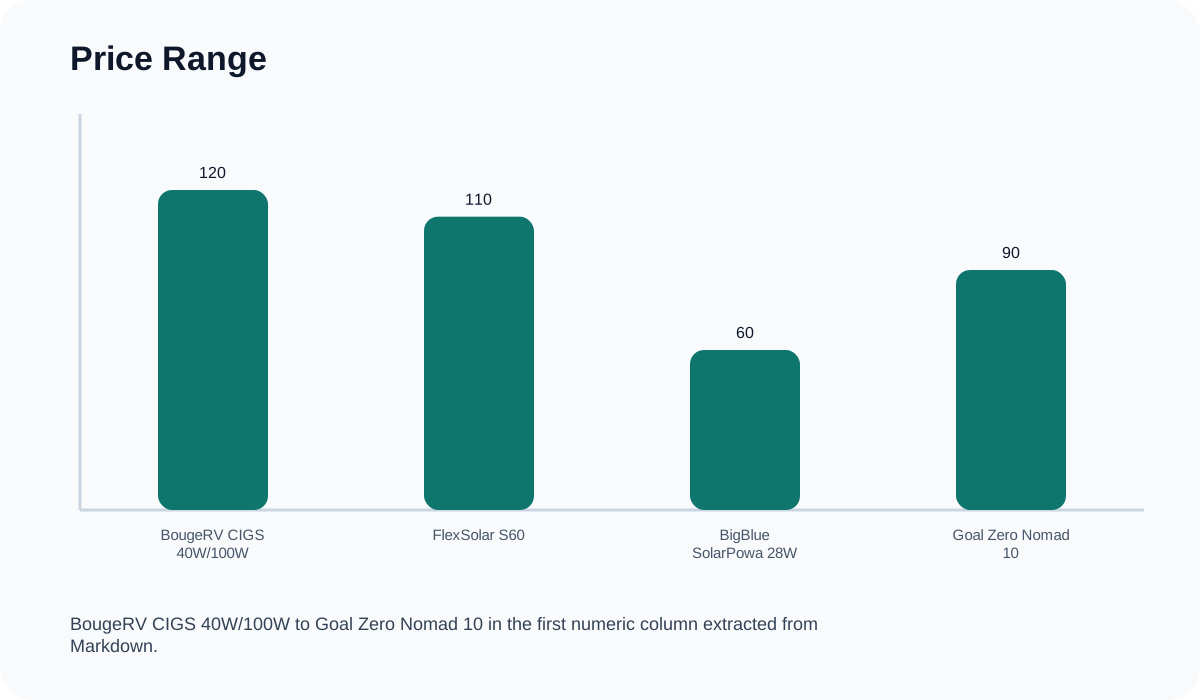
| Product | Cell Type | Price Range | Waterproof Rating | Cloudy Performance |
|---|---|---|---|---|
| BougeRV CIGS 40W/100W | CIGS Thin-Film | 190 | IP68 (Submersible) | Superior (High Shade Tolerance) |
| FlexSolar S60 | Monocrystalline (BC) | 130 | IP67 (Dust/Waterproof) | High (PD 3.0 Support) |
| BigBlue SolarPowa 28W | Monocrystalline (SunPower) | 80 | IPX4 (Splash-resistant) | High (25.4% Efficiency) |
| Goal Zero Nomad 10 | Monocrystalline | 110 | IPX4 (Ruggedized) | Medium (Reliable build) |
Technical Analysis of Top Performers
The CIGS Advantage: BougeRV
CIGS (Copper Indium Gallium Selenide) technology is uniquely suited for cloudy conditions. Because it utilizes a wider spectrum of light compared to traditional silicon, CIGS panels are 10-15% more effective in shaded and overcast environments. The BougeRV CIGS line also boasts an IP68 waterproof rating, making it highly resilient to sudden rain showers that accompany cloudy weather.
Monocrystalline Efficiency: BigBlue and FlexSolar
For limited-surface portable chargers, energy density is paramount. Panels utilizing SunPower or Back-Contact (BC) silicon—such as the BigBlue SolarPowa 28W and FlexSolar S60—can achieve conversion efficiencies up to 25.4%. While they lack the broad-spectrum advantage of CIGS, their sheer high-density baseline ensures they capture as much ambient light as physically possible.
Overcoming User Pain Points in Low-Light
Charging in cloudy weather introduces unique operational challenges that users must navigate to prevent battery drain and equipment frustration.
- Restart Anxiety & Battery Drain: As clouds pass, voltage drops and spikes can cause devices to repeatedly make a “ding” charging sound. This screen wake-up cycle can actually drain your smartphone battery faster than the panel can charge it. This is why utilizing a power bank as an intermediary buffer is universally recommended by experts.
- Overstated Wattage Reality: Real-world output rarely matches laboratory ratings. A panel marketed as 28W often peaks at 15-18W under perfect, direct sunlight. When heavy clouds roll in—representing up to a 90% drop in solar irradiance—output will drop proportionally. Adjusting expectations is vital; “bright” clouds can deceive human eyes into overestimating available solar energy.
- Smart Chip Conflicts: Some high-end power banks (such as certain Anker models) incorporate advanced safety chips that deliberately reject the low-current inputs typical of overcast days. Ensure your target power bank is capable of accepting a trickle charge.
Safety Considerations for Overcast Solar Charging
- Waterproofing Limitations: Even if a panel like the BougeRV is rated IP68 (submersible) or the FlexSolar is IP67, USB ports are rarely waterproof. You must keep the physical cable connections in a dry pouch to prevent rapid corrosion.
- Heat Management: Cloud cover does not stop a solar panel from generating heat. Ensure the power bank is stored completely in the shade (often tucked under the panel itself) to prevent catastrophic lithium battery degradation.
- Voltage Spikes: If you are chaining multiple panels in series, be cautious of “variable” clouds. Sudden transitions from full overcast to bright direct sunlight can cause rapid voltage spikes. Never exceed the Maximum Input Voltage (Voc) of your power bank.
Final Verdict
For the absolute best performance under heavy cloud cover, the BougeRV CIGS Flexible Panel is the premier choice due to its broad-spectrum thin-film technology and superior shade tolerance. For backpackers prioritizing a blend of price and high-density efficiency, the BigBlue SolarPowa 28W remains a highly capable, cost-effective monocrystalline alternative. In all cases, selecting a panel with Auto-Restart logic and charging an intermediary power bank rather than a direct-to-device connection is essential for success.
Cloudy Day Solar Charging Checklist
- Verify your panel includes an Auto-Restart feature.
- Always charge a power bank first, not your smartphone directly.
- Ensure your power bank accepts low-current trickle charges.
- Protect USB ports and connections from rain, regardless of panel IP rating.
- Keep the charging power bank shaded beneath the solar panel to minimize heat exposure.