Best Survival Electronics for Boat and Shore Emergency Kits
Equip your boat and shore emergency kits with top-rated PLBs, satellite messengers, VHF radios, and waterproof power banks. Compare specs and 5-year TCO.
Executive Summary
Building a fail-proof survival kit for marine and coastal environments requires a strategic mix of emergency beacons, two-way communicators, and resilient power solutions.
For high-stakes offshore or backcountry rescue, the ACR ResQLink AIS (Personal Locator Beacon) is the top choice due to its subscription-free, global Cospas-Sarsat satellite connection. For users needing ongoing two-way communication, the Garmin inReach Mini 2 leads the satellite messenger category, offering up to 30 days of battery life at the cost of a monthly service fee. On the water, a floating handheld VHF radio with GPS, such as the Standard Horizon HX890, is a non-negotiable requirement for immediate line-of-sight distress signaling.
Success in these environments hinges on selecting IPX7 or IPX8 waterproof devices and maintaining strict battery and registration protocols.
Emergency Electronics Comparison: Boat vs. Shore Utility
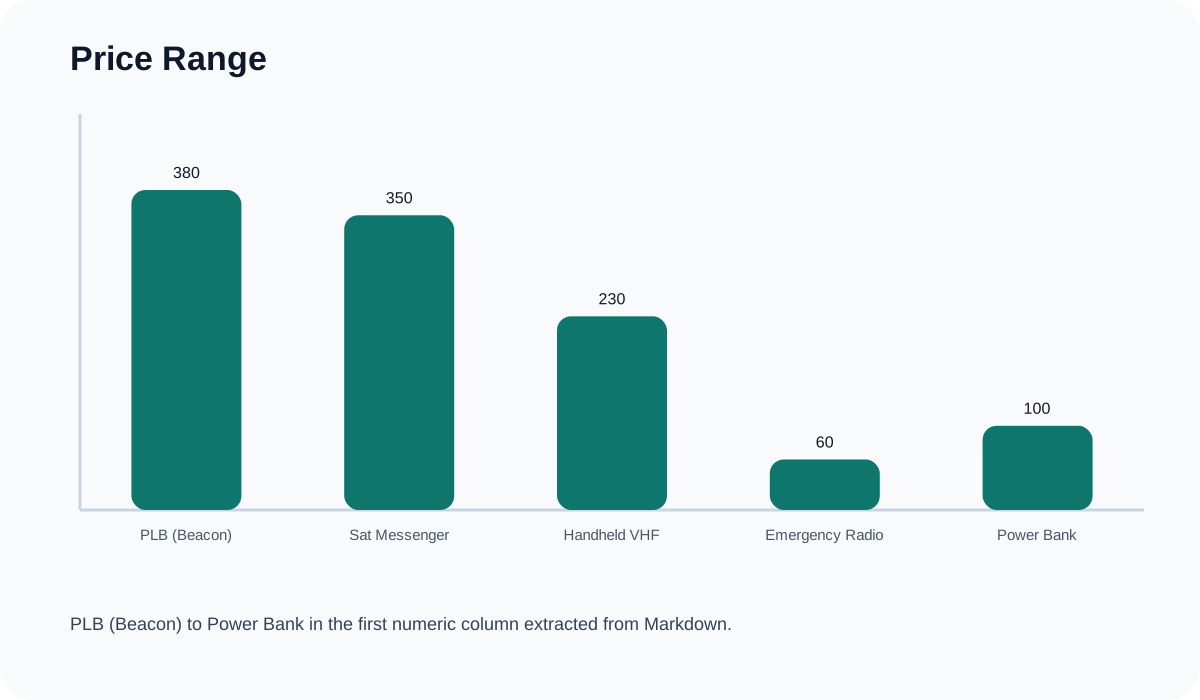
The table below outlines the top electronics categorized by their primary survival function, waterproof rating, and estimated battery runtimes.
| Product Category | Top Pick | Price Range | Waterproof Rating | Battery Runtime | Primary Use Case |
|---|---|---|---|---|---|
| PLB (Beacon) | ACR ResQLink AIS | 450 | IPX8 / Floating | 24+ Hours (Active) | Global SOS (Boat/Shore) |
| Sat Messenger | Garmin inReach Mini 2 | 400 | IPX7 | 14 - 30 Days | 2-Way Comms (Shore/Backcountry) |
| Handheld VHF | Standard Horizon HX890 | 280 | IPX8 / Floating | 11 - 20 Hours | Line-of-Sight Comms (Boat) |
| Emergency Radio | Midland ER310PRO | 90 | Water-Resistant | 32 Hours | Weather Monitoring (Shore) |
| Power Bank | Goal Zero Venture 75 | 130 | IP67 | 19,200 mAh | Device Recharging (Both) |
PLBs vs. Satellite Messengers: Understanding the Trade-Offs
The most critical decision for any survival kit is how you will signal for help if things go wrong.
- Personal Locator Beacons (PLBs): Devices like the ACR ResQLink utilize the government-funded 406 MHz Cospas-Sarsat network. They feature a high initial cost but zero subscription fees. Their batteries are designed to push a continuous, high-wattage distress signal for 24 to 48 hours.
- Satellite Messengers (SEND): Devices like the Garmin inReach Mini 2 rely on private networks (like Iridium). While they allow you to text emergency services and loved ones, they require active monthly subscriptions. Battery life is vastly superior for tracking (up to 30 days in 10-minute power-save mode), but ownership costs compound over time.
5-Year Total Cost of Ownership (TCO) Analysis
To highlight the financial differences, we calculated the 5-year TCO for leading emergency devices. (Note: Garmin subscription fees are estimated at a base safety plan rate of ~$15/month over 60 months).
Power and Short-Range Communication
Marine-Grade VHF Radios
For immediate, localized distress on the water, a handheld VHF radio is mandatory. The Standard Horizon HX890 and ICOM M25 dominate this space. Look for Digital Selective Calling (DSC) and integrated GPS. If you fall overboard, an IPX8 floating VHF allows you to hail nearby vessels—a function satellite devices cannot perform.
Shore-Focused Power Banks and Radios
Survival electronics are useless without power. Marine electronics prioritize buoyancy, but shore kits must prioritize energy density (mAh per ounce) and impact resistance. The Goal Zero Venture 75 provides 19,200 mAh within a rugged, IP67-rated shell, capable of recharging a sat messenger or VHF radio multiple times. Pair this with a dedicated NOAA weather receiver like the Midland ER310PRO (which offers up to 32 hours of runtime) to monitor incoming coastal storms.
Real-World Pain Points & Safety Considerations
Research and real-world testing reveal several critical points of failure users must plan for:
- Hidden Costs: As shown in the chart above, satellite messengers carry ongoing financial burdens. A lapsed subscription means a dead device during an emergency.
- Complex Interfaces in Wet Conditions: Touchscreens fail when wet. Devices with tactile, physical buttons are superior when operating with cold, wet hands or wearing thick neoprene gloves.
- Signal Obstruction: Satellite messengers can lose signal in deep canyons, heavy coastal canopy, or rough seas. PLBs, pushing a stronger signal to a different satellite constellation, generally penetrate adverse conditions more reliably.
- Regulatory Registration: Purchasing a PLB is only step one. By law, all PLBs and EPIRBs must be registered with NOAA (in the U.S.) or the respective national authority. Unregistered devices delay rescue, as responders will not have your vessel or emergency contact details.
Final Verdict
If you are operating heavily offshore or in remote coastal waters where rescue may take days, carry a PLB (ACR ResQLink AIS) attached to your life vest, and keep an IPX8 VHF radio (Standard Horizon HX890) on your belt.
If your shore excursions take you into backcountry areas where you need to coordinate pickups or check in with family, the Garmin inReach Mini 2 combined with a robust Goal Zero Venture 75 power bank is the optimal pairing.
Survival Electronics Maintenance Checklist
- Check Expiration Dates: Verify PLB battery expiration dates annually (typically 5-year lifespans).
- Test VHF Batteries: Fully cycle and test VHF radio batteries before every major boating season.
- Update Registrations: Log into the NOAA beacon registration database to ensure your contact and vessel info is current.
- Verify Subscriptions: Confirm your satellite messenger payment plan is active before leaving cellular range.
- Inspect Seals: Check the rubber gaskets on power banks and radios for dry rot to ensure IPX7/IPX8 integrity.