Best Survival Electronics for Hunters and Backcountry Anglers (2026)
Discover the top backcountry survival electronics of 2026. Compare Garmin, Zoleo, and ACR devices based on runtime, IP ratings, and cold-weather performance limits.
Executive Summary
The 2025-2026 product cycle has redefined backcountry survival electronics, shifting the market strictly toward USB-C rechargeable ecosystems and advanced standalone messaging capability. The Garmin inReach Mini 3 Plus and Messenger Plus currently lead the pack, offering 1,600-character text and voice memo capabilities via the Iridium satellite network.
However, technology is only as good as its power source. Hunters and anglers face a critical challenge: cold-weather environments can degrade battery capacity by up to 50% in sub-zero conditions. Real-world backcountry safety now requires a combined strategy featuring a primary satellite communicator, a standalone PLB (Personal Locator Beacon) for redundancy, and ruggedized power banks like the Nitecore NB series.
Top Survival Electronics Specification Comparison
When evaluating survival tech, weight, waterproof rating, and functional autonomy are the most critical metrics for backcountry users.
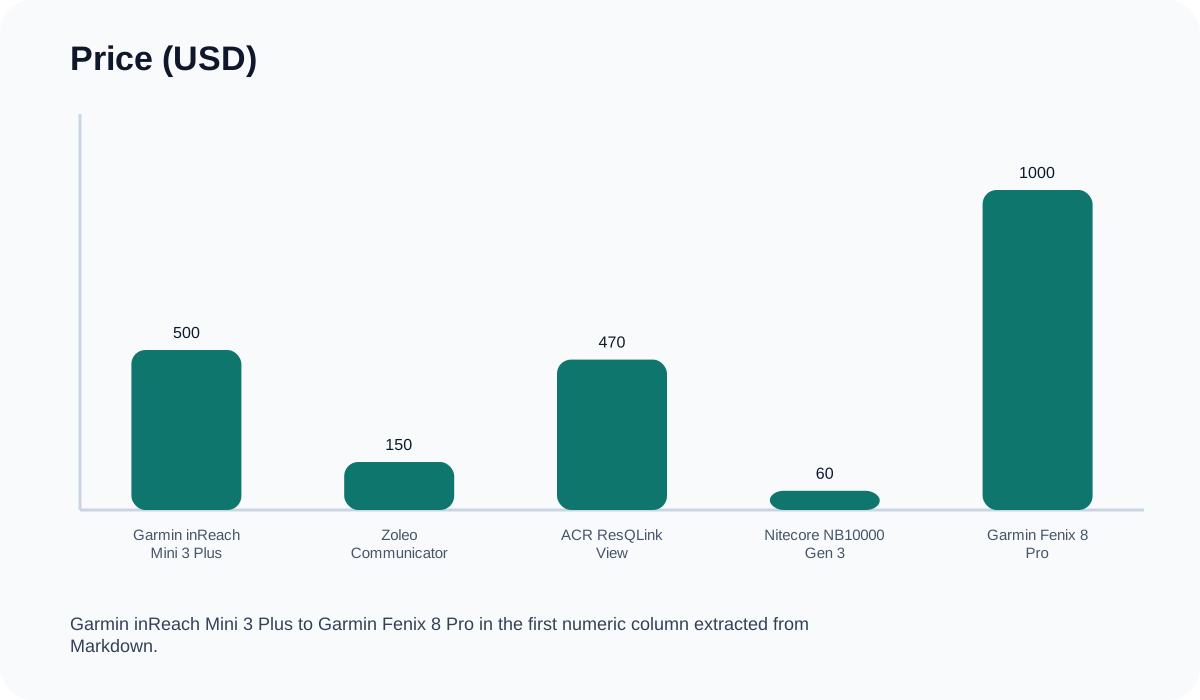
| Product | Category | Price (USD) | Waterproof Rating | Runtime/Battery |
|---|---|---|---|---|
| Garmin inReach Mini 3 Plus | Satellite Messenger | $500 | IPX7 | 14-15 Days (10m Tracking) |
| Zoleo Communicator | Budget Messenger | $150 | IP68 | 200+ Hours |
| ACR ResQLink View | PLB (No Sub) | $470 | IP68 / Buoyant | 24-Hour Active / 5-Year Shelf |
| Nitecore NB10000 Gen 3 | Power Bank | $60 | IPX5 | 10,000 mAh (2-3 Phone Charges) |
| Garmin Fenix 8 Pro | GPS Watch | $1,000 | 10 ATM | 15-28 Days (Smartwatch Mode) |
Device Weight vs. Functional Autonomy
The following chart highlights the trade-off between pack weight and the estimated days of functional autonomy in the field. (Note: The ACR ResQLink View is an anomaly representing a 5-year standby shelf life, while others represent active daily field use).
Critical Analysis: What Backcountry Users Need to Know
1. The “Messenger Plus” Shift Reduces Phone Dependency
Previous generations of satellite messengers suffered from extreme phone dependency. Budget models like the Zoleo Satellite Communicator ($150) remain highly reliant on a paired smartphone. If your phone’s battery dies or the screen cracks during a hunting incident, the Zoleo loses its full utility, creating a dangerous single point of failure.
The 2026 generation addresses this. The Garmin inReach Mini 3 Plus ($500) and Messenger Plus models now allow robust standalone features, including voice memos and 1,600-character messages directly over the Iridium Network. In an SOS event, the ability to relay specific injury details or complex terrain locations without a functioning phone drastically improves rescue outcomes.
2. Cold-Weather Battery Degradation is Substantial
While the industry has transitioned away from disposable batteries to ruggedized power banks (like the Nitecore NB10000 Gen 3) and high-efficiency 10W-28W solar panels, the cold remains the ultimate enemy of lithium-ion tech. Field data indicates that sub-zero hunting environments reduce effective battery capacity by up to 50%.
To counter this, anglers and hunters must adapt their power management:
- Keep critical electronics in interior chest pockets to utilize body heat.
- Employ dual-charging strategies (e.g., carrying a BioLite Charge 80 PD alongside solar).
3. Network Reliability: Iridium vs. Emerging NTNs
While NTN (Non-Terrestrial Network) and Starlink-to-cell technologies are rapidly closing the gap for casual hikers, the Iridium Satellite Network remains the undisputed gold standard. Because it provides true global pole-to-pole coverage, hunters in dense alpine cover and anglers in deep, remote canyons should stick to Iridium-backed devices (Garmin, Zoleo) to ensure their multi-band GNSS pings successfully punch through.
4. Subscription Fatigue vs. PLBs
A persistent real-world user pain point is the “subscription fatigue” associated with continuous satellite messenger service plans. For users who strictly want a final failsafe without monthly fees, the ACR ResQLink View ($470) is the optimal choice. It operates as a strict PLB (Personal Locator Beacon), requires no subscription, boasts an IP68 buoyant casing ideal for anglers, and holds a 5-year standby shelf life with a guaranteed 24-hour active transmission time.
Final Verdict
- Best Overall for Hunters: Garmin inReach Mini 3 Plus. At $500, its IPX7 rating, multi-band GNSS, and standalone voice-memo capabilities provide unmatched safety in dense, remote cover.
- Best for Anglers & Budget Safety: ACR ResQLink View. The buoyant, IP68 waterproof design and zero-subscription model make it perfect for marine environments.
- Best Power Bank for Electronics: Nitecore NB10000 Gen 3. At just 5.3 oz and $60, it delivers 2-3 full phone charges in an IPX5 water-resistant shell.
Backcountry Electronics Checklist
Before heading off-grid, verify these operational standards:
- Charge Integrity: Ensure devices are fully charged and power banks are kept close to body heat in cold weather (assume up to 50% capacity loss in sub-zero).
- Subscription Status: Verify that your satellite messenger plan (Garmin/Zoleo) is active. Suspended accounts will not send non-SOS messages.
- Firmware Update: Sync devices with desktop apps over Wi-Fi to update GNSS almanacs and firmware for faster satellite acquisition.
- Redundancy: If relying on a Zoleo, ensure your smartphone is in a rugged, waterproof case to prevent the single-point-of-failure risk.