Best Survival Gear Loadouts Built Around Rechargeable Tools
Discover the ultimate survival loadouts utilizing USB-C rechargeable tools, tiered solar architectures, and high-density lithium power stations.
Executive Summary
Modern survival loadouts have definitively shifted from legacy alkaline-dependent gear to high-density lithium-ion and LiFePO4 ecosystems. Driven by USB-C standardization and enhanced solar interoperability, the optimal survival kit relies on a tiered power architecture: a portable power station for base-camp replenishment, modular solar panels for off-grid mobility, and rugged, IP-rated peripherals.
While rechargeable tools deliver superior lumen-to-weight ratios and essentially infinite fuel via solar cycling, they introduce a critical vulnerability: the “Cold Weather Gap.” In sub-zero environments, lithium capacity drops by up to 50%, requiring strict thermal management to prevent permanent cell damage. By establishing a standardized USB-C loadout, survivalists can lower life cycle costs from over $100 annually in alkaline batteries to a minimal initial investment, ensuring long-term self-reliance.
The Standardized USB-C Survival Loadout
The most resilient survival kits eliminate proprietary charging cables (such as Olight’s magnetic systems) in favor of universal USB-C connectivity. Below is a blueprint for a tiered, rechargeable survival loadout.
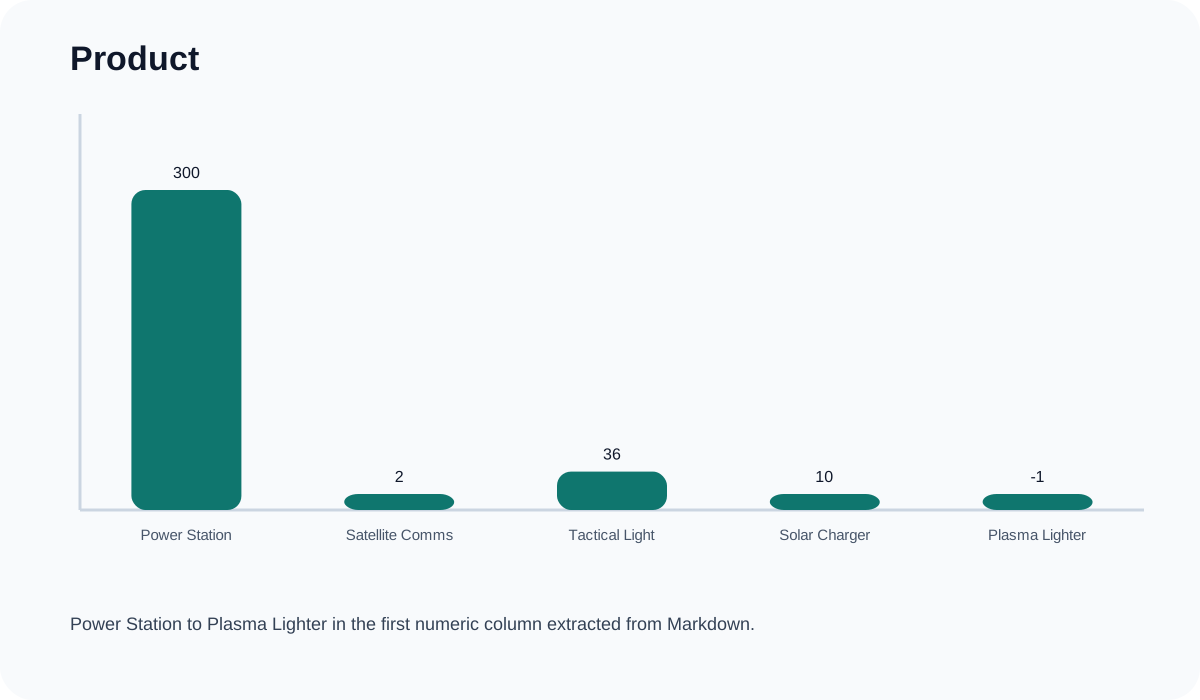
| Category | Product | Price Range | Waterproof Rating | Runtime / Capacity | Charge Method |
|---|---|---|---|---|---|
| Power Station | Jackery Explorer 300 Plus | 300 | None (Keep Dry) | 288Wh (Campsite scale) | USB-C, Solar, AC |
| Satellite Comms | Garmin inReach Mini 2 | 400 | IPX7 | 14-30 Days | USB-C |
| Tactical Light | Fenix PD36R Pro | 130 | IP68 (2m Submersion) | 2.8h (Turbo) to 42h (Low) | USB-C (Internal) |
| Solar Charger | BioLite SolarPanel 10+ | 120 | IPX4 (Splashproof) | Direct (3200mAh buffer) | Solar to USB-A |
| Plasma Lighter | LC-1 Waterproof Lighter | 30 | IP56 | 300+ Ignitions | USB-C |
Why Lithium and USB-C Dominate
The standardization of 21700 lithium cells has radically improved weight-to-power efficiency in field gear. A single 5000mAh 21700 cell can power a 2800-lumen tactical light for hours. Achieving this same lumen-to-runtime ratio previously required dozens of heavy, single-use AA batteries.
Furthermore, the financial advantage is measurable. The initial 100+ annual spend required to sustain an alkaline-based loadout, especially for high-drain devices like tactical flashlights and plasma lighters.
The Tiered Power Architecture
A resilient loadout relies on redundancy. The tiered approach ensures that no single point of failure leaves you without power:
- Base-Camp Replenishment (Macro): Utilizing a small power station like the Jackery Explorer 300 Plus (or alternatives from EcoFlow and Anker) provides a 288Wh central hub. This stores bulk energy gathered during peak daylight hours.
- Mobility Charging (Micro): For on-the-move charging, modular solar panels in the 10W-100W range bridge the gap. The BioLite SolarPanel 10+ offers an integrated 3200mAh buffer battery, allowing direct charging even when the sun dips behind clouds.
- End-Use Peripherals (Tactical): Critical gear like the Garmin inReach Mini 2, Fenix PD36R Pro, and the LC-1 Waterproof Lighter run off this stored power.
Note on Solar Efficiency: While modular solar charging is highly viable, real-world efficiency generally peaks at 60-70% of the manufacturer’s advertised wattage. For reliable winter recovery, it is necessary to oversize your solar panel array.
The “Cold Weather Gap” Vulnerability
The most significant failure point of a rechargeable loadout is cold weather. Lithium batteries experience an immediate 20-30% capacity drop at freezing temperatures (0°C).
Critical Cold Weather Mitigation
At -20°C, usable capacity plunges to 50%. More dangerously, attempting to charge a lithium cell in sub-zero conditions without pre-heating the battery can cause permanent damage through internal short circuits caused by “lithium plating.” Always keep portable chargers and power stations inside your jacket or sleeping bag to maintain a safe operating temperature prior to charging.
Final Verdict
Building your survival gear loadout around rechargeable USB-C tools is the most efficient, cost-effective strategy for modern preparedness. By centering your kit on a reliable power station, oversizing your portable solar arrays to account for the 60-70% efficiency reality, and carrying IP-rated peripherals, you secure infinite operational uptime—provided you manage your batteries carefully in freezing conditions.
Survival Pre-Deployment Checklist
- [ ] Standardize Cables: Ensure all primary electronics operate on USB-C. Phase out proprietary magnetic chargers (e.g., older Olight models) to prevent logistical risks.
- [ ] Account for Phantom Drain: Check gear every 3-6 months. Rechargeable batteries will slowly deplete even when powered off.
- [ ] Oversize Your Solar: If your devices require 10W of continuous power, deploy a 20W+ panel to compensate for real-world inefficiencies and cloud cover.
- [ ] Inspect Port Covers: Validate the physical durability of USB-C port covers on your peripherals. A compromised rubber seal on an IP68 flashlight turns it into a liability.
- [ ] Winterize Charging Protocols: Never plug a frozen power bank or flashlight into a solar panel. Warm the device against your body first.