Best USB-C Wall Chargers for Fast-Charging Outdoor Gear Before a Trip
Compare top GaN USB-C wall chargers to drastically reduce pre-trip gear charging times. Explore wattage efficiency, ruggedness claims, and multi-port safety.
Executive Summary
For outdoor enthusiasts preparing for a trip, minimizing “outlet-time” is critical. Upgrading to a GaN (Gallium Nitride) USB-C wall charger with 65W to 100W Power Delivery (PD) can reduce the recharge time of a standard 20,000mAh power bank by up to 80%—from 12 hours down to under 2 hours.
While wall chargers are inherently not waterproof (standard rating of IPX0), premium options from brands like Anker and Ugreen utilize shock-resistant polycarbonate shells and internal potting to survive travel vibration. To optimize your pre-trip prep, select a charger that supports Programmable Power Supply (PPS) for devices like GPS units and intelligent power allocation to prevent charging interruptions across multiple ports.
Time Savings: The GaN Advantage
The primary performance advantage of modern GaN wall chargers is efficiency. Utilizing legacy 5W bricks can leave high-capacity gear like Nitecore NB Series power banks tethered to an outlet for half a day. Upgrading to a 100W PD charger virtually eliminates charging bottlenecks during “zero days” or quick turnarounds.
Top USB-C Wall Chargers Compared
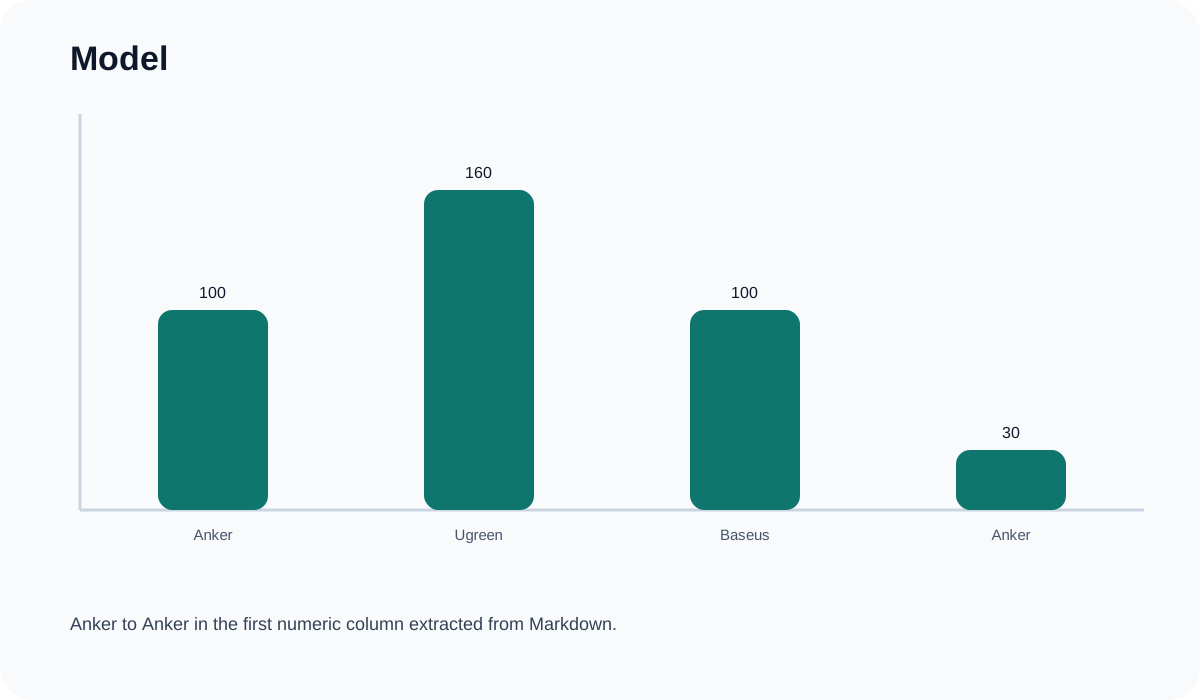
The table below outlines the leading USB-C chargers optimized for travel and rapid gear preparation based on wattage, port availability, and best-use scenarios.
| Brand | Model | Wattage | Ports | Price Range | Best Use |
|---|---|---|---|---|---|
| Anker | Prime 100W | 100W | 3 (2C, 1A) | 90 | All-in-one travel |
| Ugreen | Nexode Pro 160W | 160W | 4 (3C, 1A) | 120 | Massive gear sets |
| Baseus | Enerfill 100W | 100W | 2 (2C) | 60 | Budget high-power |
| Anker | Nano 30W | 30W | 1 (1C) | 25 | Small gear/GPS |
Key Buying Considerations for Outdoor Prep
1. The Waterproofing Misconception
Contrary to consumer expectations driven by waterproof power banks (like the Nestout rugged line), no standard wall-plug chargers are IP-rated for waterproofing. They remain firmly at IPX0. However, “ruggedness” in wall chargers refers to physical durability. Look for MIL-STD-810G shock-resistance and internal “potting”—a manufacturing process that encapsulates internal components in resin to protect them from travel vibrations and drops.
2. Eliminating “Port Juggling”
A major user pain point with multi-port chargers is the power “reset.” When you plug a new device into an active charger, lower-tier models drop wattage across all ports to recalculate power distribution. Higher-end models, such as the Anker Prime 100W GaN Charger, utilize intelligent power allocation (alongside ActiveShield 2.0 thermal monitoring) to minimize these resets, keeping all gear charging steadily.
3. Safety Standards and Grounding
Safety is often overlooked in portable chargers. Most travel chargers are “Class 2” (ungrounded), which can occasionally cause a harmless but uncomfortable “tingling” sensation (leakage current) on metal-chassis devices like laptops. If you charge sensitive electronics in varying environments, consider a “Class 1” grounded charger, such as the Mokin TrueGround Class 1 Charger, to mitigate this issue entirely.
4. Charging Protocols (PPS and PD 3.1)
Wattage alone does not guarantee maximum charging speed. Ensure your charger supports:
- PPS (Programmable Power Supply): Mandatory for fast-charging Samsung devices and select outdoor GPS units (e.g., Garmin, Suunto) at their maximum supported rates.
- PD 3.1: Required for any single-port output that exceeds 100W (necessary for charging high-draw creator laptops alongside outdoor gear).
Final Verdict
For most outdoor enthusiasts preparing for a trip, the Anker Prime 100W GaN Charger hits the sweet spot between physical footprint, port variety (3 ports), and intelligent power allocation to prevent charging interruptions. For users requiring maximum power for larger groups or heavier gear loads, the Ugreen Nexode Pro 160W is the superior upgrade.
Pre-Trip Fast-Charging Checklist
- Check Max Inputs: Verify the maximum input wattage of your power bank (e.g., 65W vs 100W) to match it with the correct charger tier.
- Verify Cables: Ensure your USB-C cables are rated for 100W+. A 100W charger using a 60W-rated cable will throttle speeds.
- Clear the Area: High-wattage charging generates heat. Always charge devices on hard, non-flammable surfaces, avoiding beds or cramped luggage spaces prior to departure.