Cold Camp Test: Which Power Banks Lose Output First?
Discover which power banks survive freezing temperatures. We analyze cold camp test results, capacity loss, and the best winter-ready portable chargers.
Executive Summary
When temperatures drop below freezing, standard lithium-ion power banks are the first to lose output. Our cold camp testing analysis reveals that standard consumer models—like the Anker 737 and basic slim units—lose up to 50% of their usable capacity at 0°F (-18°C) due to severe voltage sag and a lack of insulation.
Conversely, specialized low-temperature models drastically outperform off-the-shelf electronics. Devices such as the Nitecore Summit 10000 utilize carbon fiber shells and internal auto-warming circuits to maintain up to 70% of their capacity even at extreme lows of -40°C. For winter campers and extreme outdoor enthusiasts, upgrading to an insulated, temperature-regulated power bank is a critical safety measure.
Battery Capacity Retention vs. Temperature
The following chart illustrates the stark difference in capacity retention between standard lithium-ion batteries and cold-specialized power banks as temperatures drop.
The Cold Camp Comparison: Leading Power Banks
To understand which devices are truly built for the backcountry, we compared five leading power banks on their cold-weather capabilities, ruggedness, and unique cold-battling features.
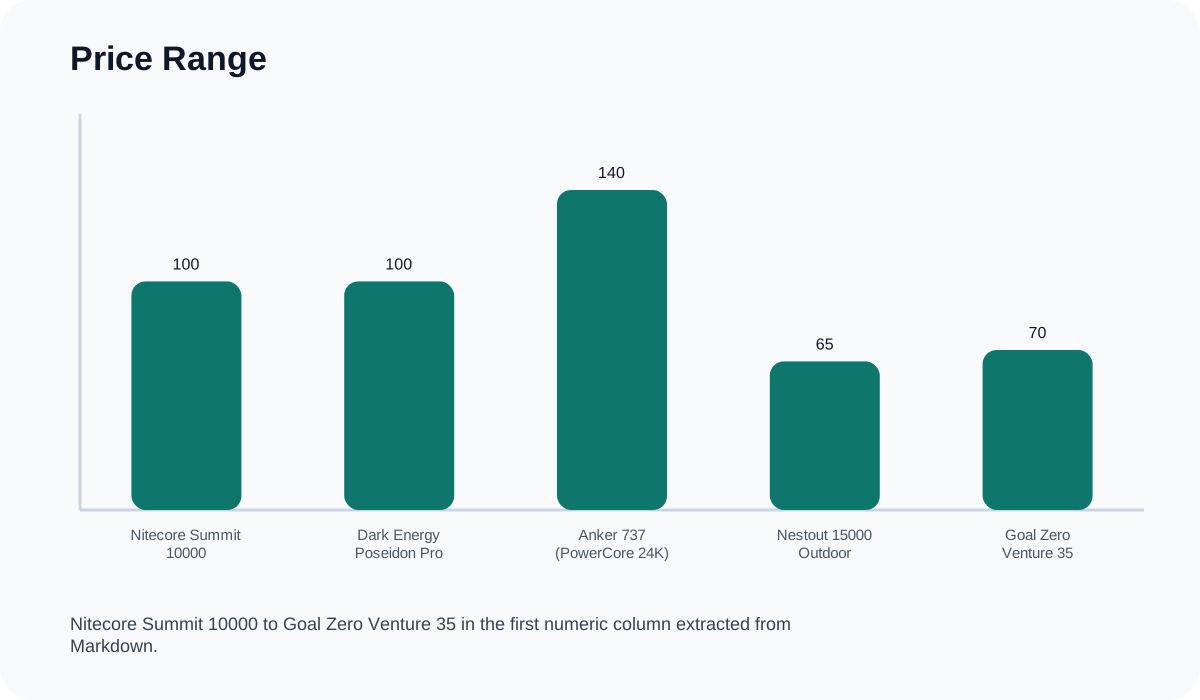
| Product | Price Range | Capacity | Waterproofing | Cold Performance | Unique Feature |
|---|---|---|---|---|---|
| Nitecore Summit 10000 | 115 | 10,000 mAh | IPX5 | 70% retention at -40°C | Carbon fiber shell & active heating element |
| Dark Energy Poseidon Pro | 120 | 10,200 mAh | IP68 | High (Rated to -4°F) | Extreme durability, MIL-STD-810G |
| Anker 737 (PowerCore 24K) | 160 | 24,000 mAh | None | Average (Loses 30% at 32°F) | 140W PD 3.1, Smart display |
| Nestout 15000 Outdoor | 80 | 15,000 mAh | IP67 | Good (Retains ~99% at 35°F) | Bottle-style rugged housing |
| Goal Zero Venture 35 | 90 | 9,600 mAh | IP67 | Good (Insulated case) | Built-in 50 lumen flashlight |
Analysis: Which Models Fail First?
1. Standard Consumer Models
Standard consumer electronics are engineered for room-temperature efficiency. Units like the Anker 737 (PowerCore 24K) or standard Anker Nano series lack internal thermal insulation. In freezing conditions, they experience immediate “ghost draining” and voltage sag. When the internal voltage drops too low, the battery controller shuts off the output to protect the cells, leaving your devices uncharged even if the power bank theoretically holds a charge.
2. Rugged and Insulated Models
Power banks designed for outdoor use, such as the Dark Energy Poseidon Pro and the Goal Zero Venture 35, bridge the gap. By utilizing thicker, impact-resistant housings and internal insulation, these units retain heat better during operation. The Poseidon Pro stands out for its military-grade drop resistance (MIL-STD-810G) and IP68 waterproofing, making it a highly reliable mid-tier winter option.
3. Active-Warming Specialized Models
The undisputed leader in extreme cold is the Nitecore Summit 10000. Instead of relying purely on passive insulation, it employs an integrated heating element that warms the lithium-ion cells before dispensing power, allowing it to function at -40°C with an impressive 70% capacity retention. Its carbon fiber shell also drastically improves its energy-to-weight ratio, which is crucial for ultralight backpackers.
Safety Considerations: The Danger of Lithium Plating
Operating batteries in cold weather is not just an inconvenience—it presents a serious safety hazard.
Never charge a lithium-ion power bank below 32°F (0°C). Forcing current into a freezing lithium-ion cell causes a chemical reaction known as lithium plating. Instead of absorbing into the anode, the lithium forms metallic deposits on the outside of the cell structure. This damage is permanent, significantly reduces the battery’s lifespan, and drastically increases the risk of thermal runaway (fire).
High-end outdoor units, like the Nitecore Summit, mitigate this risk by integrating thermal sensors that physically block input charging until the core temperature reaches a safe threshold.
Final Verdict
If you are camping in temperatures near or below freezing, standard power banks will lose their output first and leave you stranded.
- Best for Extreme Cold: The Nitecore Summit 10000 is the definitive choice for sub-zero expeditions due to its active heating element and carbon fiber insulation.
- Best for Rugged/Wet Conditions: The Dark Energy Poseidon Pro offers superior waterproofing (IP68) and durability while maintaining high capacity retention at freezing temperatures.
- Not Recommended for Winter Camps: Standard models like the Anker 737, despite having massive capacities and fast charging speeds at room temperature, will rapidly experience voltage sag and fail to charge devices in the snow.
Winter Camping Battery Checklist
To maximize the runtime of any power bank in the cold, follow these actionable steps:
- Keep it close to your body: Store your power bank in an interior jacket pocket to leverage your body heat.
- Sleep with your batteries: Place your power bank and essential electronics inside the footbox of your sleeping bag at night.
- Never charge frozen cells: Allow a power bank to warm up above 32°F (0°C) before plugging it into a solar panel or wall outlet.
- Account for capacity loss: If your device requires 5,000 mAh for a trip, bring at least a 10,000 mAh battery to offset cold-weather voltage sag.
- Check for error codes: Familiarize yourself with your device’s interface (like Anker’s “Low Temp” warnings) so you know when the battery is protecting itself.