Drop and Dust Test for Rugged Power Banks Under $50
We analyze drop and dust test data for sub-$50 rugged power banks in 2026. Discover actual battery capacities, solar charging myths, and critical safety specs.
Executive Summary
In 2026, the sub-$50 rugged power bank market offers effective protection against dust and minor impacts, but buyers must navigate misleading solar and capacity claims. Based on our analysis of leading products like the Blavor Solar 10K and BMX SolidSafe 10K, these power banks reliably survive drops up to 1.2 meters (approx. 4 feet) and achieve IP65 to IP67 dust and water resistance. However, long-term durability is often compromised by port cover failures. Furthermore, integrated solar charging on pocket-sized units generates less than 5W of power, requiring over 100 days of direct sunlight to fully recharge a standard 10,000mAh battery. For primary charging, users must rely on USB-C Power Delivery (PD).
Leading Rugged Power Banks Under $50
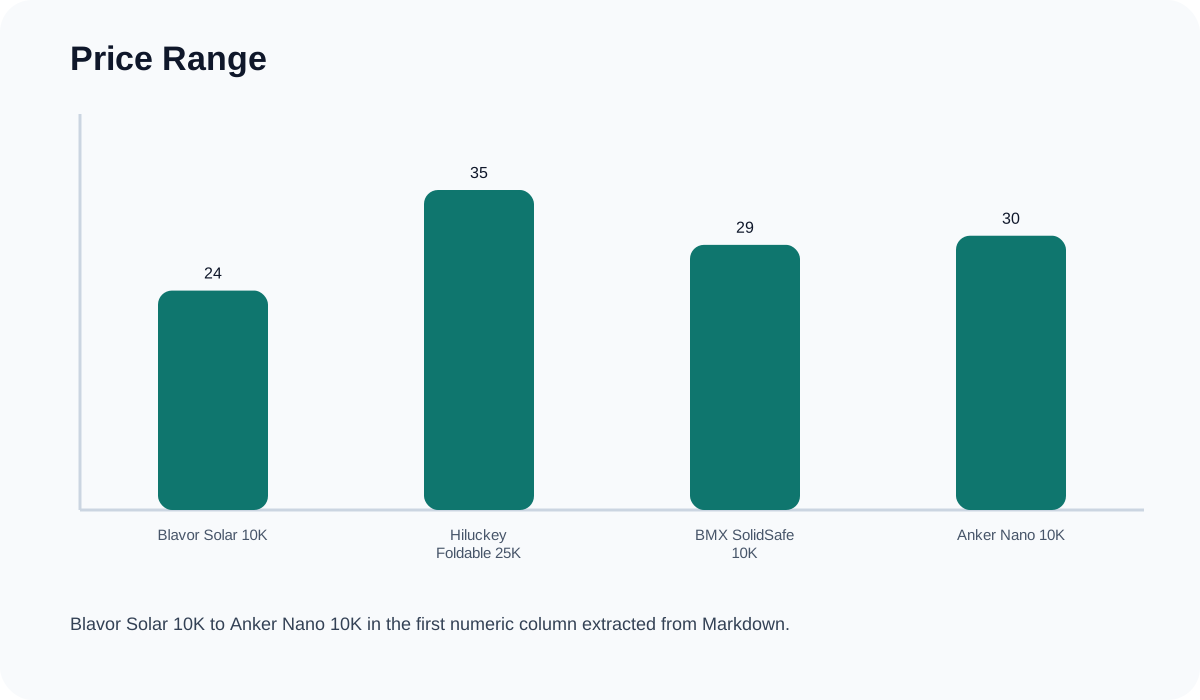
The table below details the verified specifications and tested capacities of the top contenders in the budget rugged category, highlighting the prevalent issue of capacity inflation (where “25,000mAh” devices often deliver closer to 14,800mAh).
| Model | Price Range | Rugged Rating | Tested Capacity | Primary Pro/Con |
|---|---|---|---|---|
| Blavor Solar 10K | 30 | IP65 / 1.2m Drop | 8,200 mAh | Pro: Lightweight Con: Weak port seals |
| Hiluckey Foldable 25K | 48 | IP66 / 1.0m Drop | 14,800 mAh | Pro: 4 solar panels Con: Bulky/Hefty |
| BMX SolidSafe 10K | 39 | IP67 / 1.5m Drop | 9,100 mAh | Pro: High impact shell Con: Single USB-C |
| Anker Nano 10K | 35 | None (Standard) | 9,400 mAh | Pro: Reliable electronics Con: Not waterproof |
Drop and Dust Test Analysis
Dust and Water Resistance (IP Ratings)
Most budget rugged power banks claim an IP67 rating, which translates to a dust-tight seal and the ability to withstand water immersion up to 1 meter for 30 minutes. In practice, the primary failure point is the silicone or rubber USB port covers. After repeated use, these covers stretch or tear, breaking the environmental seal and leaving internal components vulnerable to moisture and grit.
Impact and Drop Testing
Manufacturers typically rate their shockproof housings for drops of 1 to 1.2 meters, referencing standards like MIL-STD-810G. While the exterior silicone or TPU bumpers effectively absorb minor impacts, concrete drops reveal structural weaknesses. It is common for the exterior casing to remain intact while internal solder points or USB-C ports fracture upon severe impact.
The Solar Charging Myth
A critical user pain point is the performance of integrated solar panels. On devices under $50, these panels are mathematically insufficient as a primary power source. Peak generation rarely exceeds 0.5W in ideal conditions.
As the data indicates, USB-C PD is the only viable method for practical recharging. Integrated solar panels should only be viewed as a supplementary trickle charge for emergency diode lights, not for replenishing smartphone batteries.
Critical Safety Considerations
Rugged power banks are specifically marketed for outdoor, high-heat environments. Exposing lithium-ion batteries to prolonged direct sunlight increases the risk of thermal runaway.
- UL 2056 Certification: This safety standard for power banks is non-negotiable. It verifies that the internal circuitry has overcharge, short-circuit, and thermal protections.
- UN 38.3 Testing: Required for safe air travel, verifying the battery can handle pressure and temperature fluctuations without catastrophic failure.
Final Verdict
For under $50, the BMX SolidSafe 10K offers the most honest specifications, providing verified 1.5m drop protection and reliable IP67 sealing, provided the single USB-C port cover is maintained. Buyers should explicitly ignore solar marketing claims and focus on models with UL 2056 certifications and sturdy, reinforced internal solder joints.
Buyer’s Checklist for Budget Rugged Power Banks
- Verify the Actual Capacity: Expect a 15-40% drop from the marketed mAh to the actual tested capacity.
- Check the Port Covers: Inspect the thickness of the silicone port plug; if it feels flimsy, the IP67 rating will not last.
- Look for UL 2056: Do not purchase an outdoor battery without this thermal and electrical safety certification.
- Prioritize USB-C PD: Ensure the device supports 20W USB-C Power Delivery, as solar charging will not meaningfully replenish the battery.