Emergency Outage Test: Which Home Backup Setup Feels Most Practical?
An evidence-based 2026 analysis of portable home backup systems, testing usable capacity, LFP safety, and the real-world practicality of top brands.
Executive Summary
For the majority of homeowners in 2026, the most practical emergency backup setup is a 2kWh to 4kWh Lithium Iron Phosphate (LFP) portable power station equipped with solar-bypass capability.
While the market has split between ultra-portable units and hardwired whole-home systems, mid-range modular units offer the highest return on investment. However, buyers must navigate significant industry shortcomings: an inherent 10% to 15% “inverter tax” on usable energy, a lack of weather resistance (averaging IP20/IP21 ratings), and industry-wide customer service challenges. This analysis breaks down the leading systems, battery chemistries, and the realities of deploying emergency power during a grid failure.
The “Inverter Tax”: Calculating Real Usable Capacity
A critical pain point for consumers relying on manufacturer specifications is the “inverter tax.” During an actual discharge, most power stations lose a significant percentage of their stored energy to internal conversion processes (converting DC battery power to AC wall power).
Based on current testing, users should expect systems to deliver only 80% to 85% of their rated Watt-hour (Wh) capacity. If a system claims 1,000 Wh, the practical, usable capacity will be an estimated 800 to 850 Wh. When sizing a system to keep essential medical devices or refrigeration running, calculating this overhead is a mandatory step.
Safety and Longevity: Why LFP is Mandatory
Lithium Iron Phosphate (LFP or LiFePO4) chemistry has fully replaced Nickel Manganese Cobalt (NMC) as the baseline safety standard for residential environments. The shift is driven by two measurable factors: thermal stability and total life cycles.
LFP batteries boast a thermal runaway threshold of 500°C compared to NMC’s 210°C, drastically reducing the risk of fire in domestic settings. Furthermore, LFP units typically deliver a 10+ year lifespan, sustaining 3,000 to 6,000 charge cycles before degrading to 80% original capacity.
Practicality Comparison: Top 2026 Models
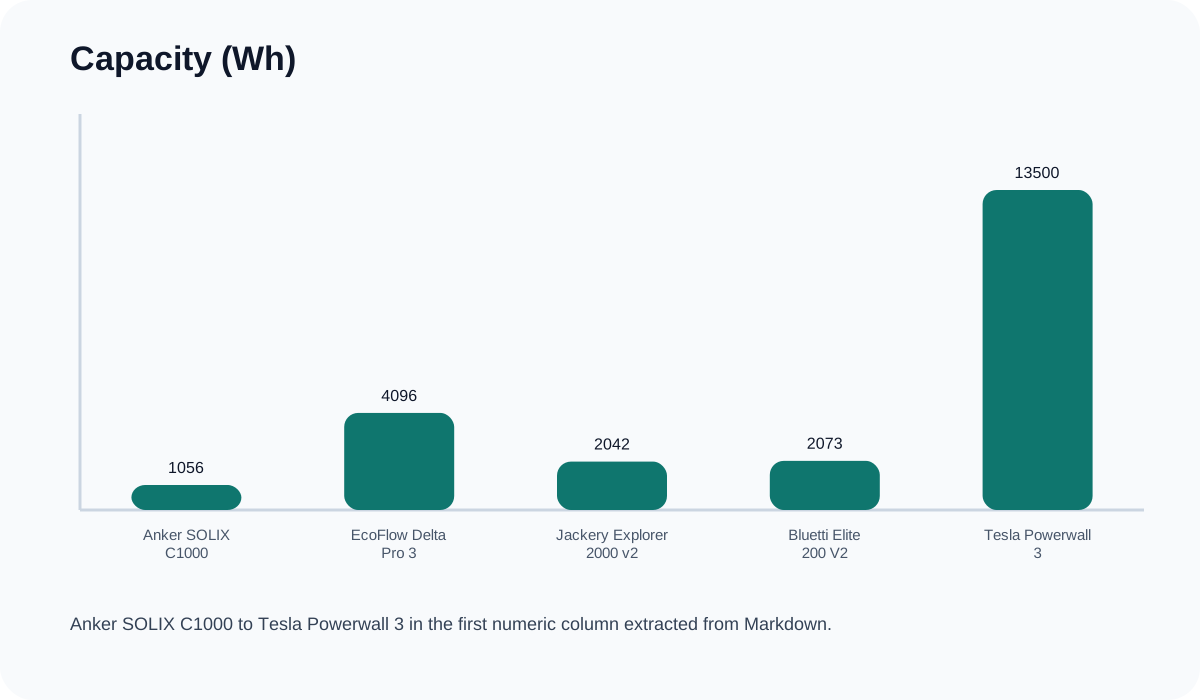
The table below evaluates leading home backup solutions by capacity, estimated retail pricing, and the specific practical niche they fill.
| Product | Capacity (Wh) | Est. Price (USD) | Chemistry | Practical Best For |
|---|---|---|---|---|
| Anker SOLIX C1000 | 1,056 Wh | 900 | LFP | Essentials (Fridge/WiFi) |
| EcoFlow Delta Pro 3 | 4,096 Wh | 3,800 | LFP | Transfer Switch/Whole Home |
| Jackery Explorer 2000 v2 | 2,042 Wh | 1,500 | LFP | Balance of Power & Weight |
| Bluetti Elite 200 V2 | 2,073 Wh | 1,400 | LFP | Budget-Conscious Durability |
| Tesla Powerwall 3 | 13,500 Wh | $13,000+ | LFP | Permanent Whole-Home Backup |
Manufacturer Caveats: Weather Resistance and Warranty Support
While companies like EcoFlow and Jackery are advancing “hybrid” systems—such as the Delta Pro 3 and Explorer 5000 Plus—that bridge portable batteries with hardwired home transfer switches, two major drawbacks plague the sector:
- Poor Weather Ratings: Despite marketing imagery showing units operating in extreme environments, true waterproofing (IP65 or higher) remains exceptionally rare in the portable segment. The vast majority of current units hold IP20 or IP21 ratings. This means they are inherently vulnerable to water and must be operated indoors or under heavily protective covers during storm-related outages.
- Customer Support Failures: Post-purchase support is a documented liability. As of mid-2026, the top three manufacturers in the space (EcoFlow, Jackery, and Bluetti) currently hold “F” ratings from the Better Business Bureau. Consumers consistently report unresponsive customer service, application bugs, and highly difficult warranty claim processes.
Final Verdict
For the highest blend of practicality, safety, and utility, investing in a mid-range 2kWh to 4kWh LFP power station (such as the Jackery Explorer 2000 v2 or EcoFlow Delta Pro 3 for larger loads) is the optimal strategy. However, buyers should treat these devices strictly as indoor-safe infrastructure and be prepared to self-troubleshoot minor issues, given current industry shortcomings in warranty support.
Emergency Backup Deployment Checklist
- Calculate with the Inverter Tax: Add a minimum 15% margin to your total required wattage to account for inherent DC-to-AC conversion losses.
- Verify Chemistry: Ensure the unit utilizes LFP (LiFePO4) chemistry for superior thermal safety and longevity.
- Plan for the Elements: Do not assume your portable unit is weatherproof. Check the IP rating; if it is IP20 or IP21, plan an indoor, well-ventilated staging area.
- Test Immediately: Because customer service channels are frequently backlogged (as indicated by poor BBB ratings), stress-test the unit under maximum household load within the first 14 days of purchase to utilize standard retail return windows.
Sources:
- Best Tested Portable Power Stations in 2026 - CNET
- EcoFlow vs Bluetti vs Jackery: The $1500 Test - Independent Testing (YouTube)
- LFP vs NMC Battery: 2026 Safety & Lifespan Comparison - EVLithium