Field Test: Is a Solar Panel Worth Packing for a Two-Night Trip?
Field test data reveals whether a portable solar panel or a power bank is the best choice for a weekend excursion. Compare real-world wattage and weights.
Executive Summary: The Bottom Line Up Front
Field tests and expert reviews consistently show that for a two-night trip, a high-capacity power bank is a significantly more reliable and weight-efficient choice than a portable solar panel.
While portable panels like the BigBlue SolarPowa 28W and Goal Zero Nomad 10 offer “infinite” energy theoretically, they are high-risk primary power sources for short excursions. Their energy output drops by up to 90% in overcast conditions. Solar panels are only recommended as a primary power solution for trips exceeding 4 to 5 days, or for specific high-drain setups (like drone and camera equipment) where a fixed battery reserve falls short.
Real-World Charging Performance
Advertised wattages on solar panels are rarely met in the field. To understand the practical difference between wall-charged power banks and solar arrays, consider the time required to charge a standard 5000mAh smartphone battery.
Note: Solar data is based on a 20W-rated monocrystalline panel.
The Efficiency Gap: Power Banks vs. Solar Panels
When evaluating gear for a short trip, weight and reliability are the primary metrics. The data reveals a distinct “efficiency gap” favoring lithium batteries over solar cells for 48-hour timelines.
- Weight-to-Power Ratio: A standard 20,000 mAh power bank (e.g., Nitecore NB10000 series) typically weighs 15–18 oz and guarantees approximately 4–6 smartphone charges. Conversely, a comparable 20W solar panel weighs 20+ oz and delivers zero power during rain or at night.
- Output Drop-off: Field tests demonstrate that a typical 28W panel delivers 12–15W in direct, unshaded sunlight. Under partial clouds, this output can plummet to as little as 2W.
Top Portable Solar Panels for Backpacking (2025-2026)
If you are extending your trip beyond two nights or carrying high-drain equipment, the market offers several capable panels.
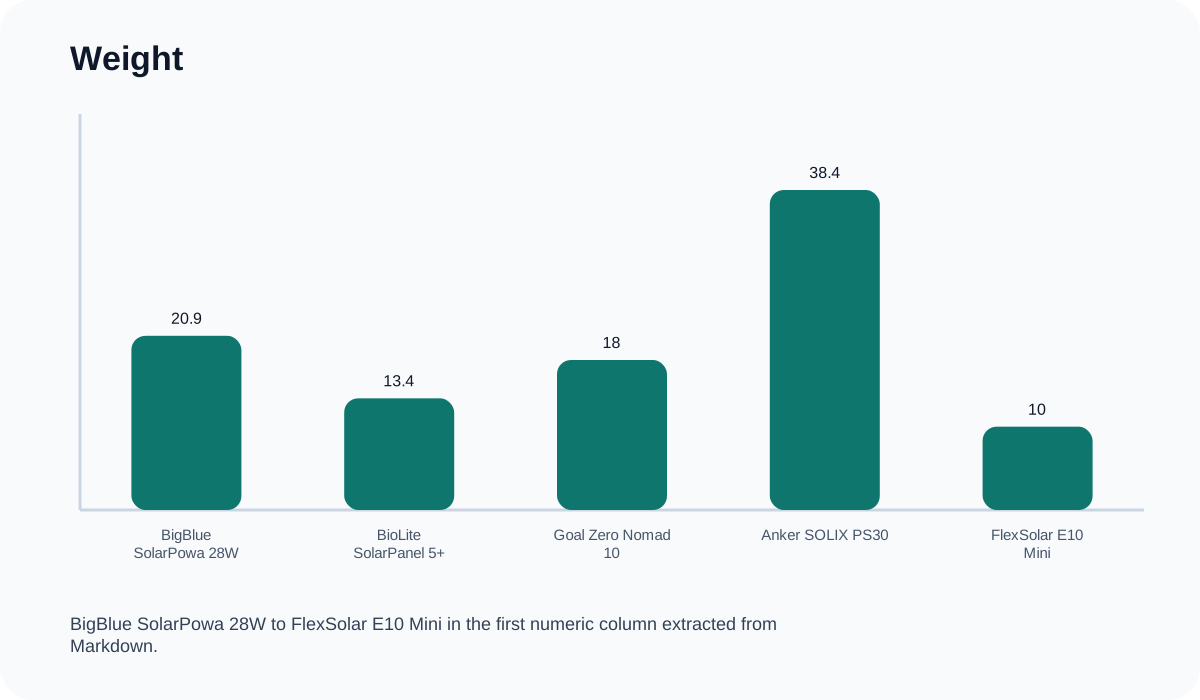
| Product | Weight | Peak Wattage | Price Range | Waterproof Rating |
|---|---|---|---|---|
| BigBlue SolarPowa 28W | 20.9 oz | 28W | 80 | IPX4 (Water Resistant) |
| BioLite SolarPanel 5+ | 13.4 oz | 5W | 90 | IPX4 (3200mAh Integrated) |
| Goal Zero Nomad 10 | 18.0 oz | 10W | 110 | IP67 (Dust/Waterproof) |
| Anker SOLIX PS30 | 38.4 oz | 30W | 85 | IP65 (Splashproof) |
| FlexSolar E10 Mini | 10.0 oz | 10W | 55 | IP65 (Splashproof) |
Real User Pain Points
When relying on solar power in the backcountry, users frequently report the following operational hurdles:
- Cloud Instability: Passing clouds disrupt the charging current. Phones often disconnect and repeatedly “beep,” which can interrupt the device’s internal charging logic and drain the battery faster than it charges.
- Alignment Fatigue: To maintain peak efficiency, users must manually re-angle the panels every 30 to 60 minutes to track the sun.
- Overheating: Charging requires direct sun exposure, which often results in devices shutting down with a “Device Temperature Too High” warning.
- Bulk: Even folding panels consume a significantly larger footprint in a backpack compared to dense lithium battery bricks.
Safety Considerations and Best Practices
Deploying consumer electronics in outdoor environments carries inherent risks.
- Battery Swelling: Placing power banks or phones in direct sunlight (especially under a solar panel) can cause intense heat buildup, leading to permanent lithium cell damage and swelling.
- Short Circuits: Many panels only feature an IPX4 water-resistance rating. These non-waterproof ports are highly vulnerable to unexpected downpours or salt spray.
- Cable Hazards: Frayed USB cables paired with variable current can cause electrical arcing. Experts advise seeking panels constructed with ETFE coatings for superior durability.
- The “Buffer” Strategy: To mitigate power fluctuations and protect your phone’s battery from damaging “charge-stop-start” cycles, experts recommend using the solar panel to charge a separate “buffer” power bank. The power bank is then used to charge your phone safely in the shade or at night.
Final Verdict
Is a solar panel worth packing for a two-night trip? No. The weight penalty, unreliability in shaded or cloudy conditions, and hands-on maintenance make them inferior to a fully charged 10,000–20,000 mAh power bank for a weekend excursion. Reserve solar panels for off-grid trips lasting 5 days or longer.
Pre-Trip Power Checklist
- Assess trip duration (If < 4 days, pack a reliable power bank).
- Fully charge primary and backup power banks 24 hours before departure.
- Download offline maps and media to conserve phone battery on the trail.
- If packing solar (for longer trips), ensure you have a “buffer” power bank to stabilize output.
- Check weather forecasts to gauge solar viability before departing.