How to Compare Emergency Readiness Across Rechargeable Tools
Learn how to evaluate emergency rechargeable tools using battery chemistry (LFP vs. NMC), IPX ratings, charging redundancy, and long-term storage protocols.
Executive Summary
Comparing rechargeable tools for emergency readiness requires a multidimensional evaluation of three core factors: battery chemistry, ingress protection (IP) ratings, and redundant charging capabilities. While standard metrics like lumen output or immediate energy density are attractive for everyday use, long-term survival readiness is determined by a tool’s self-discharge rate and thermal stability. Lithium Iron Phosphate (LFP) chemistries provide superior safety and shelf life for stationary backup, whereas Lithium-Ion (NMC) cells dominate portable, high-intensity gear. True emergency readiness demands tools with at least an IPX4 splash-proof rating and multi-input “Tri-Power” charging capabilities to counter long-term grid failures.
Battery Chemistry Trade-Offs: LFP vs. NMC
The most critical component of any rechargeable emergency tool—from arc lighters to high-output flashlights—is the internal battery chemistry. The two dominant market choices are standard Lithium-Ion (NMC) and Lithium Iron Phosphate (LFP/LiFePO4).
- Lithium Iron Phosphate (LFP): Offers significantly higher safety metrics. LFP batteries can sustain 3,000+ charge cycles and have a high thermal runaway threshold of 270°C+. They are the superior choice for stationary backup and safe long-term vehicle storage.
- Standard Lithium-Ion (NMC): Remains dominant for portable, high-intensity performance due to its lower weight and higher energy density. However, it carries higher degradation risks and a lower thermal runaway threshold of 150°C, making it more prone to fire risks under physical stress or extreme heat.
Ingress Protection (IP) Standards for Survival
Electronic failure due to moisture is a primary risk during storms and floods. For practical emergency readiness, tools must carry verified IP (Ingress Protection) ratings rather than vague “water-resistant” marketing claims.
- Minimum Viable Readiness: IPX4 (splash-proof) is the bare minimum required for basic rain exposure.
- Severe Weather/Flood Readiness: IP67 or IP68 ratings are critical for extreme scenarios. These ratings ensure internal components remain completely dry during total submersion, protecting sensitive battery control boards from short-circuiting.
Emergency Readiness Specifications by Top Product
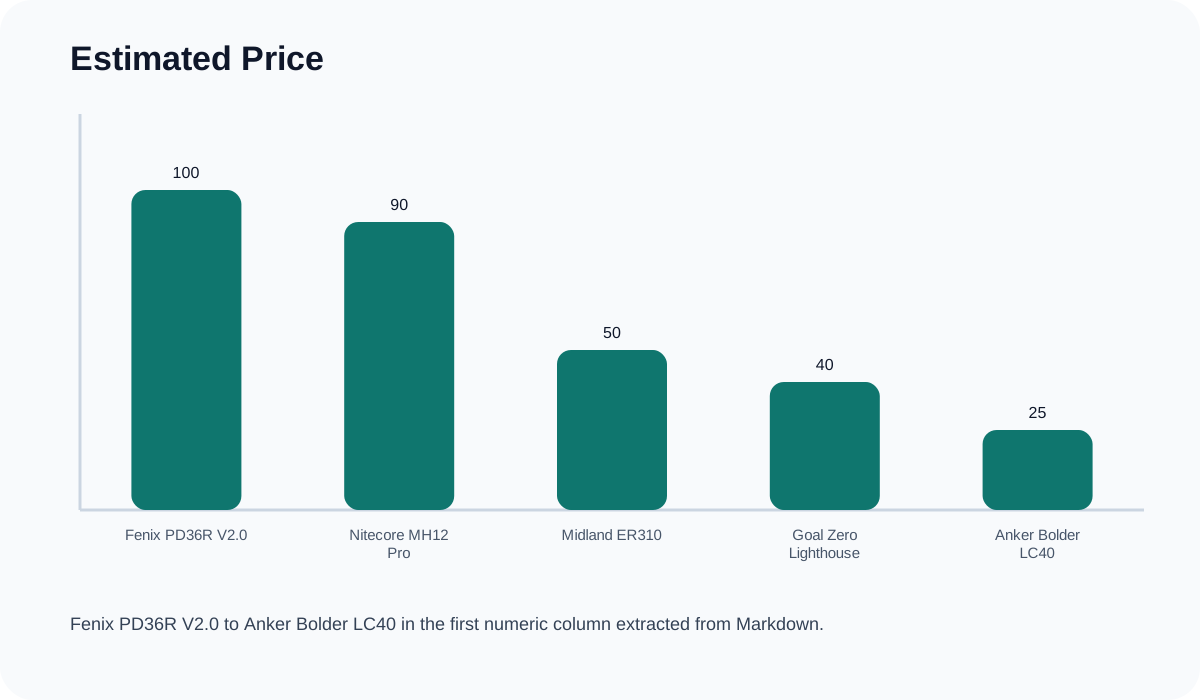
The following table compares leading rechargeable tools based on estimated pricing, maximum runtime in eco/low modes, waterproofing, and charging methods.
| Product | Estimated Price | Waterproof Rating | Max Runtime (Eco) | Charging Methods |
|---|---|---|---|---|
| Fenix PD36R V2.0 | 120 | IP68 (Submersible) | 482 hours | USB-C |
| Nitecore MH12 Pro | 110 | IP68 (Submersible) | 500 hours | USB-C |
| Midland ER310 | 70 | IPX4 (Splash) | 32 hours | USB, Solar, Hand-Crank, AA |
| Goal Zero Lighthouse | 60 | IPX6 (Heavy Rain) | 170 hours | Built-in USB, Solar-ready |
| Anker Bolder LC40 | 30 | IP65 (Dust/Jet) | 20 hours | Micro-USB |
Charging Redundancy and Maintenance Gaps
A common user pain point with rechargeable tools is “phantom drain” (or parasitic drain), where devices slowly lose their charge over 6 to 12 months of storage. A tool with a dead battery during a blackout offers zero emergency readiness.
To mitigate this, readiness protocols dictate two strategies:
- Redundant Charging (Tri-Power): Prioritize gear that supports multiple power inputs. Tools like the Midland ER310 utilize USB for fast charging, integrated solar for maintenance, and mechanical hand-cranks or replaceable AA batteries as an absolute fail-safe.
- Storage Protocols: Modern guidelines recommend storing rechargeable lithium batteries at 50% to 70% capacity to preserve internal chemistry life. Users must check and cycle charge levels every 3 to 6 months.
Final Verdict
Evaluating emergency rechargeable tools is an exercise in risk mitigation. If you are prioritizing long-term storage in potentially hot environments (like a car trunk), LFP-based tools offer unparalleled safety and longevity. For compact “go-bags” where size-to-output ratios are critical, NMC-based flashlights (such as the Nitecore MH12 Pro) remain the practical choice, provided they feature IP68 waterproofing and USB-C standardization.
Readiness Checklist
- Does it use LFP or NMC? Select LFP for stationary backup and safety; NMC for portable performance.
- Is it IPX4 or higher? Reject any tool without a quantifiable IP rating. Aim for IP68 in flood-prone zones.
- Does it have redundant power? Look for solar, hand-crank, or standard battery bypass options.
- Have you checked it recently? Schedule maintenance to test batteries and return them to a 50-70% charge state every 6 months to avoid phantom drain.