How to Match a Power Bank to Small Outdoor Electronics
Learn how to choose the best power bank for your outdoor electronics using Watt-hours, the 80% efficiency rule, and IP67 ratings for reliable field power.
Executive Summary
To effectively match a power bank to outdoor electronics like the Garmin inReach Mini 2 or Petzl Swift RL, you must evaluate Watt-hours (Wh) rather than advertised milliamp-hours (mAh). Based on current 2026 data, the most reliable setup for weekend trips is a 10,000mAh (roughly 37Wh) unit featuring an IP67 rating and USB-C Power Delivery (PD). Applying an “80% efficiency rule” is critical to calculate realistic field runtimes, accounting for voltage conversion losses and environmental factors like extreme temperatures.
The Math Behind Real-World Capacity
The most common mistake buyers make is trusting advertised mAh capacities. Actual usable capacity is typically 20% lower than the marketed number. This happens because power banks store energy internally at 3.7V but must boost it to 5V (or higher) to output to your devices via USB.
This discrepancy creates a known user pain point: budget brands often advertise high capacities like 20,000mAh, but real-world testing proves they deliver an estimated 12,000mAh of usable charge. Therefore, evaluating your energy needs in Watt-hours (Wh) is essential for accuracy.
Estimated Runtimes for Outdoor Electronics
Applying the 80% efficiency rule (at an optimal 20°C ambient temperature), here is what you can expect a standard 10,000mAh (37Wh) power bank to deliver in the field:
Environmental Threats: Temperature and Weather Resistance
Matching a battery to your devices is only half the battle; the power bank must survive the environment where those devices operate.
- Temperature Extremes: Capacity drops significantly in extreme weather. Expect an estimated 20% to 30% reduction in capacity in freezing conditions (below 0°C). Conversely, temperatures exceeding 45°C (113°F) risk permanent battery degradation and will trigger thermal safety shut-offs.
- IP Ratings vs. “Rugged” Marketing: Do not trust aesthetic “rugged” marketing that lacks an official Ingress Protection (IP) rating. True outdoor reliability requires at least an IP67 rating (dust-tight and submersible up to 1 meter in water). Buyers should be aware that unrated rugged cases often add an estimated 40% more weight to the pack without adding any battery capacity.
Hardware Features You Cannot Ignore
When evaluating power banks for modern outdoor gear, legacy ports are a liability. Users report frequent port failures and intolerably slow charging speeds with older Micro-USB models.
Key hardware requirements include:
- USB-C PD (Power Delivery): Now the required standard for efficient power transfer and multi-device compatibility.
- Pass-Through Charging: A critical feature for thru-hikers and campers, allowing you to charge both the power bank and connected electronics simultaneously from a single wall outlet or solar panel.
Comparison of Top-Tier Outdoor Power Banks (2026)
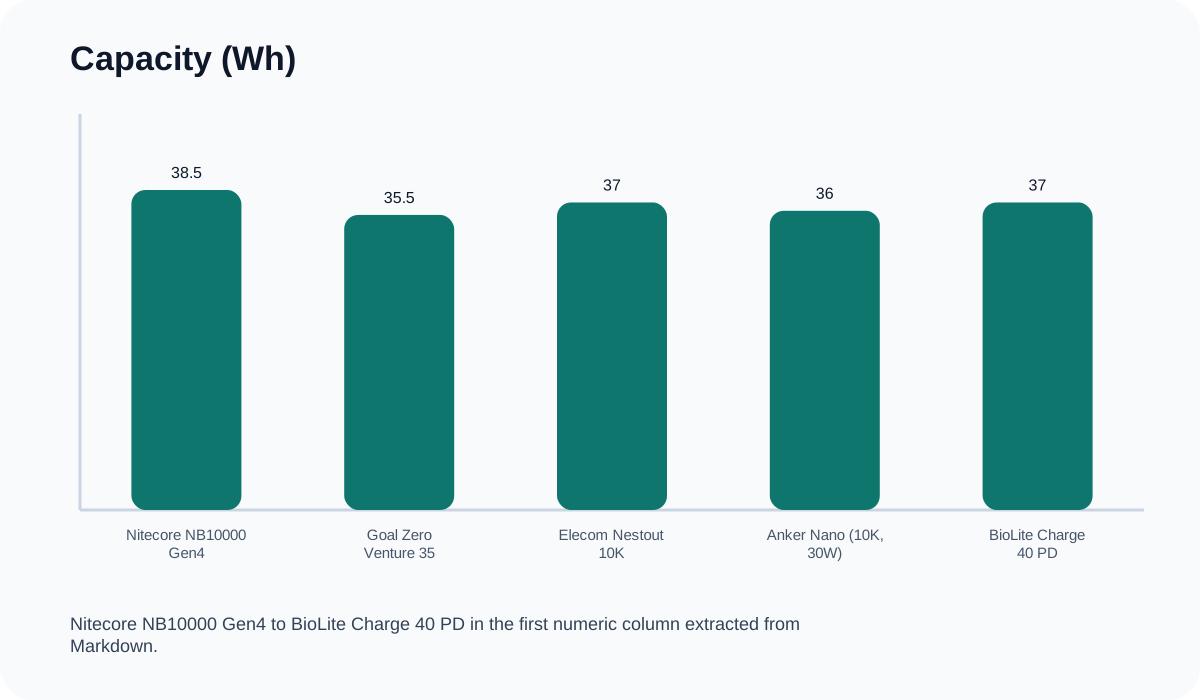
| Product | Capacity (Wh) | IP Rating | Weight | Best For |
|---|---|---|---|---|
| Nitecore NB10000 Gen4 | 38.5 Wh | IPX5 | 5.3 oz | Ultralight Thru-hiking |
| Goal Zero Venture 35 | 35.5 Wh | IP67 | 10.1 oz | Wet/Rugged Environments |
| Elecom Nestout 10K | 37.0 Wh | IP67 | 8.5 oz | Extreme Impact Resistance |
| Anker Nano (10K, 30W) | 36.0 Wh | N/A | 7.6 oz | Fast Charging/Day Trips |
| BioLite Charge 40 PD | 37.0 Wh | IPX6 | 9.4 oz | General Camping/Durability |
(Note: Other notable compact entries entering the market include the Flextail Zero Power, offering specialized utility for ultralight setups.)
Final Verdict
For weight-conscious backpackers, the Nitecore NB10000 Gen4 stands unmatched at 5.3 ounces, offering premium energy density. However, if your trip involves heavy rain, water crossings, or harsh mud, the Goal Zero Venture 35 and Elecom Nestout 10K are superior choices due to their verified IP67 submersible ratings.
Buyer Checklist: Matching Power Banks to Your Gear
- Calculate Total Wh: Add up the Wh capacity of all devices (headlamp, GPS, phone) you plan to charge between wall outlets.
- Apply the 80% Rule: Multiply your power bank’s advertised capacity by 0.8 to find your actual usable charge.
- Verify IP Rating: Ensure the unit is rated IPX6 or IP67 if you anticipate wet weather.
- Check the Ports: Confirm the unit features USB-C PD and supports pass-through charging.
- Account for Weather: Budget 30% extra capacity if you will be camping in freezing temperatures.