How to Read Outdoor Gear Spec Sheets Like a Skeptic
Learn to decode outdoor gear marketing. Understand the real-world gaps in battery runtime, solar output, and waterproofing before your next adventure.
Executive Summary
When buying outdoor electronics—from arc lighters and headlamps to heavy-duty portable power stations—taking the manufacturer’s spec sheet at face value is a mistake. Marketing metrics rely heavily on idealized laboratory conditions that rarely match real-world performance. Expect a 30% to 50% gap between advertised battery or solar capacities and actual field output.
A skeptic-first approach to buying gear means prioritizing Watt-hours (Wh) over Amp-hours (mAh), recognizing the severe impact of cold weather on lithium-ion batteries, and understanding that IP ratings do not guarantee invincibility against dynamic weather. By looking past “Max Lumens” and “Ideal Conditions,” you can make purchasing decisions that ensure your gear works when you need it most.
Power Ratings: The mAh vs. Wh Trap
The Bottom Line: Never trust a capacity rating measured solely in milliamp-hours (mAh). Always calculate or look for Watt-hours (Wh) for a true measure of energy storage.
Many portable chargers and arc lighters boast massive numbers like “50,000mAh.” However, without knowing the voltage, mAh is a relatively meaningless metric for total power. Watt-hours (Wh) dictate the actual amount of energy a battery holds.
Furthermore, when converting DC power from the battery to AC power for standard electronics, portable power stations (like those from Jackery, EcoFlow, and Goal Zero) lose 10% to 15% of their total capacity due to inverter conversion inefficiencies. This loss is almost never factored into the headline specifications.
The Impact of Cold Weather on Batteries
Laboratory tests for battery capacity are standardly conducted at a comfortable 25°C (77°F). If you are relying on Li-ion powered gear, including LiTime LiFePO4 batteries or Nitecore headlamps, for alpine or winter conditions, you must account for non-linear capacity drop-offs. At -20°C, you can lose up to 50% of your available capacity.
Runtimes and Output: Max vs. Sustained
The Bottom Line: “Up to 40 Hours” runtime claims are usually tested on the absolute lowest, least practical power setting.
When evaluating products like the Petzl Swift RL or Black Diamond Storm headlamps, manufacturers highlight a “Max Lumen” output next to a “Max Runtime.” These two metrics are rarely achievable simultaneously. High-output modes drain batteries up to 10x faster than low-power settings. In some tactical flashlights and arc lighters, the “Max” mode may only last a few seconds before thermal throttling kicks in to prevent the device from melting.
Solar Charging: The Myth of 100W
The Bottom Line: Expect a 100W solar panel to realistically output 65W to 75W in the field.
Solar panels are rated under Standard Test Conditions (STC), which assume a steady 25°C temperature and perfect overhead sunlight. As solar panels heat up in the sun, they lose roughly 0.4% efficiency per degree above 25°C. Under light cloud cover, output can plummet to just 10W - 25W. Skeptical buyers should always factor in a 25-35% loss when sizing a solar setup for off-grid trips.
Decoding Waterproofing Claims
The Bottom Line: “IPX7 Waterproof” means the device was submerged in perfectly still water for 30 minutes. It does not mean it will survive the dynamic pressure of driving rain, crashing waves, or a fast-moving river.
Moving water creates hydrodynamic pressure that can force moisture past static seals. A device rated IPX7 might survive being gently dropped in a puddle, but could flood if exposed to heavy, wind-blown rain during a storm.
Spec Sheet vs. Skeptic’s Reality
| Specification | Marketing Claim | Skeptical Reality | Why It Happens |
|---|---|---|---|
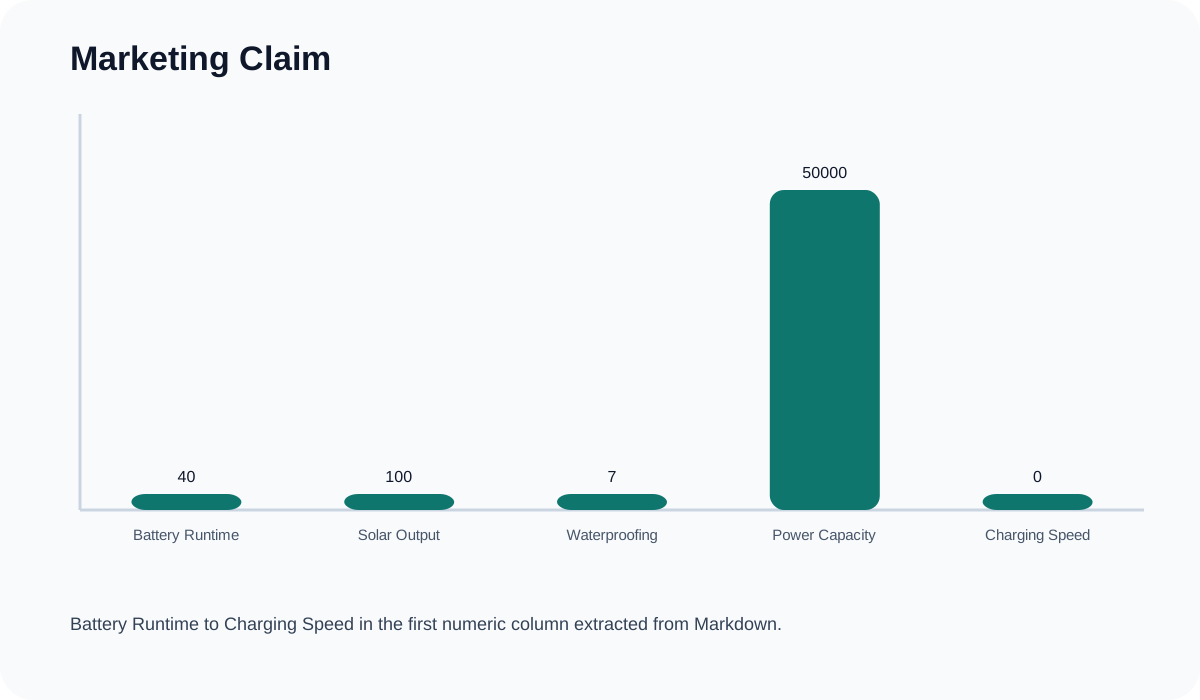
| Battery Runtime | Up to 40 Hours | 4-6 Hours (Usable) | Marketing uses the lowest brightness setting; high-output modes drain 10x faster. |
| Solar Output | 100W Charging | 65W - 75W | STC assumes 25°C; actual panels heat up, losing 0.4% efficiency per degree. |
| Waterproofing | IPX7 Waterproof | Splash-resistant only | Tested in static water; dynamic pressure from rain or waves can force water through seals. |
| Power Capacity | 50,000mAh | 185Wh (Approx) | mAh is meaningless without voltage; Wh is the true measure of total energy stored. |
| Charging Speed | 0-80% in 1 Hour | 90-120 Minutes | Charging speed throttles significantly after 80% to protect battery health (thermal management). |
Safety Certifications: The UL 2743 Baseline
With high-drain outdoor gear, safety should be non-negotiable. As of March 2026, major retailers like Amazon made the UL 2743 standard mandatory for portable power products. This certification ensures proper thermal management to prevent catastrophic thermal runaway. If you are reviewing a spec sheet and do not see UL 2743 (or equivalent) explicitly listed, walk away.
The Skeptic’s Pre-Purchase Checklist
- Convert to Wh: Multiply Ah by Voltage to find total energy (Wh).
- Deduct Inverter Loss: Subtract 15% from the total Wh if you plan to use AC outlets.
- Account for the Cold: Halve your battery expectations if operating at or below -20°C.
- Check Sustained Output: Ignore the “Max Lumens” and look for the sustained output graph.
- Verify Certifications: Ensure UL 2743 compliance for any large lithium-based power station.
Final Verdict
Spec sheets aren’t inherently deceitful, but they represent the absolute best-case scenario. The elements—cold, heat, moving water, and electrical conversion losses—will degrade performance across the board. By reading outdoor gear specifications through the lens of a skeptic, you can set realistic expectations, pack appropriately, and avoid dangerous gear failures in the wild.