Trail Weight Test: Which Charging Kit Gives the Best Runtime per Ounce?
We analyzed 2026's top power banks to find the highest mAh-per-ounce charging kits. Compare Flextail, Nitecore, and BioLite for your ultralight setup.
Executive Summary
For ultralight backpackers and through-hikers, the “North Star” metric for any electrical kit is energy density—specifically, the milliamp-hour (mAh) per ounce ratio. In our 2026 trail weight analysis, the Flextail Zero Power claims the top spot, delivering approximately 1,960 mAh per ounce. It narrowly edges out the carbon-fiber Nitecore NB10000 Gen 4, which offers 1,886 mAh per ounce.
However, trail readiness requires balancing this raw power-to-weight ratio against environmental vulnerabilities. Real-world usable capacity sits closer to 60–70% of advertised ratings due to voltage conversion, and sub-zero temperatures can drain an additional 13–30% of battery efficiency. Furthermore, maximizing energy density often means sacrificing ruggedness; top-tier ultralight carbon-fiber models are prone to port durability issues and frequently lack full submersion (IPX7) waterproofing.
The Runtime per Ounce Leaderboard
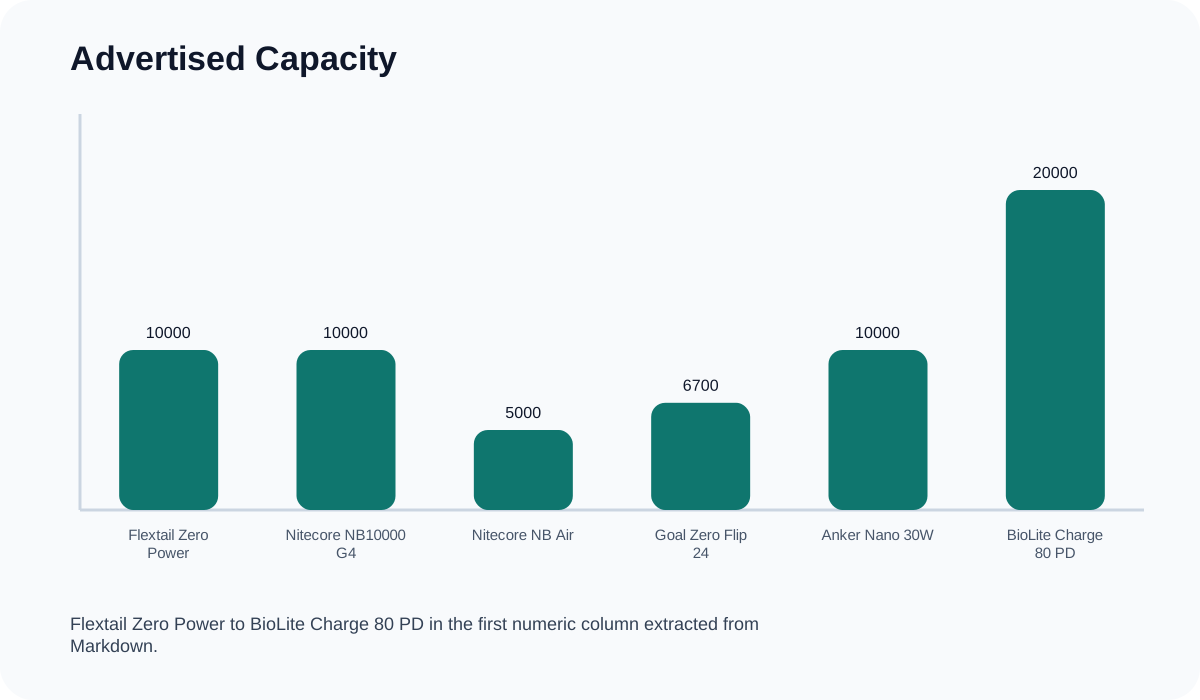
Below is a visualization of how 2026’s leading portable charging kits stack up regarding energy density.
2026 Power Bank Comparison Table
| Product | Advertised Capacity | Weight | Efficiency (mAh/oz) | IP Rating | Est. Price (USD) |
|---|---|---|---|---|---|
| Flextail Zero Power | 10,000 mAh | 5.1 oz | 1,960 | IPX4 | $64.00 |
| Nitecore NB10000 G4 | 10,000 mAh | 5.3 oz | 1,886 | IPX5 | $84.00 |
| Nitecore NB Air | 5,000 mAh | 3.1 oz | 1,612 | IPX7 | $40.00 |
| Goal Zero Flip 24 | 6,700 mAh | 4.6 oz | 1,456 | None | $30.00 |
| Anker Nano 30W | 10,000 mAh | 7.7 oz | 1,298 | None | $35.00 |
| BioLite Charge 80 PD | 20,000 mAh | 16.4 oz | 1,219 | Rugged (N/A) | $99.00 |
Understanding Usable Capacity vs. Advertised Specs
When calculating trail runtime, buyers must look past the marketed capacity. Advertised mAh represents the internal battery cell capacity (typically at 3.7V). However, standard USB charging operates at 5V (or higher for USB-PD).
Due to the laws of thermodynamics and internal voltage conversion losses, the actual usable capacity is typically only 60% to 70% of the advertised rating.
- Example Application: A nominally rated 10,000 mAh bank (like the Flextail Zero Power or Nitecore NB10000) will generally yield between 6,200 and 6,500 mAh of actual charge output.
- Device Equivalency: This translates to roughly 1.5 to 2 full charges for a modern flagship smartphone, not the 3+ charges simplified math might suggest.
Environmental Factors: Weather and Durability Trade-Offs
The Cold Weather Tax
Standard lithium-ion battery chemistry degrades significantly in freezing conditions due to lithium plating. On sub-zero winter trails, hikers should anticipate a 13% to 30% reduction in efficiency. To mitigate this, thermal management is necessary. Storing your power bank close to your body or inside your sleeping bag at night helps preserve the chemical reaction necessary for optimal discharge. For extreme alpine environments, dedicated low-temp kits (like the Nitecore Summit 10000, which features internal heaters) may be required, though they trade away top-tier weight efficiency.
Weight vs. Waterproofing
The pursuit of maximum mAh-per-ounce comes at a structural cost. To achieve ~1,900+ mAh/oz, manufacturers utilize ultrathin carbon fiber shells. While lightweight, user feedback indicates these housings offer reduced impact resistance around USB ports.
Furthermore, water ingress protection varies wildly:
- Ultralight/Minimalist: The Flextail Zero Power (IPX4) and Nitecore NB10000 Gen 4 (IPX5) can survive light rain or splashes but cannot be submerged.
- Balanced Submersible: The Nitecore NB Air (IPX7) provides full submersion protection while maintaining a respectable 1,612 mAh/oz.
- Heavy Duty: Options like the BioLite Charge 80 PD offer robust physical shock and weather resistance but suffer in energy density (1,219 mAh/oz).
Final Verdict
If your primary objective is shaving every possible gram while maintaining enough power for GPS devices and emergency communications, the Flextail Zero Power is the current market leader. If you demand a slightly more established track record with comparable stats, the Nitecore NB10000 Gen 4 remains a highly competitive choice. However, if your trail route includes river crossings or prolonged torrential rain, the Nitecore NB Air presents the smartest compromise between water resistance (IPX7) and weight.
Pre-Trail Battery Checklist
- Calculate True Needs: Multiply your devices’ battery sizes by the number of charges needed, then divide by 0.65 to determine the advertised mAh size you actually need to buy.
- Verify IP Rating: Ensure the battery’s ingress protection matches your environment. Pack it in a dry bag if it is rated IPX5 or lower.
- Plan for Cold: If temperatures will dip below freezing, integrate a body-proximity pocket into your hiking layering system for battery storage.
- Check Port Integrity: Inspect the USB-C ports on carbon-fiber banks before departure; these are known structural weak points.