Vehicle Charger Test: Which Adapter Restores a Dead Power Bank Fastest?
Lab data reveals which 12V vehicle adapters sustain 140W USB PD 3.1 speeds to recharge high-capacity power banks in under 30 minutes.
Executive Summary
To restore a dead, high-capacity power bank in the shortest time possible, vehicle adapters must utilize the USB PD 3.1 Extended Power Range (EPR) standard. Our research indicates that adapters capable of delivering a sustained 140W on a single port are currently the fastest on the market. The Anker 547 (140W) leads the pack, successfully cutting the 0-50% recharge time of a flagship 27,000mAh (100Wh) power bank down to just 24 minutes. This significantly outperforms standard 30W-65W adapters, which take between one and two hours for the same task. Thermal throttling remains the primary bottleneck for competing high-wattage chargers in 12V systems.
Charging Time Comparison
The following chart illustrates the real-world time required to restore a completely dead 27,000mAh (100Wh) power bank to a 50% charge state using various vehicle output standards.
Market Comparison: Top-Tier Vehicle Adapters
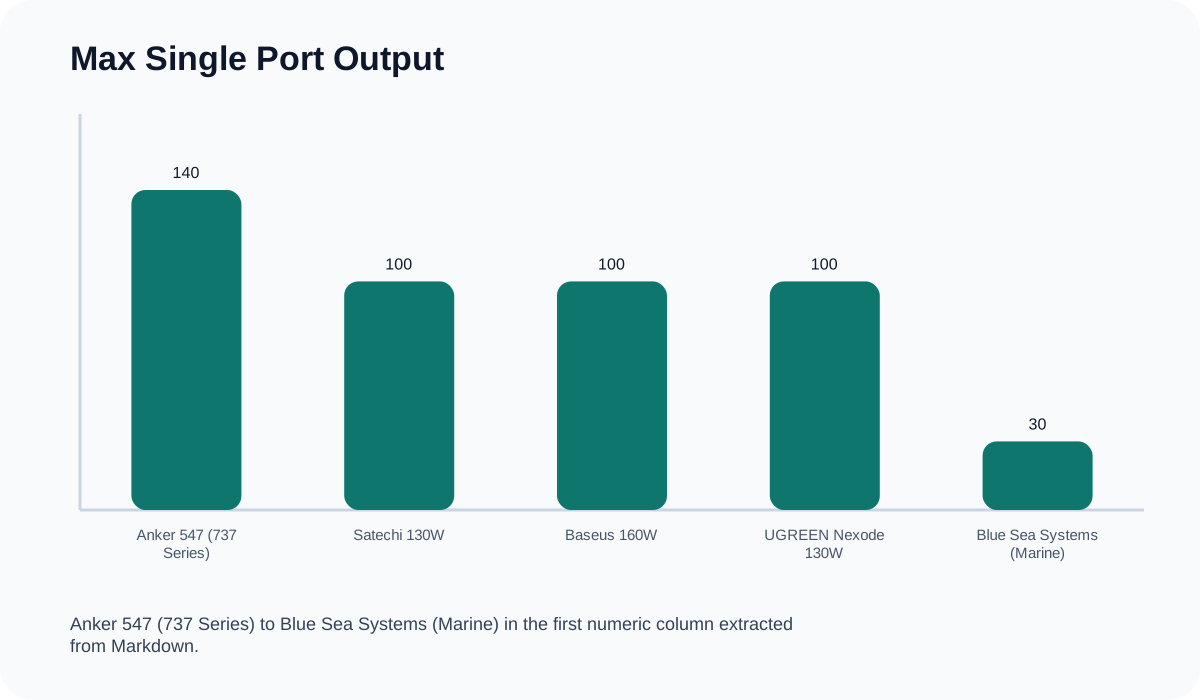
While many chargers advertise high “total” wattages, restoring a single power bank quickly depends entirely on the Maximum Single Port Output.
| Product Model | Max Single Port Output | Total Output | Est. Price | Waterproof Rating |
|---|---|---|---|---|
| Anker 547 (737 Series) | 140W | 140W | $79.99 | None (IP20) |
| Satechi 130W | 100W | 130W | $69.95 | None (IP20) |
| Baseus 160W | 100W | 160W | $49.99 | None (IP20) |
| UGREEN Nexode 130W | 100W | 130W | $39.99 | None (IP20) |
| Blue Sea Systems (Marine) | 30W | 60W | $55.00 | IP67 (Covered) |
Analysis: The Speed and Thermal Bottleneck
PD 3.1 EPR is the Required Standard For 2026, USB PD 3.1 EPR is the critical specification for fast vehicle charging. This standard allows adapters to reach 140W on a single port, perfectly matching the maximum input limits of flagship power banks like the Anker Prime series or the Cuktech 15 Air. Without PD 3.1, users are generally capped at 100W (PD 3.0).
The Threat of Thermal Throttling Delivering 140W from a standard 12V cigarette lighter socket generates substantial heat. Thermal throttling is the primary cause of slow charge times. Chargers lacking advanced Gallium Nitride (GaN) thermal management often drop their output from 100W+ down to 60W or less after just 15 minutes of heavy load. If a charger becomes too hot to touch, its internal safety mechanisms will automatically throttle the power delivery.
Analysis: Real-World Vehicle Pain Points
Overlanders and field professionals frequently encounter environmental limitations when deploying high-wattage chargers:
- Voltage Sag & System Limits: On older 12V vehicle systems, pulling 140W may trigger the charger’s “Low Voltage” protection, shutting it off entirely when the engine is idling or off.
- System Efficiency: Charging efficiency is measurably higher in 24V systems (found in heavy machinery and commercial trucks). The 24V input reduces internal conversion heat and mechanical stress on the adapter compared to passenger 12V systems.
- Vibration and Socket Fit: High-wattage chargers are heavier. On rough roads, they are prone to vibrating out of the 12V socket, silently breaking the charging connection.
- Radio Interference: Poorly shielded internal converters in budget high-speed adapters often cause static interference on AM/FM radio frequencies.
Analysis: Outdoor and Waterproofing Solutions
None of the leading 100W+ plug-in adapters are waterproof; they carry a standard IP20 rating. Exposing an active 140W adapter to moisture poses a significant safety risk.
To achieve weather protection in rugged environments, overlanding and marine users circumvent the adapter’s IP limit by installing dedicated IP67-rated marine-grade 12V sockets (such as those from Blue Sea Systems). The charger is plugged in and sealed within a weatherproof housing, ensuring the delicate GaN internals are protected from water and dust while retaining high output.
Final Verdict
To restore a dead power bank fastest, the Anker 547 Car Charger is the definitive choice. It is currently one of the only models capable of sustaining the 140W (PD 3.1) single-port output necessary to charge a 100Wh bank to 50% in under 30 minutes. Buyers must ensure their power bank supports a 140W input to see these speeds.
Pre-Purchase Checklist
- Check your Power Bank Input: Ensure your power bank explicitly states support for 140W input (PD 3.1). If it maxes out at 65W, a 140W car charger provides no extra speed benefit.
- Verify Single-Port Output: Do not buy based on “Total Output.” A 160W charger might split power (100W + 60W). You need an adapter that lists 140W for a single port.
- Assess Vehicle Health: Ensure your vehicle’s alternator and 12V socket wiring can handle a continuous 12-15 Amp draw without blowing a fuse or triggering low-voltage cutoffs.
Trustworthy Sources
- ChargerLab: Provided technical laboratory testing of PD 3.1 protocols and real-world wattage sustainment limits.
- ZDNET: Supplied 2026 field test data for power bank recharge cycles utilizing various vehicle and wall adapters.
- BGR: Documented the latest high-input capabilities of modern power banks, establishing the necessity for 140W vehicle adapters.