What Makes a Good Lab-Style Review for Outdoor Gear?
Learn how to spot trustworthy outdoor gear reviews by looking for objective metrics like usable power, thermal integrity, and UL 2743 safety standards.
Executive Summary
A high-quality lab-style review for outdoor gear—particularly portable power stations—abandons subjective field anecdotes in favor of objective, repeatable metrics. To evaluate outdoor energy systems accurately, reviews must quantify the efficiency gap (typically measuring 15-20% inverter conversion loss), test thermal management under continuous high loads (1000W+), and verify safety standards such as UL 2743. Trustworthy evaluations also identify critical mismatches, such as pairing IP67 waterproof solar panels with IP20 non-waterproof base stations, ensuring buyers understand the real-world limitations of their gear in harsh environments.
The Efficiency Gap: Stated vs. Usable Capacity
The most critical marker of a rigorous lab review is the transition from “Stated Capacity” to “Usable Power.” Most manufacturers market power stations based on raw battery cell capacity in Watt-hours (Wh). However, lab testing routinely reveals that consumers only experience 65-85% of that stated capacity.
This discrepancy is caused by a 15-20% energy conversion loss primarily due to inverter overhead and safety buffers designed to prevent cell degradation. A reliable review will rigorously drain the unit under standardized loads and present the exact usable Wh, preventing buyers from falling for deceptive capacity claims.
Thermal and Environmental Integrity
Quality lab reviews push hardware to its physical and thermal limits to uncover flaws that casual testing misses.
- Thermal Imaging Under Load: Testing must involve continuous, high-draw cycles (e.g., 1000W+) while monitoring the unit with thermal cameras. This identifies heat-sink failures that could lead to premature system shutdowns or permanent cell damage.
- The IP Rating Mismatch: A glaring environmental vulnerability often overlooked is weather resistance. While companion solar panels frequently boast IP67 or IP68 ratings (highly water and dust resistant), the power stations themselves are typically rated IP20, meaning they offer zero water resistance. Accurate reviews highlight this mismatch, warning users about the dangers of wet-condition deployment.
- Dust Ingress: Comprehensive inspections must check ports for dust accumulation, which can cause electrical arcing in outdoor environments.
Safety Standards and BMS Benchmarks
Battery Management Systems (BMS) are the invisible shield protecting outdoor gear from catastrophic failure. A standard consumer review might note that a unit turns on; a lab review verifies the underlying safety architecture.
Top-tier evaluations check for UL 2743 (Portable Power Packs) certification, considered the gold standard for electrical integrity. Furthermore, reviewers should verify the presence of multi-layer BMS protections, specifically:
- Over-voltage and short-circuit prevention.
- Low-Temperature Charge Protection: This crucial feature cuts off charging if the temperature drops below freezing, preventing permanent chemical damage to the battery.
- Battery Chemistry: Verifying the use of LiFePO4 (Lithium Iron Phosphate) cells over older NCM chemistries to ensure 3,000+ cycle longevity and superior fire stability.
Leading Portable Power Stations: Lab Specs vs. Real Use
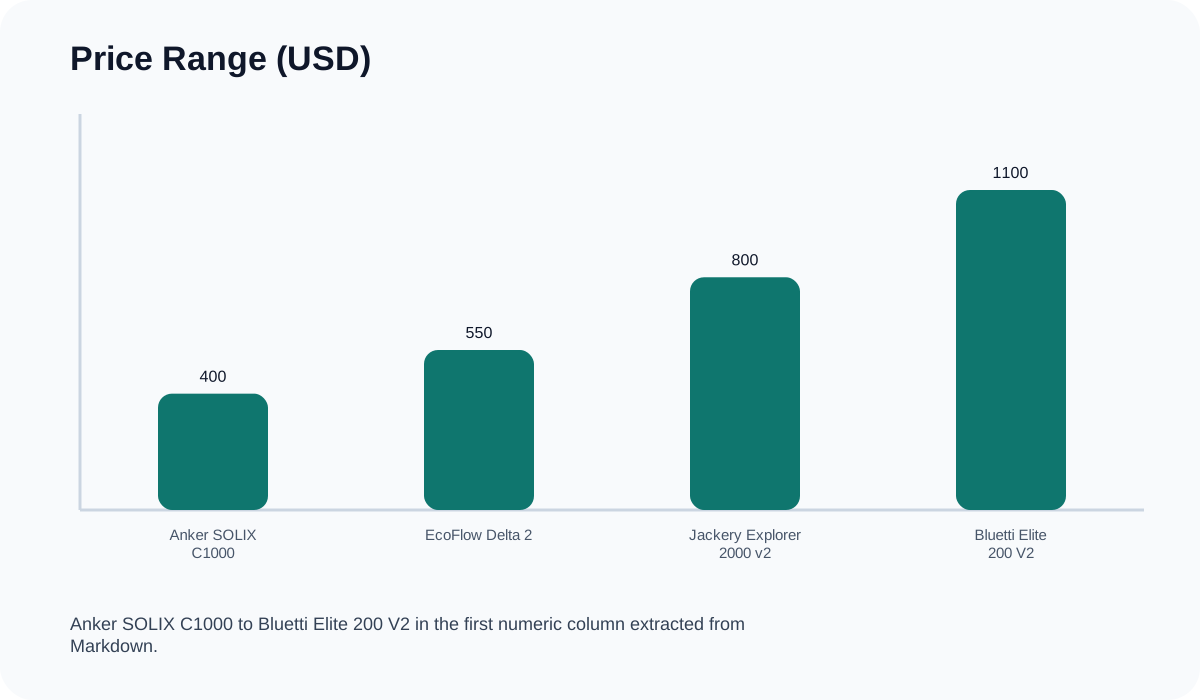
The table below highlights key specifications for leading power stations. Notice the lack of waterproofing across most models, reinforcing the need for careful outdoor placement.
| Product | Price Range (USD) | Stated Capacity | Chemistry | Waterproof Rating | Charging Method |
|---|---|---|---|---|---|
| Anker SOLIX C1000 | 600 | 1056Wh | LiFePO4 | IP20 (Not Waterproof) | AC, Solar, Car |
| EcoFlow Delta 2 | 700 | 1024Wh | LiFePO4 | IP20 (Not Waterproof) | AC, Solar, Car |
| Jackery Explorer 2000 v2 | 1,200 | 2042Wh | LiFePO4 | IPX4 (Splash Resistant) | AC, Solar, Car |
| Bluetti Elite 200 V2 | 1,500 | 2073Wh | LiFePO4 | IP20 (Not Waterproof) | AC, Solar, Car |
Lab Review Checklist & Common Pain Points
When reading an outdoor gear review, ensure the reviewer has addressed these common real-world user pain points:
- Solar Recharging Speeds: Have they tested for mismatched controller (MPPT) voltage requirements that cause unexpectedly slow solar charging?
- Acoustic Testing (Noise Levels): Did they measure fan decibels? Excessive fan noise is a major issue for users running CPAP machines or charging overnight.
- Ergonomics and Weight: If a unit exceeds 40 lbs, does the review critically assess the handle design and wheel availability for actual portability?
Final Verdict
A good lab-style review for portable outdoor power gear acts as a vital bridge between manufacturer marketing and real-world application. By quantifying usable power after inverter loss, actively monitoring thermal performance under 1000W+ loads, and verifying UL 2743 safety compliances alongside IP-rating realities, lab reviews protect buyers from costly and potentially dangerous investments. Before purchasing a portable power station, ensure the reviews you trust rely on instruments and data, rather than just subjective camping anecdotes.