Why Cold Weather Makes Power Banks Feel Smaller
Discover why cold weather causes power bank phantom drain. Learn about internal resistance, voltage drops, and the best cold-resistant power banks for winter.
Executive Summary
If you have ever relied on a power bank during a winter excursion only to watch the battery indicator plummet from 40% to 0% instantly, you have experienced cold-induced “phantom drain.” Cold weather does not actually destroy the stored energy; rather, low temperatures increase the internal resistance of lithium-ion cells. This resistance slows chemical reactions, leading to a sudden voltage drop under load. The device’s Battery Management System (BMS) misinterprets this low voltage as an empty battery and triggers an automatic shutdown to prevent damage.
For outdoor enthusiasts relying on electric arc lighters, heated gear, or navigation tools, managing this 20% to 50% drop in usable capacity is critical. This guide breaks down the science behind cold-weather battery drain, details critical safety hazards like lithium plating, and reviews specialized power banks built to survive sub-zero temperatures.
The Science: Effective Capacity vs. Ambient Temperature
The colder it gets, the slower lithium ions move through the battery’s liquid electrolyte. This forces the battery to work much harder to deliver the same amount of power. At freezing temperatures, standard power banks lose a significant portion of their effective capacity.
- At 0°C (32°F): Usable capacity drops by approximately 20%.
- At -20°C (-4°F): Usable capacity can drop by up to 50%.
The chart below illustrates the quantified drop in effective capacity as ambient temperatures decrease.
Core User Pain Points in Sub-Zero Climates
When testing standard electronics in winter conditions, users report two primary failure points:
- Phantom Drain & Premature Shutdown: A standard power bank will show a 40% charge at rest but will instantly die when a load (like charging a phone) is applied. The stored chemical energy remains, but the BMS shuts the device off due to voltage sag.
- Cable Failures: Standard PVC or rubberized charging cables become stiff and brittle in freezing air. This leads to physical cracking of the insulation and lost connectivity at the charging ports.
Severe Safety Hazard: Never Charge a Frozen Battery
While discharging a cold battery primarily causes annoyance and temporary power loss, charging a cold battery is a severe safety hazard.
Attempting to recharge a lithium-ion battery with an internal temperature below 0°C (32°F) can trigger a phenomenon known as lithium plating. Instead of intercalating into the graphite anode, the lithium ions deposit on the surface as metallic lithium. Over time, this creates sharp, microscopic spikes called dendrites that can pierce the battery separator, eventually causing a short circuit and subsequent thermal runaway (battery fire).
Comparison: Leading Cold-Weather Power Banks
To combat extreme cold, manufacturers are now designing specialized batteries that feature carbon-fiber insulation or even active internal heating elements.
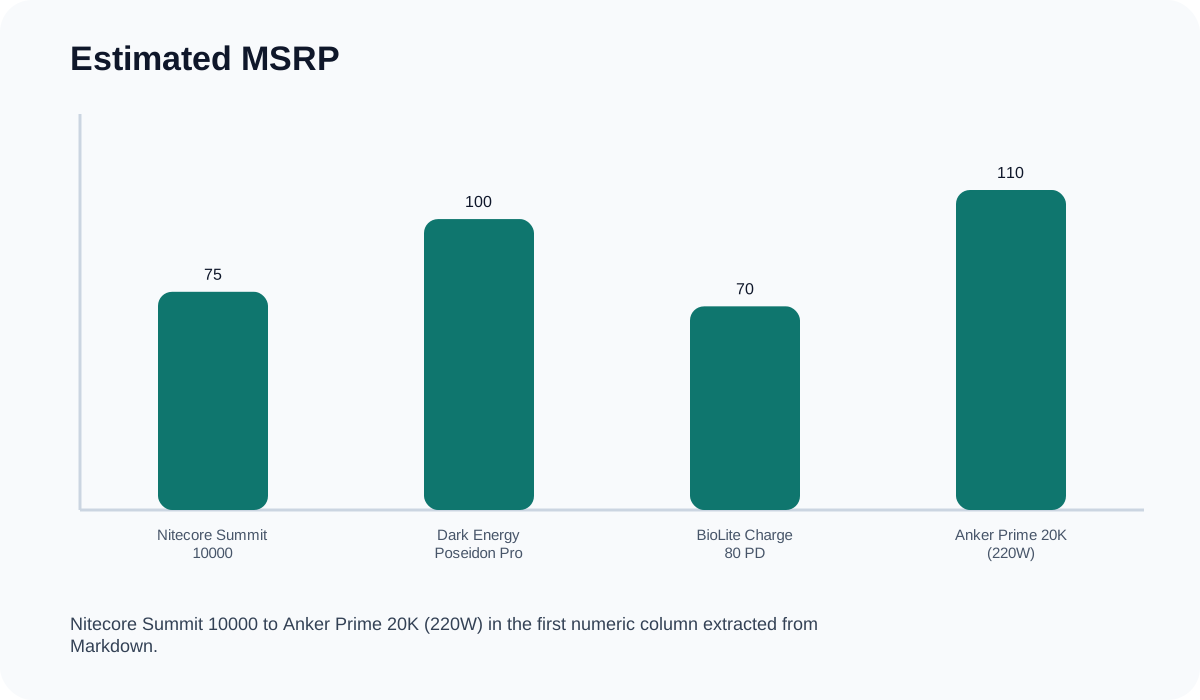
| Product | Estimated MSRP | Temperature Rating | Waterproof (IP Rating) | Key Differentiator |
|---|---|---|---|---|
| Nitecore Summit 10000 | 99 | -40°C to 50°C | IPX5 | Built-in internal heater; Carbon fiber shell |
| Dark Energy Poseidon Pro | 120 | -20°C to 60°C | IP68 | Military-grade durability; Submersible |
| BioLite Charge 80 PD | 85 | -20°C to 45°C | IP66 | Rugged stainless steel/silicone build |
| Anker Prime 20K (220W) | 130 | 0°C to 35°C (Optimum) | None | Smart display; 100W ultra-fast recharging |
Analysis of the Top Contenders
The Nitecore Summit 10000 stands out as the ultimate cold-weather solution. It is explicitly designed for sub-zero environments (-40°C), utilizing a carbon-fiber shell for passive insulation and an innovative built-in internal heater to actively maintain cell temperatures above freezing.
The Dark Energy Poseidon Pro and BioLite Charge 80 PD are ruggedized options that offer superior moisture protection (IP68 and IP66, respectively), making them excellent for wet, snowy conditions, though they rely on chemical hardiness rather than active heating.
The Anker Prime 20K is a powerhouse for modern electronics, boasting 220W total output and a smart display, but its optimal operating temperature (0°C to 35°C) makes it highly susceptible to the phantom drain phenomenon if exposed directly to freezing ambient air.
Winter Power Bank Checklist
To maximize the capacity and lifespan of your power banks during winter expeditions, follow this checklist:
- Keep it close to your body: Store your power bank in an interior jacket pocket to leverage your body heat. Passive warming prevents voltage sag.
- Never charge while frozen: Allow your power bank to warm up to room temperature (above 32°F/0°C) before plugging it into a wall outlet to prevent lithium plating.
- Upgrade your cables: Swap standard charging cables for braided nylon or specialized cold-weather silicone cables that won’t crack in sub-zero air.
- Account for capacity loss: If your device requires 5,000mAh for a weekend trip, pack at least 10,000mAh to account for the estimated 50% capacity reduction at -20°C.
Final Verdict
Cold weather doesn’t steal your power bank’s energy; it temporarily traps it behind increased internal resistance. For casual winter users, simply keeping a standard power bank warm in an inner pocket is enough to bypass the voltage drop. However, for serious cold-weather campers, ice fishers, and mountaineers, investing in a specialized unit with active thermal management—like the Nitecore Summit 10000—is the only way to guarantee your essential arc lighters, GPS devices, and phones stay powered when the temperature drops below zero.