Why Field Conditions Matter More Than Manufacturer Claims
Discover why portable power stations deliver 10-15% less power in the field and how temperature, dust, and moisture impact real-world battery performance.
Executive Summary
Portable power stations routinely fail to meet their advertised specifications in real-world scenarios. The reason is simple: manufacturers base their claims on Standard Test Conditions (STC)—idealized 25°C laboratory environments with zero dust or moisture. In the field, users face a typical 10% to 15% capacity loss due to inverter inefficiencies, severe battery degradation outside optimal temperature zones, and environmental hazards like cable wicking. For professionals in construction, emergency response, and off-grid living, understanding these field variances is essential for safety and operational reliability.
The “Inverter Tax” and Usable Capacity
Bottom Line: A 1000Wh portable power station will typically yield only 850Wh of usable AC power, even under perfect weather conditions.
When a power station converts stored Direct Current (DC) from its LiFePO4 (Lithium Iron Phosphate) battery cells to Alternating Current (AC) to run standard electronics, the internal inverter consumes energy. This conversion process, combined with the continuous power draw of the Battery Management System (BMS), accounts for a 10% to 15% efficiency loss. Industry-leading models from brands like Jackery (Explorer 2000 Plus), EcoFlow (Delta Pro 3), Bluetti (AC200L), and Anker (SOLIX F2000) are all bound by these thermodynamic realities. Buyers must account for this baseline “inverter tax” when calculating their operational power needs.
Thermal Realities: The 15°C to 25°C Goldilocks Zone
Bottom Line: Operating outside the 15°C to 25°C temperature range leads to rapid capacity degradation in cold conditions and reduced efficiency or thermal shutdowns in extreme heat.
Battery chemistry is inherently temperature-dependent. Manufacturer runtimes are strictly calculated at a comfortable 25°C (77°F). As temperatures drop below freezing or rise above 35°C (95°F), the electrochemical reactions within the cells change. Cold weather increases internal resistance, severely restricting usable capacity, while extreme heat forces the BMS to throttle output or engage thermal safety shutdowns to prevent permanent damage.
Environmental Hazards: Beyond IP Ratings
Bottom Line: An IP65 rating offers a false sense of security against field hazards like “cable wicking” and conductive dust sludge.
While a splash-proof enclosure performs well in controlled lab testing, the field introduces dynamic variables. Dust and particulate matter can mix with ambient moisture or high humidity to form a conductive sludge, bypassing standard enclosure seals and potentially arcing internal components. Furthermore, “cable wicking”—a phenomenon where rain or heavy condensation travels along connected charging cords directly into the power station’s open ports—can cause catastrophic short circuits despite the overall unit carrying an IP65 rating.
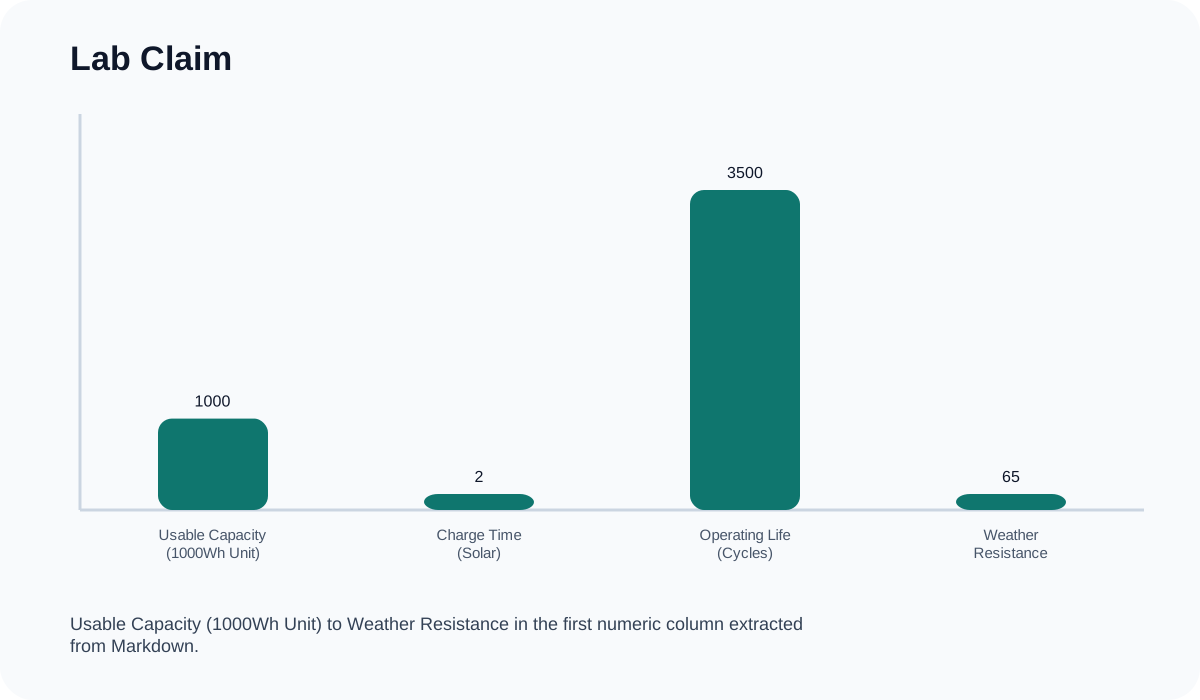
Manufacturer Lab Specs vs. Real-World Field Performance
| Metric | Lab Claim | Field Reality | Variance Reason |
|---|---|---|---|
| Usable Capacity (1000Wh Unit) | 1000Wh (100%) | 830Wh - 880Wh | Inverter conversion loss + internal BMS power draw |
| Charge Time (Solar) | 2 Hours (Full Sun) | 4 - 8 Hours | Cloud cover, panel angle, and high heat efficiency loss |
| Operating Life (Cycles) | 3500+ Cycles to 80% | 2000 - 2800 Cycles | Frequent deep discharges and exposure to extreme temperatures |
| Weather Resistance | IP65 (Dust/Splash Proof) | High Risk at Ports | Condensation from temp shifts and water wicking into open outlets |
Final Verdict
For end-users, manufacturer claims should be viewed as an idealized ceiling rather than a guaranteed baseline. While modern LiFePO4 power stations are highly capable, STC lab ratings do not reflect the physical realities of job sites, campsites, or emergency situations. When sizing a portable power station, calculate your required watt-hours and add a minimum 20% buffer to safely account for inverter conversion loss and environmental degradation.
Field Deployment Checklist
To maximize your power station’s field reliability, follow these operational guidelines:
- Buffer Capacity: Always purchase a unit with 15-20% more watt-hours than your strict calculated load.
- Manage Temperatures: Keep the unit shaded in extreme heat and insulated (but adequately ventilated) in sub-freezing conditions to stay near the 15°C - 25°C Goldilocks zone.
- Create Drip Loops: Allow connected cables to dip below the height of the input/output ports to prevent water wicking during rain or heavy dew.
- Port Protection: Keep unused AC and DC ports sealed with their rubberized covers to prevent conductive dust accumulation.